
Test
Biology Chapter 2 Test Review
Este test tiene tipos de pregunta que se abren en el reproductor de siempre.
Preguntas del test (27)
1Name the leaf arrangement that has two leaves growing from each node. This arrangement has leaves arranged at right angles to the leaves above and below them, to maximize exposure to the light.
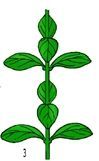
- Aopposite
2Label the image with the type of leaf arrangement that has only one leaf growing from each node. The leaves are on different sides of the stem.
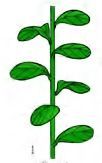
- Aalternate
3Label the image with the type of leaf arrangement where three or more leaves grow from each node.
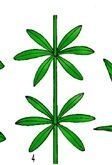
- Awhorled
4Label the image with the type of leaf pattern where a cluster of leaves grow around the base.
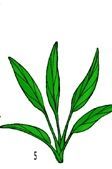
- Arosette
5Three types of plant tissues are...
- AStructual
- BVascular
- CMeristematic
- DSystematic
6Four types of Structural Tissue
- APhloem
- BEpidermal Tissue
- CApical merstems
- DCork
- EParenchyma
- FVascular Cambium
- GSupport and Strengthening Tissue
7Choose the TWO types of vascular tissue.
- ACork
- BXylem
- CPhloem
- DCork cambium
8Select the THREE kinds of meristematic tissue.
- AParenchyma
- BApical meristems
- CVascular cambium
- DCork cambium
- EXylem
9One of the most important types of meristematic tissue is [blank_start]cambium[blank_end] tissue.
- Acambium
10The parts of a plant cell that separate its contents from the surrounding environment is called either a cell [blank_start]membrane[blank_end] or a cell [blank_start]wall[blank_end].
- Amembrane
- Bwall
11The part of a plant cell that controls the cell's activities is called the [blank_start]nucleus[blank_end].
- Anucleus
12Three types of venation are [blank_start]parallel[blank_end], [blank_start]pinnate[blank_end], and [blank_start]palmate[blank_end].
- Aparallel
- Bpinnate
- Cpalmate
13The structures in a plant cell that carry out photosynthesis are called [blank_start]chloroplasts[blank_end].
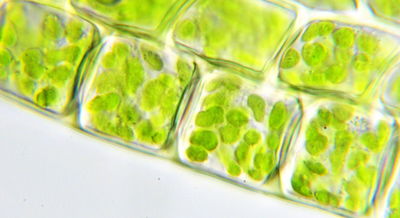
- Achloroplasts
14[blank_start]Ordinary[blank_end] leaves have petioles; [blank_start]sessile[blank_end] leaves do not.
- ASessile
- BOrdinary
- Csessile
- Dordinary
15[blank_start]Simple[blank_end] leaves have only one blade per petiole; [blank_start]compound[blank_end] leaves have more than one blade per petiole.
- ASimple
- BCompound
- Csimple
- Dcompound
16The purpose of cork tissue is to [blank_start]protect[blank_end] and [blank_start]waterproof[blank_end] the stem.
- Aprotect
- Bwaterproof
17The purpose of parenchyma tissue is to [blank_start]make[blank_end] and [blank_start]store[blank_end] food.
- Amake
- Bstore
18[blank_start]Xylem[blank_end] tissue transports [blank_start]water[blank_end] and dissolved minerals upwards to the leaves; [blank_start]Phloem[blank_end] transports [blank_start]food[blank_end] manufactured in the leaves downward to the rest of the plant.
- AXylem
- BPhloem
- Cwater
- Dfood
- Exylem
- Fphloem
- Gfood
- Hwater
19The purpose of the leaf's epidermis is to [blank_start]cover[blank_end] and [blank_start]protect[blank_end] the leaf surfaces.
- Acover
- Bprotect
20The purpose of vacuoles is to [blank_start]store[blank_end] food materials, fluid substances, and minerals.
- Astore
21This is the process of photosynthesis. The plant uses the energy of the [blank_start]sun[blank_end] to split the [blank_start]water[blank_end] molecules into hydrogen ions and oxygen. The hydrogen ions are combined with [blank_start]carbon dioxide[blank_end] from the air to form [blank_start]glucose[blank_end], a simple sugar.
- Asun
- Bwater
- Ccarbon dioxide
- Dglucose
22Choose the 4 factors that affect the rate of photosynthesis:
- Aamount of water available
- Bamount of hydrogen available
- Camount of carbon dioxide available
- Dtemperature
- Eamount of nitrogen in the soil
- Fintensity of light
23What causes leaves to turn different colors in autumn?
- AThe weather turns cold which dissolves the abscission layer and changes the chlorophyll to different colors.
- BWhen the abscission layer forms, the chlorophyll in the leaf begins to deteriorate, allowing other pigments that had previously been hidden by the chlorophyll to become visible.
- CIn autumn, there is less sunlight, which causes the rainbow to appear in the leaves.
24When the [blank_start]abscission[blank_end] layer forms, the [blank_start]chlorophyll[blank_end] in the leaf begins to deteriorate, allowing other pigments that had previously been [blank_start]hidden[blank_end] by the chlorophyll to become visible.
- Aabscission
- Bchlorophyll
- Chidden
25How do guard cells help conserve water? When [blank_start]water[blank_end] is being lost faster than it can be replenished, the [blank_start]guard[blank_end] cells lose [blank_start]turgor[blank_end] pressure and close the [blank_start]stomata[blank_end]. This reduces the rate of [blank_start]transpiration[blank_end] and water loss.
- Awater
- Bguard
- Cturgor
- Dstomata
- Etranspiration
26Why is the concept of the "simple cell" not valid?
A single cell is like a tiny self-contained [blank_start]city[blank_end] with its own [blank_start]power[blank_end] plants, chemical factories, food [blank_start]warehouses[blank_end], [blank_start]waste[blank_end] disposal facilities, and [blank_start]transportation[blank_end] networks, all directed automatically by programs in the cell's [blank_start]control[blank_end] center.- Acity
- Bpower
- Cwarehouses
- Dwaste
- Etransportation
- Fcontrol
27Explain why a leaf would not function correctly without veins. Veins are needed to [blank_start]transport[blank_end] water and other nutrients to the leaf from the [blank_start]roots[blank_end] and to transport sugars produced in the [blank_start]leaf[blank_end] to the other parts of the plant.
- Atransport
- Broots
- Cleaf
Información
- Descripción
- Chapter 2 Review
- Autor
- Kelda Brenny
- Idioma
- English
- Visitas
- 242
- Etiquetas
- Valoración
- 5,0 de 5 · 1 valoración Valora este test