
Test
Genetics Final Exam
Este test tiene tipos de pregunta que se abren en el reproductor de siempre.
Preguntas del test (112)
1The full chemical name of DNA is [blank_start]deoxyribonucleic acid[blank_end] .
- Adeoxyribonucleic acid
2The protein, [blank_start]primase[blank_end], is needed to lay down a segment of RNA complementary to the DNA before replication can begin.
- Aprimase
3An origin of replication generally has [blank_start]two[blank_end] (how many?) replication forks.
- Atwo
4The discontinuous lagging strand on a replication fork consists of [blank_start]Okazaki fragments[blank_end] that are later ligated together to form one strand of DNA.
- AOkazaki fragments
5The E. coli chromosome contains [blank_start]one[blank_end] (how many?) origin(s) of replication?
- Aone
6A prokaryote lacks a [blank_start]nuclear[blank_end] membrane.
- Anuclear
7Recombination is probably always initiated by [blank_start]nicking[blank_end] of DNA.
- Anicking
8The [blank_start]leading[blank_end] strand is synthesized continuously during DNA replication.
- Aleading
9A [blank_start]restriction[blank_end] enzyme recognizes a specific DNA sequence and is able to cleave the DNA generating either “blunt” or “sticky” ends of the DNA.
- Arestriction
10A virus that infects bacterial cells is called a [blank_start]bacteriophage[blank_end].
- Abacteriophage
11The genetic material of some viruses such as pi X 174 and M13 is [blank_start]single-stranded DNA[blank_end].
- Asingle-stranded DNA
12The genetic material of the viruses that cause polio and AIDS is [blank_start]RNA[blank_end] .
- ARNA
13Topoisomerase [blank_start]relaxes[blank_end] supercoils by nicking the DNA.
- Arelaxes
14In E. coli, recombination begins at [blank_start]chi[blank_end] sites where recBCD nicks and displaces a strand.
- Achi
15Which of the following is not true of DNA?
- AIt is acidic.
- BIt contains deoxyribose.
- CIt is found in cell nuclei.
- DIt contains phosphate.
- EIt contains proteins.
16The molecule of heredity is:
- ARNA
- BDNA
- Cprotein
- Dcarbohydrate
- Enone of the above
17The four subunits which compose DNA are called:
- Aphosphodiesters
- Bproteins
- Cnucleotides
- Dnucleosides
- Epolymers
18DNA is localized mainly in the
- Acell membrane
- Bendoplasmic reticulum
- Cvacuoles
- Dchromosomes
- ENone of the above
19Each nucleotide of DNA is made up of:
- Aa deoxyribose sugar
- Ba nitrogenous base
- Ca phosphate
- DA and B only
- EAll of the above
20The polarity of DNA synthesis is:
- A5' → 3'
- B3' → 5'
- C5' → 2'
- D2' → 5'
- Enone of the above
21In the Hershey and Chase experiment designed to determine the molecule of heredity, what was radiolabeled with 35-S?
- Aprotein
- BDNA
- CRNA
- DrRNA
- Enone of the above
22The ratio of _____ is 1:1.
- Aguanine to adenine
- Badenine to thymine
- Ccytosine to adenine
- Duracil to cytosine
- Enone of the above
23X-ray data showed that the spacing between repeating units along the axis of the DNA helix is:
- A2.0 angstroms.
- B3.4 angstroms.
- C20 angstroms.
- D34 angstroms.
- Enone of the above
24X-ray data showed that the DNA helix undergoes one complete turn every:
- A2.0 angstroms.
- B3.4 angstroms.
- C20 angstroms.
- D34 angstroms.
- Enone of the above
25________ bonds are responsible for the chemical affinity between A and T (or G and C) nucleotides.
- AIonic
- BCovalent
- CHydrogen
- DElectro-ionic
- Enone of the above
26_______ -form DNA spirals to the right and is the major form of naturally occurring DNA molecules.
- AA
- BB
- CD
- DY
- EZ
27The nucleotide that is present in RNA but not DNA is:
- Athymine
- Buracil
- Cadenine
- Dcytosine
- Eguanosine
28DNA replication occurs through a _________process.
- Aconservative
- Bsemiconervative
- Cdispersive
- Dtransferal
- Enone of the above
29During complementary base pairing, enzymes join the base's nucleotide to the preceding nucleotide by a __________bond.
- AHydrogen
- BIonic
- CPhosphodiester
- DElectrostatic
- ENone of the above
30During early interphase the state of the DNA can be described as:
- Aa single continuous linear double helix.
- Ba double helix replicated semiconservatively.
- Ca double helix replicated conservatively.
- Dsingle-stranded DNA.
- ENone of the above
31During the S phase of interphase, the state of the DNA can be described as:
- Aa single continuous linear double helix.
- Ba double helix replicated semiconservatively.
- Ca double helix replicated conservatively.
- Da triple helix replicated semiconservatively.
- ENone of the above
32The step in DNA replication in which the replication proteins open up the double helix and prepare for complementary base pairing is called:
- AInitiation
- BElongation
- CTermination
- DTranslation
- ETranslocation
33The step in DNA replication in which the proteins connect the correct sequence of nucleotides into a continuous new strand is called:
- AInitiation
- BElongation
- CTermination
- DTranslation
- ETranslocation
34The step in DNA replication in which two replication forks moving in opposite directions may meet is called:
- AIntiation
- BElongation
- CTermination
- DTranslation
- ETranslocation
35The group of enzymes able to relax supercoils in DNA is called:
- APrimases
- BHelicases
- CTopoisomerases
- DTelomeres
- ELigases
36How many replication forks depart from an origin of replication?
- Aone
- Btwo
- Cthree
- Dfour
- Enone of the above
37The protein that progressively unwinds DNA ahead of each replication fork is called:
- APrimase
- BHelicase
- CTopoisomerase
- DTelomerase
- ELigase
38In eukaryotic cells, replication proceeds from ____ origin(s) of replication.
- Ano
- Bone
- Ctwo
- Dseveral
- Emany
39Eukaryotic chromosomes have evolved special structures at the ends of chromosomes to ensure the replication of the two ends of linear chromosomes. These structures are
- Amethylases
- Bcapping proteins
- Cligases
- Dtelomerases
- Esingle-stranded binding proteins
40Which of the following is NOT involved in ensuring the accuracy of a cell's genetic information?
- Aredundancy
- Brepair enzymes
- Cprecision of replication machinery
- DDNA polymerase proofreading mechanism
- ERestriction endonucleases
41The process of _________ is extremely important in generating genetic diversity.
- ATranslation
- BTranscription
- CRecombination
- DTransformation
- ENone of the above
42Any deviation from the expected 2:2 segregation of parental alleles that results from recombination is known as:
- AAllelic exchange
- BGene conversion
- CCrossing over
- DRecombination
- EDNA replication
43Recombination involves the breakage and reunion of DNA molecules from:
- Ahomologous nonsister chromatids
- Bhomologous sister chromatids
- Cheterologous nonsister chromatids
- Dheterologous sister chromatids
- ENone of the above
44The nicking of DNA that initiates recombination during mitosis may be due to all but:
- Ainstruction from normal cell-cycle program
- BX-rays
- CChemical change
- DPhysical change
- ERadiation
45What radiolabeled substance did Hershey and Chase use to label the protein component of the bacteriophage in their study to determine whether protein or DNA was necessary for phage production?
- Anitrogen
- Bcarbon
- Csulfur
- Dphosphorous
- Eiodide
46If 35% of the bases in a region of the mouse genome are cytosine, what percentage in that region are adenine?
- A15%
- B20%
- C30%
- D35%
- Enone of the above
47The complementary sequence of 5' AATTCGCTTA 3' is:
- A5' AATTCGCTTA 3'
- B3' AATTCGCTTA 5'
- C5' TAACGCTTAA 3'
- D5' TAAGCGAATT 3'
- E3' TAAGCGAATT 5'
48Two strains of S. cerevisae (yeast) are crossed. One has the genotype ABC and the other abc. Five sets of the resultant tetrads are noted below. In which set did a gene conversion event occur?
- Aabc, aBc, AbC, aBC
- Babc, abc, ABC, ABC
- CaBc, aBc, AbC, AbC
- DabC, abc, ABc, ABC
- EAbc, Abc, aBC, aBC
49Recombination occurs during meiotic ________.
- Aanaphase
- Binterphase
- Cprophase
- Dmetaphase
- Enone of the above
50Without __________ regions on the DNA during recombination, gene conversion could not occur.
- Ahomoduplex
- Bheteroduplex
- Chomotriplex
- Dheterotriplex
- Enone of the above
51Occasionally, a loss of function mutation may occur in the telomerase enzyme in a cell. What is likely to be the result of this mutation on the DNA in the cell over the the course of several rounds of mitosis?
- Achromosome length will gradually increase
- Bchromosome length will gradually decrease
- Cchromosome length will stay constant
- Dchromosomes will fail to dissociate after replication
- Enone of the above
52Bacterial DNA is resistant to degradation by its own restriction enzymes through the protection of:
- AMethylases
- BRecombinases
- CTopoisomerases
- DLigases
- EPrimases
53Hershey and Chase relied on ________ to physically separate the infected bacterial cells from the phage ghosts.
- Aradioactivity
- Bgel filtration
- Cion exchange
- Dcentrifugation
- Enone of the above
54Meselson and Stahl relied on equilibrium density gradient centrifugation in a _______ solution to resolve the DNA containing 14N from the DNA containing 15-N.
- Aradiolabeled phosphate
- Bcalcium chloride
- Cradiolabeled nitrogen
- Dsodium acetate
- Ecesium chloride
55Match the scientist with their contribution to understanding more about DNA
a. early recombination models
b. transformation
c. semiconservative replication
d. x-ray structure of DNA
e. revised recombination models
f. basic structure of DNA
g. DNA = molecule of heredity
h. discovery of “nuclein”
i. nucleotide ratios in DNA
j. famous phage blender experiment
55. [blank_start]f[blank_end] Watson and Crick
56. [blank_start]i[blank_end] Chargaff
57. [blank_start]d[blank_end] Franklin and Wilkins
58. [blank_start]b[blank_end] Griffith
59. [blank_start]j[blank_end] Hershey and Chase
60. [blank_start]h[blank_end] Miescher
61. [blank_start]c[blank_end] Meselson and Stahl
62. [blank_start]a[blank_end] Holliday
63. [blank_start]e[blank_end] Meselson and Radding
64. [blank_start]g[blank_end] Avery, MacLeod and McCarty- Af
- Bi
- Cd
- Db
- Ej
- Fh
- Gc
- Ha
- Ie
- Jg
56Diagram Matching (Match the region or item on the diagram with the correct term from the list below)
-lagging strand
-leading strand
-origin
-RNA primer
-Okazaki fragment
-helicase
-polymerase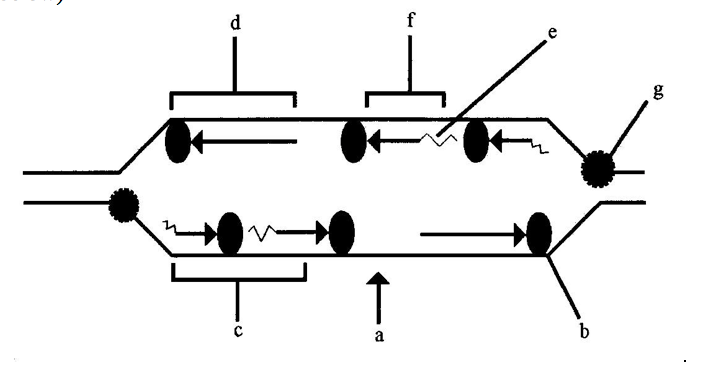
- Aleading strand
- BOkazaki fragment
- CRNA primer
- Dhelicase
- Epolymerase
- Forigin
- Glagging strand
57A phosphodiester bond joins one nucleotide together in the DNA polymer.
- AVerdadero
- BFalso
58Prokaryotes have a circular chromosome surrounded by a nuclear membrane.
- AVerdadero
- BFalso
59Transformation in bacteria results from the uptake of foreign DNA.
- AVerdadero
- BFalso
60DNA is highly negatively charged throughout the molecule and therefore has no
- AVerdadero
- BFalso
61A region of DNA 100 bp in length has the potential to be represented by 4100 unique sequences.
- AVerdadero
- BFalso
62Viruses use only DNA as their genetic material.
- AVerdadero
- BFalso
63Restriction enzymes are molecular weapons which cut DNA that bacteria use in their fight to protect themselves from DNA viruses.
- AVerdadero
- BFalso
64Human DNA is replicated in a conservative manner.
- AVerdadero
- BFalso
65In DNA replication, new DNA is produced in a continuous bi-directional fashion.
- AVerdadero
- BFalso
66DNA topoisomerase supercoils DNA to get it out of the way of DNA polymerase.
- AVerdadero
- BFalso
67Accuracy of replication is enhanced by the redundancy of DNA, enzymatic repair of damaged DNA and the remarkable precision of the cellular replication machinery.
- AVerdadero
- BFalso
68A 2:2 segregation of parental alleles is known as gene conversion.
- AVerdadero
- BFalso
69Recombination events are limited to only “hot spots” along a chromosome.
- AVerdadero
- BFalso
70Gene conversion in which a small segment of information from one homologous chromosome transfers to the other can give rise to an unequal yield of two different alleles.
- AVerdadero
- BFalso
71Alternative resolutions of the Holliday intermediate are responsible for whether or not crossing over or gene conversion occurs.
- AVerdadero
- BFalso
72Genes that “travel” together from one generation to the next more often than not exhibit [blank_start]genetic linkage[blank_end] .
- Agenetic linkage
73A probability test that measures “goodness of fit” between observed and predicted results is a [blank_start]chi squared[blank_end] test.
- Achi squared
74A hypothesis that predicts no linkage between genes is called the [blank_start]null[blank_end] hypothesis.
- Anull
75Genes that can serve points of reference on a chromosome are useful as genetic markers while cytologically visible abnormalities that also make it possible to keep track of chromosomes are called [blank_start]physical[blank_end] markers.
- Aphysical
76The movement of chiasmata toward the end of a chromosome is called [blank_start]terminalization[blank_end] .
- Aterminalization
77One percentage point of recombination, or recombination frequency, is a unit of measure called either centimorgan or [blank_start]map unit[blank_end] .
- Amap unit
78Crossovers do not occur independently and the occurrence of one crossover reduces the likelihood of another occurring elsewhere on the chromosome this is called [blank_start]chromosomal interference[blank_end] .
- Achromosomal interference
79A tetrad that contains four recombinant class haploid cells is known as a [blank_start]non-parental[blank_end] ditype.
- Anon-parental
80A tetrad that carries four kinds of haploid cells: two different parental and two different recombinant class spores is referred to as [blank_start]tetratype[blank_end].
- Atetratype
81Mistakes in mitosis during development often result in [blank_start]mosaic[blank_end] organisms containing tissues of different genotypes.
- Amosaic
82The R/r and S/s genes are linked and 10 map units apart. In the cross Rs/rS rs/rs what fraction of the progeny will be RS/rs?
- A5%
- B10%
- C25%
- D40%
- E45%
83If the map distance between genes A and B is 10 map units and the map distance between genes B and C is 25 map units, what is the map distance between genes A and C?
- A15 map units
- B35 map units
- CEither 15 map units or 35 map units, depending on the order of the genes
- DThe map distance between A and C can not be predicted from this data
84In Drosophila, singed bristles (sn) and cut wings (ct) are both caused by recessive, X-linked alleles. The wild type alleles (sn+ and ct+) are responsible for straight bristles and intact wings, respectively. A female homozygous for sn and ct+ is crossed to a sn+ct male. The F1 flies are interbred. The F2 males are distributed as follows:
sn ct 13
sn ct+ 36
sn+ ct 39
sn+ ct+ 12
What is the map distance between sn and ct?- A12 m.u.
- B13 m.u.
- C25 m.u.
- D50 m.u.
- E75 m.u.
85What is the value of X2 for a test of the hypothesis that the sn and car genes are unlinked?
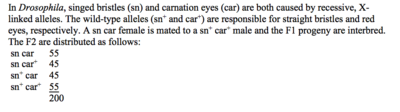
- A0.5
- B1.0
- C2.0
- D0.4
- E20
86What is the p value from this test? (Pick the most accurate choice.)
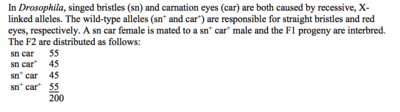
- Ap > 0.5
- B0.5 > p > 0.1
- Cp < 0.1
- Dp < 0.05
- Ep < 0.01
87Suppose the L and M genes are on the same chromosome but separated by 100 map units. What fraction of the progeny from the cross LM/lm x lm/lm would be Lm/lm?
- A10%
- B25%
- C50%
- D75%
- E100%
88The pairwise map distances for four linked genes are as follows: A-B = 22 m.u., B-C = 7 m.u., C-D = 9 m.u., B-D = 2 m.u., A-D = 20 m.u., A-C = 29 m.u. What is the order of these four genes?
- AABCD
- BADBC
- CABDC
- DBADC
- ECADB
89The zipper-like connection between paired homologs in early prophase is known as a:
- Aspindle fiber
- Bsynaptic junction
- Csynaptomnemal complex
- Dchiasma
- Enone of the above
90The measured distance between genes D and E in a two point test cross is 50 map units. What does this mean in physical terms?
- AD and E are on different pairs of chromosomes.
- BD and E are linked and exactly 50 map units apart.
- CD and E are linked and at least 50 map units apart.
- Deither A or B
- Eeither A or C
91Suppose an individual is heterozygous for a pair of alleles (e.g. A/a). Under what conditions would a crossover in a somatic cell of this individual lead to a clone of cells homozygous for a? (Pick the most precise answer.)
- AThe crossover would have to occur between the A locus and the centromere and involve two homologous (non-sister) chromatids.
- BThe crossover would have to occur between the A locus and the end of the chromosome and involve two homologous (non-sister) chromatids.
- CThe crossover would have to occur on the same chromosome arm as the A locus and involve two homologous (non-sister) chromatids.
- DThe crossover would have to occur on the same chromosome as the A locus and involve two homologous (non-sister) chromatids.
- EThe crossover would have to occur between the A locus and the centromere and involve two sister chromatids (not homologous) chromatids.
92Suppose an individual is heterozygous for two linked pairs of alleles on the same chromosome arm, Ab/aB such that the A locus is closer to the centromere than the B locus. Under what conditions would a crossover in a somatic cell generate a twin spot, i.e. two adjacent clones of cells, one clone homozygous for a and the other clone homozygous for b?
- AThe crossover would have to occur between the A locus and the centromere locus and involve two homologous (non-sister) chromatids.
- BThe crossover would have to occur between the A locus and the B locus locus and involve two homologous (non-sister) chromatids.
- CThe crossover would have to occur between the B locus and the end of the chromosome locus and involve two homologous (non-sister) chromatids.
- DA double crossover would have to occur, with one crossover between the A locus and the centromere and a second crossover between the A and B loci locus and both crossovers would have to involve two homologous (non-sister) chromatids.
- ENo crossover in a somatic cell could generate a twin spot.
93What happens physically during the process of crossing over?
- ATwo homologous chromatids break and rejoin at random sites along the chromosome.
- BThe genetic information on one chromatid is replaced by copying genetic information from a homologous chromatid without there being any physical exchange between the chromosomes.
- CTwo homologous chromatids break and rejoin at precisely the same site along the chromosome so that there is no loss or gain of material on either product.
- DIt is not known what occurs during crossing over.
94Here is a list of events during meiosis I. It is not in the correct order.
A) Homologous chromosomes are roughly aligned but not physically linked.
B) Homologous chromosomes segregate to opposite poles.
C) Homologous chromosomes are linked by synaptonemal complexes.
D) Homologous chromosomes are linked by chiasmata.
E) Chromosomes replicate.
What is the correct order of these events?- AACDBE
- BAECDB
- CEACDB
- DEADCB
- ECDABE
95Some of the larger human chromosomes typically contain multiple chiasmata during meiotic prophase. If you were to carefully study the distribution of these chiasmata, what would you find?
- AChiasmata are randomly distributed along chromosomes.
- BAll chromosome pairs have the same number of chiasmata.
- CA single chromosome pair always has the same number of chiasmata in every meiotic cell.
- DChiasmata are spaced along a chromosome arm more regularly than would be expected by chance.
- EChiasmata are spaced more irregularly along a chromosome arm than would be expected by chance.
96Recombination due to crossing over occurs only rarely in mitosis.
- AVerdadero
- BFalso
97When considering the chi-square test, a p-value of 0.05 is often considered significant but is actually an arbitrary assignment of significance.
- AVerdadero
- BFalso
98Chiasmata are structures of cross over between sister chromatids of homologous chromosomes.
- AVerdadero
- BFalso
99Chiasmata can be seen through a light microscope and are sites of recombination.
- AVerdadero
- BFalso
100Three-point crosses are more tedious and less accurate than two-point crosses.
- AVerdadero
- BFalso
101Chromosomal interference is not uniform and may significantly vary within a region of a single chromosome.
- AVerdadero
- BFalso
102Genetic mapping distance calculated for a chromosome is directly related to physical distance along that chromosome.
- AVerdadero
- BFalso
103Genes chained together by linkage relationships are known collectively as a linkage group.
- AVerdadero
- BFalso
104Ascospores are haploid cells that can germinate, replicate by mitosis, and survive as haploid individuals.
- AVerdadero
- BFalso
105The Hardy-Weinberg equilibrium principle yields which of the following conclusions?
- AIf the allele frequencies in a population are given by p and q, the genotype frequencies are given by p2, 2 pq and q2.
- BThe allele frequencies in a population will not change over time.
- CIf the allele frequencies in a population are given by p and q, the genotype frequencies are given by p2 and q2. d. The first and third answers are correct.
- DThe first and second choices are correct.
106The HIV epidemic is unlikely to lead to an increase in the CCR5 delta-32 allele over the short term because ___________________.
- AIn populations with high selection pressure, the allele frequency is low.
- Bthe allele is recessive and deleterious.
- CThe first and second choices are correct.
- Din populations with a high frequency of the allele, selection pressure is relatively low.
107Over the long term, selection favoring the rare phenotype in a polymorphic population (i.e., negative frequency dependent selection), will __________ genetic diversity in the population.
- Adecrease
- Bincrease
- Cmaintain
108Which of these statements is true for underdominance?
- AAllele frequencies will tend to move towards fixation or loss.
- BAllele frequencies will tend to move toward a stable equilibrium.
- CAllele frequencies may initially hover at an unstable equilibrium, but will eventually change.
109When selection acts against a recessive allele that is initially at high frequency in a population, ____________________.
- Athe frequency of the allele will stay high for a long time, then decline slowly.
- Bthe allele declines in frequency until it is eliminated.
- Cthe frequency of the allele will be unchanged;
- Dthe population will remain in Hardy-Weinberg equilibrium. the frequency of the allele will decline rapidly, and then stabilize at very low frequency.
110When selection favors heterozygotes over homozygotes, ____________________.
- Aboth alleles are maintained at a frequency different from that predicted by Hardy-Weinberg principles based on the strength of selection against the recessive allele.
- Bthe selective advantage enjoyed by the deleterious allele in the heterozygote exactly
- Cgenetic diversity in the population can be maintained indefinitely, in spite of selection acting against the allele. balances the selective disadvantage suffered by homozygous recessive individuals.
- DThe first two choices are both correct.
- EThe first three choices are correct.
111When selection favors homozygotes over heterozygotes ____________________.
- Agenetic variation among populations will decline.
- Bthe most common outcome will be that the most common allele will become fixed (will increase to a frequency of 1) in the population.
- Cboth alleles are maintained in the population at frequencies different from those predicted by Hardy-Weinberg principles.
- Dthe genetic variation within a population is maintained over time
112Pier and his colleagues have suggested that cystic fibrosis is maintained at relatively high levels in people of European ancestry because of heterozygote superiority; specifically, he proposposes that heterozygotes are more resistant to typhoid fever than are the dominant homozygotes. Evidence in favor of this hypothesis includes which of the following findings?
- AThe mutation rate for new loss-of-function mutations in the CFTR gene is too low for the prevalence of the disease to be explained by mutation/selection balance.
- BPier and his colleagues have found, in 11 European countries, an association between the severity of typhoid fever outbreaks and the frequency of the delta-F508 allele (the most common loss-of-function mutation) a generation later.
- CPier et al. engineered cells homozygous for functional CFTR alleles, homozygous for a common loss-of-function allele, and heterozygous for the two. The loss-of-function homozygotes were virtually impervious to invasion by typhoid fever-causing bacteria; heterozygotes were more vulnerable, but accumulated 86% fewer bacteria than did the dominant homozygotes.
- DAll of the choices above are correct.
- ESalmonella typhi bacteria manipulate their host cells, causing them to express more CFTR protein on their membranes.
Información
- Descripción
- Kocher, Thomas. University of MD, College Park. Genetics Final Exam Review Fall 2016
- Autor
- Engela Zalmy
- Idioma
- English
- Visitas
- 684
- Etiquetas
- Valoración
- Aún sin valoraciones Valora este test