
Test
Chesapeake Bay & Oceanography
Este test tiene tipos de pregunta que se abren en el reproductor de siempre.
Preguntas del test (21)
1Humans have only seen [blank_start]5[blank_end]% of the oceans!
- A5
2Main Motivation for Sea Voyages was to find...
- ALand
- BOcean
- CCreatures
- DRoutes
- EWealth
- FNew food sources
3Early sea explorers contributed much in the creation of world [blank_start]maps[blank_end] and developing [blank_start]coordinate[blank_end] systems
- Amaps
- Bstar charts
- Ccultures
- Dcoordinate
- Emaps
- Fcoordinate
- Gstar charts
- Hculture
4In 18[blank_start]72[blank_end], the H.M.S. [blank_start]Challenger[blank_end] was the first expedition devoted entirely to the advancement of ocean science.
Scientists onboard...
•Measure ocean depths (called [blank_start]soundings[blank_end])
•Took [blank_start]water[blank_end] samples
•Measure ocean [blank_start]currents[blank_end]
•Recorded [blank_start]temperatures[blank_end]- A72
- BChallenger
- Csoundings
- Dwater
- Ecurrents
- Ftemperatures
5The US Navy developed [blank_start]SONAR[blank_end] to track German U-Boats during [blank_start]WWII[blank_end]. It provided boats w/ a quick way to map the ocean [blank_start]floor[blank_end]. Before this, they used rope.
- ASONAR
- BDOPPLER RADAR
- CTECH
- DWWII
- EWWI
- FThe Cold War
- GThe war on drugs
- H1854
- Ifloor
- Jcurrents
- Kmovement
- Llife
6To explore the ocean, scientists use...
- ADSV
- BSUV
- CAUV
- DVCR
- ESUB
7DSVs are controlled by [blank_start]humans[blank_end] inside
AUVs are controlled by [blank_start]robots[blank_end] from a distance- Ahumans
- Brobots
8[blank_start]Alvin[blank_end] is a [blank_start]DSV[blank_end] owned by the Woods Hole Oceanographic Institute and operated by Dr. Bob Ballard. This submersible is very famous and
has made from fascinating discoveries. It was used to discover the [blank_start]Titanic[blank_end] as well as deep sea trenches, hydrothermal [blank_start]vents[blank_end], and many other deep ocean features.- AAlvin
- BDSV
- CTitanic
- Dvents
9The largest feature on earth is Mid-Ocean [blank_start]Ridge[blank_end]
- ARidge
10_________________ were the beginning of life
- Ahypothermal vents
- Bmeteor
- Cswamps
- Dplankton
- Esalt water
113 methods used by scientists to study the ocean floor:
*Echo Sounding ([blank_start]SONAR[blank_end])
*[blank_start]Sediment[blank_end] Cores
*[blank_start]Satellites[blank_end]- ASONAR
- BSediment
- CSatellites
12Submarine Canyons:
Submarine canyons were formed by extensive [blank_start]erosion[blank_end] either from a river entering the continental shelf, [blank_start]earthquakes[blank_end], or turbidity currents (a large
underwater [blank_start]avalanche[blank_end] of sediment).- Aerosion
- Bearthquakes
- Cavalanche
13Continental Shelf: extends from the [blank_start]continent[blank_end] to the continental slope; composed of sediments
Passive Margins: [blank_start]no[blank_end] tectonics [ex) east coast]
Continental Slope: water depth begins to [blank_start]in[blank_end]crease rapidly; steep drop off to the ocean bottom.
Continental Rise: pile of [blank_start]sediment[blank_end] lying on the ocean crust at the base of the continental slope.
Active Margins: [blank_start]yes[blank_end] tectonics [ex) japan]- Acontinent
- Bno
- Cin
- Dsediment
- Eyes
14[blank_start]Abyssal[blank_end] Plain: large flat area of the ocean covered in sediment.
[blank_start]Trench[blank_end]: deep ravine feature located at convergent boundaries.
Mid-Ocean [blank_start]Ridge[blank_end]: linear mountain range under the ocean with a rift valley in the middle; located a divergent boundaries
[blank_start]Volcanic[blank_end] Island: when a seamount breaches the surface of the ocean
[blank_start]Guyot[blank_end]: seamount has been flattened on top by current action
[blank_start]Seamount[blank_end]: underwater mountain of volcanic origin- AAbyssal
- BTrench
- CRidge
- DVolcanic
- EGuyot
- FSeamount
15Atolls: 1st described by [blank_start]Darwin[blank_end]. A ring of [blank_start]coral[blank_end] reefs around a [blank_start]volcanic[blank_end] island. Once the volcano goes extinct, it begins to [blank_start]sink[blank_end]. Eventually, a circle of coral is left in the middle of the ocean with a lagoon in the middle.
- ADarwin
- Bcoral
- Cvolcanic
- Dsink
16The five major rivers that lead into the Chesapeake Bay are:
*[blank_start]Susquehanna[blank_end]
*[blank_start]Potomac[blank_end]
*[blank_start]Rappahannock[blank_end]
*[blank_start]York[blank_end]
*[blank_start]James[blank_end]- ASusquehanna
- BPotomac
- CRappahannock
- DYork
- EJames
17There are more than [blank_start]100,000[blank_end] streams and tributaries are part of the watershed. We all live within a few miles of one.
- A100,000
18Estuary: Body of water that is influenced by both [blank_start]salt[blank_end] and fresh water. The Bay is the largest estuary in N. America & the [blank_start]3[blank_end]rd largest in the world.
- Asalt
- B3
19The bay supports approximately [blank_start]3600[blank_end] species of plants and animals. It provides nearly 600 million tons of seafood each year.
- A3600
20[blank_start]Plankton[blank_end]: [blank_start]small[blank_end] organisms, either plants, protists, or animals that [blank_start]drift[blank_end] with the ocean’s currents. Typically, they are found in the [blank_start]top[blank_end] portion of the ocean.
Ex) Phytoplankton & Zooplankton
[blank_start]Nekton[blank_end]: [blank_start]Free[blank_end] swimming organisms. Range in size from very small to very large. They live in all depths of the ocean.
Ex) Turtles, Sharks, Whales, Fish
[blank_start]Benthic[blank_end]: organisms that live on the ocean [blank_start]floor[blank_end]. They can be found at all
depths
Ex) Coral, Crabs, Lobsters, Shrimp, Oysters- Asmall
- Bdrift
- Ctop
- DNekton
- Efloor
- FPlankton
- GFree
- HBenthic
21LABEL FLOWCHART
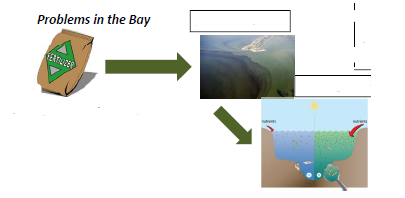
- ANitrogen & Phosphorus
- BAlgal Bloom
- CDead Zones
Información
- Descripción
- o3irjhik4fik24hn
- Autor
- Ankita A :)
- Idioma
- English
- Visitas
- 87
- Etiquetas
- Valoración
- Aún sin valoraciones Valora este test