
Test
Edexcel: Additional Sciences - Biology: Topic 1 (The building blocks of cells)
Este test tiene tipos de pregunta que se abren en el reproductor de siempre.
Preguntas del test (10)
1True or false: The Nucleus is an organelle that contains DNA.
- AVerdadero
- BFalso
2True or False: The Mitochondria are organelles in which respiration occurs.
- AVerdadero
- BFalso
3True or False: In light microscopes, light passes through a specimen and then through magnifying lenses so you see the object much bigger than it really is.
- AVerdadero
- BFalso
4The [blank_start]cell membrane[blank_end] separates the contents of the cell and its surroundings. It controls the movement of substances like [blank_start]oxygen[blank_end], [blank_start]glucose[blank_end] and [blank_start]carbon dioxide[blank_end].
- Acell membrane
- Boxygen
- Cglucose
- Dcarbon dioxide
5Plant and animal cells have some features in common.. These are?
- ACell membrane
- BCytoplasm
- CNucleus
- DMitochondria
- ECell wall
- FCellulose
- GVacuoles
- HChloroplasts
6In the [blank_start]1930's[blank_end] the [blank_start]electron microscope[blank_end] was invented. This uses a [blank_start]beam of electrons[blank_end] to magnify speciments up to about [blank_start]2,000,000[blank_end] times. This would make an average person 3333km tall.
- A1930's
- B1940's
- C1950's
- D1960's
- Eelectron microscope
- FLight microscope
- GLeeuwenhoek microscope
- Hbeam of electrons
- Ibeam of neutrons
- Jbeam of protons
- K2,000,000
- L4,000,000
- M6,000,000
- N8,000,000
7Electron microscopes show us that bacterial cells contain two types of DNA. [blank_start]Chromosomal DNA[blank_end] is a [blank_start]giant loop[blank_end] of DNA [blank_start]containing most[blank_end] of the genetic material. It is not neatly packaged like plant or human chromosomes. [blank_start]Plasmid DNA[blank_end] comes in small loops and [blank_start]carries extra[blank_end] information
- AChromosomal DNA
- BPlasmid DNA
- CAntoni DNA
- Dgiant loop
- Esmall loop
- FQuite long
- Gcontaining most
- Hcontaining some
- Icontaining all
- Jcontaining none
- KPlasmid DNA
- LChromosomal DNA
- Mcarries extra
- Ncarries less
- Ocarries an equal amount of
8Label the parts of a bacterial cell.
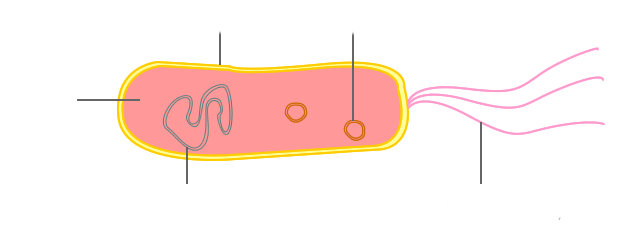
- ACytoplasm
- BBlood
- CBacterial plasma.
- DCell wall
- ECell Membrane
- FPlasmid DNA
- GMitochondria
- HNucleus
- IChromosomal DNA
- JAntoni DNA
- KSome random DNA
- LFlagellum
- MTail
- NLegs
9The Chromosomes in the nuclei of your cells contain your genetic information. They are made of a chemical called [BLANK]. What is it?
- ADNA
- BRNA
- CmRNA
- DtRNA
10One Gene contains the instructions for [blank_start]One protein[blank_end]. Often [blank_start]several genes work together[blank_end] to produce what is needed for a single feature. For example, your [blank_start]eye colour[blank_end] is the result of proteins made by several different genes. So is the size and shape of your [blank_start]nose[blank_end], and so many other features of your body. Some Genes also carry the instructions for the proteins that control the chemical processes in your body.
- Aseveral genes work together
- Btwo genes work together
- Csingle genes work together
- Deight genes work together
- EOne protein
- FTwo proteins
- GThree proteins
- Hfour proteins
- Ieye colour
- Jshoe size
- Khair colour
- Lheight
- Mnose
- Nfeet
- Oeyes
- Plips
Información
- Descripción
- GCSE (Biology) Additional Science Test sobre Edexcel: Additional Sciences - Biology: Topic 1 (The building blocks of cells), creado por Joe Barry el 03/04/2017.
- Autor
- Joe Barry
- Idioma
- English
- Visitas
- 55
- Etiquetas
- Valoración
- 5,0 de 5 · 2 valoraciones Valora este test