
Test
HIV
Este test tiene tipos de pregunta que se abren en el reproductor de siempre.
Preguntas del test (24)
1HIV isn't a very [blank_start]tough[blank_end] virus and can't [blank_start]survive[blank_end] outside the body for any significant time. It can be passed on only in [blank_start]body fluids[blank_end], such as blood, vaginal secretions and semen, but [blank_start]not[blank_end] saliva or urine. Infection can occur if you have [blank_start]unprotected sex[blank_end] with someone who is already infected, or if [blank_start]blood[blank_end] from such a person enters your bloodstream. For infection to occur, the body fluids have to be transferred [blank_start]directly[blank_end] into the body of the next host.
- Atough
- Bsurvive
- Cbody fluids
- Dnot
- Eunprotected sex
- Fblood
- Gdirectly
2For the infection to occur, the body fluids have to be transferred directly into the body of the next host. This can occur in the following ways:
- ASharing needles
- BUnprotected sex. The virus can enter the bloodstream of a partner through breaks in the skin or lesions caused by other infections - usually these infections are other STIs. The use of a condom can prevent this transmission. Infection can also occur via oral sex, though this is rare.
- CDirect blood-to-blood transfer can occur through cuts and grazes. Police, paramedics and medical staff are particularly at risk from this method of transmission and precautions are taken to minimise the risk.
- DMaternal transmission from mother to unborn child or in breast milk. The risk of the virus being passed to the baby occurs in the last few weeks of pregnancy, mostly around the birth itself, when mingling of infant and maternal blood is likely to happen. Taking anti-HIV drugs during the last 3 months of pregnancy and giving birth by Caesarean section greatly reduces this risk, from about 20% to 5%. This option is only realistically available in countries with advanced medical care.
- EDroplet infection - through mucus or saliva suspended in air that has come from the infected person sneezing, coughing or talking.
3Reasons for lower estimates for HIV/ AIDS cases?
- Aimproved methodology for making estimates
- Bbetter HIV surveillance for countries
- Cchanges in key epidemiological assumptions used to calculate the estimates
- Dcleverer peeps
4AIDS stands for [blank_start]acquired immune deficiency syndrome[blank_end]. It's caused by infection with the [blank_start]human immunodeficiency virus[blank_end] aka HIV. A syndrome is a collection of symptoms related to the same cause, in this case the action of HIV, which gradually destroys parts of the [blank_start]immune[blank_end] system. The symptoms of AIDS are those of [blank_start]opportunistic[blank_end] infections to which the patient becomes susceptible as their immune system is weakened.
- Aacquired immune deficiency syndrome
- Bhuman immunodeficiency virus
- Cimmune
- Dopportunistic
5HIV is a structurally [blank_start]complex[blank_end] virus, an example of an [blank_start]enveloped[blank_end] virus. The virus consist of [blank_start]RNA[blank_end] surrounded by a 20-sided (icosahedral) [blank_start]protein capsid[blank_end] (coat) enclosed in a layer of [blank_start]viral protein[blank_end]. The [blank_start]lipid envelope[blank_end] is formed from the [blank_start]host cell membrane[blank_end] as the new virus particles emerge from the cell cytoplasm. Sticking through the envelope are viral [blank_start]glycoprotein[blank_end] (gp) molecules.
- Aenveloped
- Bcomplex
- CRNA
- Dprotein capsid
- Eviral protein
- Flipid envelope
- Ghost cell membrane
- Hglycoprotein
6Label the diagram:
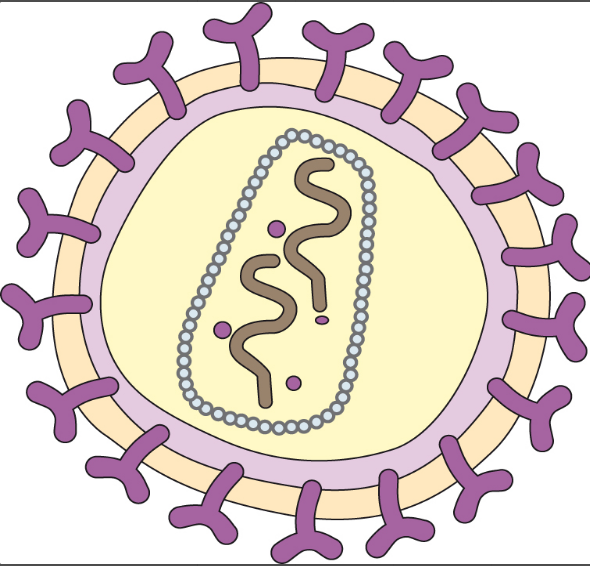
- AmRNA (2 copies)
- BDNA (2 copies
- Cglycoprotein
- Dprotein capsid
- Elipid bilayer
- Flayer of viral protein
- Glayer of viral protein
- Hlipid bilayer
- Icapsid made up of protein units
- Jlayer of viral protein
- Kviral proteins e.g.reverse transcriptase
- Lglycoprotein
7[blank_start]HIV[blank_end] invades [blank_start]T helper cells[blank_end] within the immune system. Glycoprotein molecules, called [blank_start]gp120[blank_end], which are located on the virus surface, bind to the [blank_start]CD4[blank_end] receptors on the surface of the [blank_start]T helper cells[blank_end]. The envelope surrounding the virus fuses with the [blank_start]T helper cell[blank_end] membrane, enabling the virus [blank_start]RNA[blank_end] to enter the cell. [blank_start]Macrophages[blank_end] also have CD4 receptors, so the viruses can also infect them.
- AT helper cells
- BB cells
- CHIV
- DTB
- Egp120
- FCD4
- GCD4
- Hgp120
- IT helper cells
- JB cells
- KT helper cell
- LB cell
- MRNA
- NDNA
- OMacrophages
- PNeutrophils
8Label the diagram:
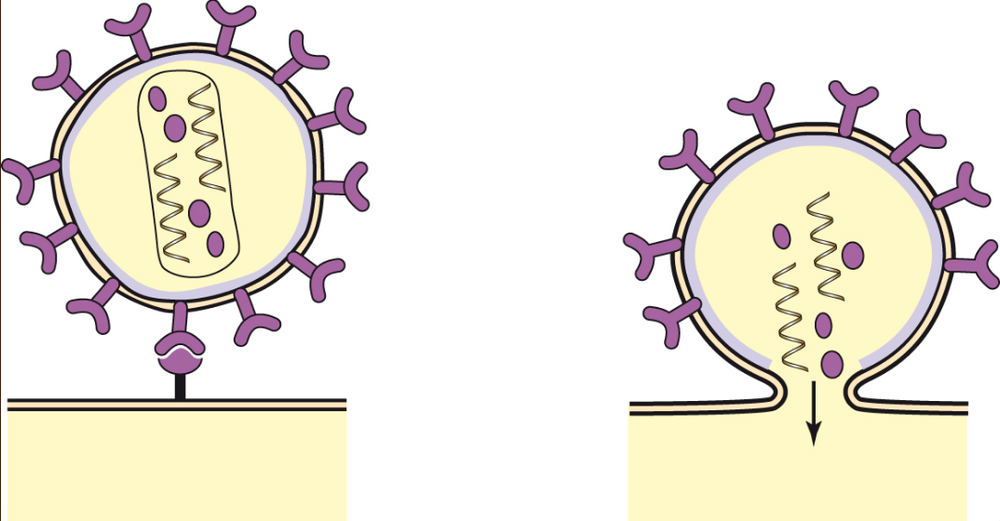
- Agp120 molecules
- BCD4 receptor
- Ccytoplasm
- DT helper cell
- Ecell surface membrane
9Once inside the host [blank_start]T helper cell[blank_end], the virus needs to make the host cell replicate new virus components. HIV genetic material is in the form of [blank_start]RNA[blank_end] not DNA. Therefore the first step is to reverse normal transcription and manufacture DNA from the RNA template. To do this, the virus uses an enzyme called [blank_start]reverse transcriptase[blank_end]. Viruses that contain RNA and use reverse transcriptase in this way are called [blank_start]retroviruses[blank_end]. Once the HIV DNA strand is produced, it is integrated into the host's DNA by another HIV enzyme, [blank_start]integrase[blank_end]. Once the HIV genome is integrated into the host cell's genome, it can be transcribed and translated to produce new virus [blank_start]proteins[blank_end].
- AT helper cell
- BRNA
- Creverse transcriptase
- Dretroviruses
- Eintegrase
- Fproteins
10The new HIV virus proteins produced, together with [blank_start]glycoproteins[blank_end] and nuclear material, are assembled into new viruses. The new viruses bud out of the T cell, taking some of the host cell [blank_start]surface membrane[blank_end] with them as their [blank_start]envelope[blank_end], and [blank_start]killing[blank_end] the cell as they leave. Infected T helper cells will also be destroyed by [blank_start]T killer cells[blank_end].
- Aglycoproteins
- Bsurface membrane
- Cenvelope
- Dkilling
- ET killer cells
11As the number of viruses increases, the number of host T helper cells increases.
- AVerdadero
- BFalso
12What does a loss of T helper cells result in?
- Amacrophages, B cell and T killer cells aren't properly activated and don't function properly
- Ba healthier immune system
13What factors does the course of HIV/ AIDS depend on?
- Athe health of the host before infection
- Btheir genetic resistance to infection
- Cthe quality of their immune response to initial infection
- Dtheir lifestyle and nutrition
- Ethe availability of drug treatment
- Fwhat clothes they enjoy wearing
14AIDS has no cure
- AVerdadero
- BFalso
15The Acute Phase:
- AHIV antibodies appear in the blood after 3-12 weeks
- BHIV antibodies appear in the blood after 40 weeks
- CThe infected person may experience symptoms such as fever, sweats, headache, sore throat and swollen lymph nodes or they may have no symptoms
- DThe infected person may experience symptoms such as dizziness, diarrhoea, tardive dyskenia or they may have no symptoms
- EThere is rapid replication of the virus and loss the T helper cells
- FAfter a few weeks, infected T helper cells are recognised by T killer cells, which start to destroy them. This greatly reduces the rate of virus replication, but does not totally eliminate it.
16The Chronic Phase:
- ASometimes called the 'latent' phase
- BThe virus continues to reproduce rapidly, but the numbers are kept in check by the immune system
- CThere may be no symptoms during this phase, but there can be an increasing tendency to suffer colds or other infections, which are slow to go away
- DDormant diseases like TB and shingles can reactivate
- ECan last for many years
- FOnly lasts a few days
17In fit young people with a [blank_start]healthy[blank_end] lifestyle, the chronic phase can last for [blank_start]20[blank_end] years or more, especially if combined with [blank_start]drug[blank_end] treatment. Unfortunately, most HIV infection occurs in [blank_start]developing[blank_end] countries with little money available to provide drugs and amongst people who often don't have access to food or [blank_start]clean[blank_end] water. These people may develop AIDS within a [blank_start]few[blank_end] years of infection.
- Ahealthy
- B20
- Cdrug
- Ddeveloping
- Eclean
- Ffew
18Eventually, the increased number of viruses in circulation ([blank_start]viral load[blank_end]) and a declining number of T helper cells indicates the onset of AIDS, the [blank_start]disease[blank_end] phase. The decreased number of T helper cells leaves the immune system vulnerable to other diseases. These are known as [blank_start]opportunistic infections[blank_end], which can rapidly be fatal. They often include [blank_start]pneumonia[blank_end] and TB. There can be significant [blank_start]weight loss[blank_end]. Patients can also develop [blank_start]dementia[blank_end] - memory and intellect loss. Also susceptible to tumours, such as [blank_start]Kaposi's sarcoma[blank_end]. This cancer is readily identified by purple/ black patches on the skin.
- Aviral load
- Bdisease
- Copportunistic infections
- Dpneumonia
- Eweight loss
- Fdementia
- GKaposi's sarcoma
19A normal T helper cell count is over 500 per mm cubed of blood. At what T helper cell count is there a high risk of opportunistic infections?
- Abelow 200 per mm cubed of blood
- Bbelow 400 per mm cubed of blood
20There is [blank_start]no[blank_end] treatment to get rid of HIV in someone who is infected with the virus because the virus is [blank_start]hidden[blank_end] inside T helper cells. But there are drugs available that [blank_start]reduce[blank_end] the production of more viruses. These are known as [blank_start]antiretroviral[blank_end] drugs.
- Ano
- Bhidden
- Creduce
- Dantiretroviral
21Reverse transcriptase inhibitors:
- Aprevent the viral RNA from making DNA for integration into the host's genome
- Binhibit the proteases that catalyse the cutting of larger proteins into small polypeptides for use in the construction of new viruses
22Protease inhibitors:
- Aprevent the viral RNA from making DNA for integration into the host's genome
- Binhibit the proteases that catalyse the cutting of larger proteins into small polypeptides for use in the construction of new viruses
23Which other drugs have also been approved for use?
- Aintegrase inhibitors
- Bfusion inhibitor drugs
- Clactase inhibitors
24HIV can develop [blank_start]resistance[blank_end] to anti-HIV drugs and therefore these drugs are often given in [blank_start]combination[blank_end]. If the virus becomes resistant to one drug, it may still be susceptible to the other drugs being taken. Access to antiretrovirals is increasing across the world and with it comes a decline in the number of AIDS-related deaths.
- Aresistance
- Bcombination
Información
- Descripción
- 24 questions
- Autor
- Ella Middlemiss
- Idioma
- English
- Visitas
- 15
- Etiquetas
- Valoración
- Aún sin valoraciones Valora este test