
Managing Change
Diapositivas del conjunto (29)
-
-
- A body will remain at rest, or continue to move with uniform velocity, unless acted upon by an outside force.
- Newton was describing two concepts:
- - Inertia (a tendency to do nothing or to remain unchanged)
- - Force (strength or energy as an attribute of physical action or movement)
-
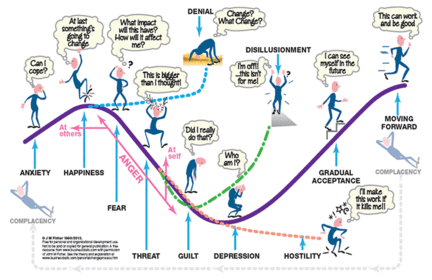
- People are not by nature resistant to change and neither are organisations; on the contrary they are open to change and they continually change themselves.
- It is all a question of where the change comes from: if it comes from within, it feels good; if it is imposed from outside it can feel like a threat, because it is unknown and outside one's own control.
- It should be no surprise that people (and organisations) are defensive in the face of perceived threat - we are all absolutely right to be defensive when threatened. But it is not the change which we resist it is the threat which fills us with fear.
- Organisations are defined as resistant to change only by those who are trying to change them.
-
Resistance to Change - Stakeholders
- Different stakeholders (perspectives) may have different objections to change:
- - Conflict of interest
- - Low tolerance for change
- - Differing assessments of the need for change
- - Misunderstanding
- - Lack of trust
-
- Organisational
- - Structural and cultural factors can result in widespread resistance
- - e.g. rapid and radical changes may overwhelm current systems
- - e.g. a new centralised IS may be seen as inappropriate to an organisation with an autonomous culture.
- Group
- - A need to be kept informed
- - A need to be consulted
- - A need to participate in the whole process
- - A need to share ownership of the change
- Individual
- - It can create anxieties around important issues such as job security
- - It often upsets familiar surroundings and patterns of relationships that we feel comfortable with.
- - In practical terms, it may result in all sorts of unforeseen complications that you may have to deal with.
- - It may demand skills you don't have.
-
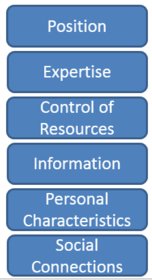
- Position – Power stems from a person's
- formal position – the role which they perform includes the legitimate right to
- make decisions and to control the rewards of those they supervise.
- Expertise –
- Also considered a legitimate source of power when used appropriately. On certain issues, organisations rely upon
- the expert judgement of those who possess the required knowledge. Managers
- themselves are no longer "experts" in the operational fields.
- Control of Resources – The
- extent to which A depends on B is affected by several factors – How much does A
- want it? Are there any alternatives? It is possible for A to be very dependent
- on B but the reverse may not be true – this gives B considerable power over A
- Information – A
- particular resource. "Knowledge is Power". Witholding
- information, or providing selective information can be used to manipulate
- decisions. This is use of power, but not a legitimate one. The ideal situation
- is for information to be freely and fully available – though commercial
- confidentiality may reduce this ability.
- Personal Characteristics –
- "Charisma", if you like someone and want to please them – they have
- some power over you. This power can be used or abused, depending on those
- personal characteristics!
- Social Connections –
- It's not what you know, but who! Personal word of mouth or recommendation is a
- source of power. Websites such as LinkedIn, networking before/after events –
- all add to your social connections and increase your level of power.
-
- •Theories/Models
- for Managing Change
- - Lewin
- - Bullock and Batten
- - Burnes
- - Kantor's 10 commandments
- •Leadership
-
- •Need
- to
- – plan
- and implement strategic projects like other projects
- – create
- conditions for successful change
- – sustain
- the change and continuously develop
- •People
- are the key to managing change effectively
- – managers
- must be change agents and lead participatively
- •Plan for success, but be ready to accommodate failure
-
Why is managing change important?
- Most
- modern IT projects are change projects (earlier projects often replaced some part
- of existing processes without changing them… modern strategic management means that
- we are inevitably dealing with change)
- need to understand issues associated with
- successful change to implement a useful IS strategy
- need to recognise that successful change comes
- from having a strategy to make that change work
- …
- even a well-developed system might not realise expected benefits in use due to
- poor handling of changeover!!!
-
Modelling Change Description & Strategies
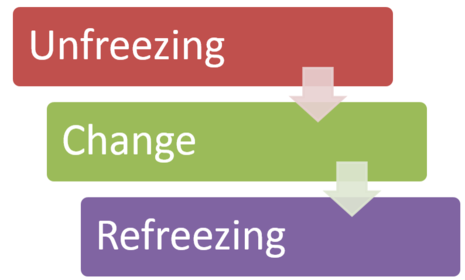
- Pie de imagen: Lewin's (1958) recognised three critical phases in the implementation of change.
- Phase
- 1: Unfreezing
- •Need to prepare for resistance to change
- •Proposed or planned change may be met with
- - Emotional conflict (will it be good or bad)
- - Uncertainty and fear
- - Support or obstruction
- •Need to gain support for change
- - confrontation
- or re-education is necessary
- - active
- support can be achieved through means such as
- * team
- building
- * presenting
- analysis of problem to be solved (changed) to show that a serious problem
- exist
-
- •Hence some form of confrontation meeting or re-education is necessary. This might be achieved through team building or some other form of management development, in which the problem to be solved (changed) is analysed, or data presented to show that a serious problem exists.
- Organisational change often results in some form of human resistance. There may be some use of past experience as guidelines giving rise to a number of preconceived ideas in the change agent about how different groups will react. may result in positive engagement, support or obstruction, active resistance. People affected by change will experience some emotional conflict, positive and rational changes can still involve loss and uncertainty. For a number of reasons, individuals or groups will react differently to change, from positively resisting it, to aggressively trying to undermine it, to embracing it.
-
- - Need a strategy to manage change
- ~ Pre-planned and dictatorial, or flexible and involving?
- - 'Best' strategy depends on factors including
- ~ Anticipated or recognised amount/kind of resistance
- ~ Power
- relationship between initiator and resisters
- ~ Level
- of commitment needed from others to make change work
- ~ The
- stakes involved
- - Can improve likelihood of success by
- ~ honest analysis of current situation, causes of problems
- ~ selecting
- a sensible strategy for change
- ~ carefully
- monitoring the change as it progresses and reacting appropriately to unexpected
- events
-
Phase 2 -Change (Managing - Managers)
- A common mistake is to
- approach change in a disjointed or incremental way which is not part of an
- overall considered strategy. Managers must make
- decisions either implicitly or explicitly about the speed of the effort, amount
- of preplanning, involvement of others and the relative emphasis they will give
- to different approaches. These options
- can be thought of as continuum at one end change
- strategy calls for a very rapid change implementation, a clear plan of action,
- and little involvement of others.At the other end, the
- strategy would call for a much slower change process, a less clear plan and the
- involvement of many others apart from the initiators. This type of strategy is designed to reduce
- resistance to a minimum.
-
- Situational Factors: Exactly what sort of change strategy should be considered depends on four factors.
- • The amount and kind of resistance that is anticipated, all other factors being equal, the greater the anticipated resistance, the more difficult it will be to simply overwhelm it and the more the change will have to be organised from the right of the continuum and find ways to reduce some of it.
- • The position of the initiator vis-à-vis the resistors, especially with regard to power. The less power the initiator has with respect to others, the more the initiator must move to the left of the continuum.
- • The person who has the relevant data for designing the change and the energy for implementing it. The more the initiators anticipate that they will need information and commitment from others to help design and implement change, the more they must move to the right. (gatekeeper!)
- • The stakes involved. The greater the short-run potential for risks to organisational performance and survival if the present situation is not changed, the more one must move to the left.
-
- Implications : The chances of success in organisational change situation can be improved by:
- • Conducting organisational analysis that identifies the current situation, problems and forces that are possible causes for these problems.
- • Conducting an analysis of factors relevant to producing the needed changes. This analysis can focus on who might resist change, why and how much: who has information that is needed to design the change and whose co-operation is essential to implementing it and what is the position of the initiator as regards others in terms of power, trust, normal modes of interaction etc.
- • Selecting a strategy for change, based on previous analysis, that specifies the speed of the change, the amount of preplanning and the degree of involvement of others: that selects specific tactics for use with various individuals and groups: and that is internally consistent.
- • Monitoring the implementation process. No matter how good a job is done selecting a strategy something will always happen and only careful monitoring can ensure that the unexpected can be identified and reacted to intelligently.
-
- Directive Strategies
- ~ Management's "right" to implement change
- Expert Strategies
- ~ Management of change as "problem solving"
- Negotiation Strategies
- ~ Bargaining about change
- Normative Strategies
- ~Winning hearts and minds
- Participative Strategies
- ~ We're all "in it together"
-
- Careful
- monitoring of the change is most important to ensure process
- reaches the consolidating phase that
- the correct change is being consolidated and that the people involved haven't
- changed the process.
- Possible
- issues/problems ~ People
- may take unexpected roles, procedures may be accepted in form but not
- spirit. Changes
- that appeared to be acceptable earlier may become unacceptable to the people
- affected. Need
- to use supporting mechanisms that positively reinforce new ways of working including
- organisational culture, norms, policies and practices.
-
- When change is complete, need to
- ~ Stop the change activity at the right time
- ~ ensure that new mechanisms will continue to work correctly
- Need to
- ~ Ensure new procedures are accepted in spirit as well as form
- ~ Develop supporting mechanisms that positively reinforce new ways of working including appropriate changes to
- - Organisational culture, norms, policies and practices
-
Bullock and Batten's 4 Phase Model
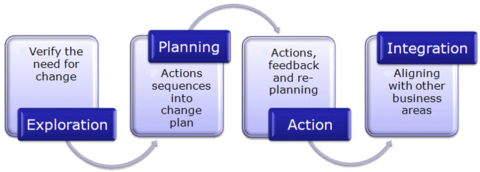
- Pie de imagen: Exploration , Planning, Action , Integration
-
- 1
- Exploration phase
- - becoming aware of the need for change
- - searching for outside assistance (a consultant/facilitator)
- - establishing a contract with the consultant
- 2
- Planning phase
- - collecting information in order to establish correct diagnosis
- - establishing change goals, designing appropriate actions to achieve these goals
- - getting key decision makers to approve goals and support proposed changes
- 3 Action phase
- - establishing appropriate arrangements to manage change process & gaining support for actions to be taken
- - evaluating implementation activities, feeding back results so adjustments can be made
- 4 Integration phase
- - reinforcing new behaviours through feedback and reward systems
- - decreasing reliance on consultant & diffusing the successful aspects of the change process through the organisation
- - training managers & employees to constantly monitor the changes and their results seek to improve on them
-
Bullock and Batten's 4 Phase Model
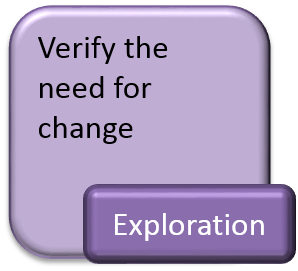
- Exploration phase
- The organisation has to make decision on
- the need for change:
- •Explore
- and decide on the need for change
- •Identify
- what changes are required
- •Identify
- resources required
- Pie de imagen: Exploration
-
Bullock and Batten's 4 Phase Model
- Planning phase
- Understanding the problem:
- •Diagnosis
- of the problem
- •Clarify
- goals and objectives •Identify
- specific activities required to undertake change
- •Agree
- changes with stakeholders
- •Identify
- supports required to enable change to occur
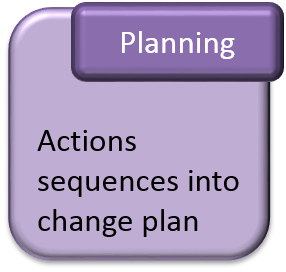
- Pie de imagen: Planning
-
Bullock and Batten's 4 Phase Model

- Action phase
- Changes identified are agreed and
- implemented:
- •Support
- for change is explicit •Changes
- are monitored and evaluated
- •Results
- are communicated and acted upon
- •Adjustments
- and refinements are made where necessary
-
Bullock and Batten's 4 Phase Model

- Integration phase
- Stabilizing and embedding change:
- •Changes
- supported and reinforced
- •Results
- and outcomes from change
- communicated throughout
- the organisation
- •Continuous
- development of employees through training, education
- •Ongoing
- monitoring and evaluation
-
- • Choice Management – Change Management
- Model
- –three
- interdependent
- processes depicted
- as triangles on the model
- ~ choice
- ~ trajectory
- ~ change
- • 9 key elements organised in 3
- groups
- 1. Context,
- focus, trajectory
- 2.Vision,
- strategy, change
- 3.Objectives,
- planning, people
- • Elements interact in “subtle or complex” ways
-
-
Burnes' Model - Choice Process
- The
- Choice process triangle (organisational decision making) ( successful
- organisation need to know their own strengths and
- weaknesses nature of environment in
- which they operate)
- • Determine Context of choice
- – Use
- SWOT, PESTLE, etc. (good idea to use easy-to-understand mechanisms to promote openness, reduce political behaviour and conflict)
- • Identify focus of choice (or choice of
- focus?)
- – Timescales ~ short/medium/long
- term
- – Objectives ~ improving
- performance, developing competences or technologies
- ~ Align
- with constraints under which organisation
- operates
- ~ or
- try to influence them?
- • Decide
- on trajectory
-
Burnes’ Model – Trajectory Process
- -
- Where should we go next?
- Decisions often need to
- be made with incomplete information, especially about future managers in reality
- often tend to try to muddle through rather than relying on deep analysis (even
- when this is possible!)
- -
- Answer strongly influenced by
- o
- Where we’re coming from (Choice from triangle 1)
- o
- Approach to change, itself influenced by
- §
- Vision (Ambitious view of where the org is going allows
- thinking without worrying about current constraints etc.; but can result
- in over-ambitious goals!
- made
- up of (p.463))
- o
- Mission (why are we here; what is our strategic
- purpose?)
- o
- Valued outcomes (what performance and human outcomes
- would org like to achieve?
- o
- Behaviour and skill as well as profit and turnover!)
- o Valued conditions (what should org look like to achieve these outcomes? structure, culture, openness, management style, relationship to suppliers
- o Mid-point goals (waypoints on route to vision; shorter term, more concrete, easier to steer towards!)
- § Strategy
- o “coherent or consistent steam of actions” to move towards vision
- o can be delegated from top or bottom-up, but should be informed/guided by vision. Can be conscious, or emergent from reacting to day-to-day constraints, past patterns of behaviour. Often mix of formal and informal plans and actions might be broad, general for next 5-10 years, detailed for next 12-18 months. Includes how organisation reacts to events: often blend or (or clash between) predetermined strategy and exploiting opportunities as they arise. Can include sub-strategies to be adopted over time like links in a chain to get us to the vision
- § But this can only become reality if there is Change
-
- General issues:
- - is change continuous?
- ~ Some organisations see it as on-going, others regard
- it as a series of one-offs.(It depends on culture, values)
- - Failure of change programmes often due to organisational politics
- ~ Burnes seeks to avoid this by appealing for openness making explicit the objectives in this part of his model to help sell the change to people affected by it.

Información
- Descripción
- Diapositivas sobre Managing Change, creado por mk13aau el 01/04/2016.
- Creado por
- mk13aau
- Visitas
- 1
- Valoración