
Sin título
Diapositivas del conjunto (11)
-
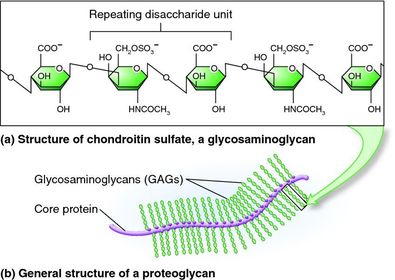
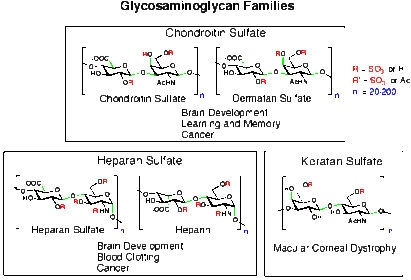
- GAGS: made up of multiple disaccharide units forming a polysaccharide unbranched chain, negatively charged.
- -disaccharide: composed of:
- 1)amino sugar(D-glucosamine OR D-Galactosamine-> in which amino group is usually acetylated that eliminates its positive charge.
- ->the amino sugar may also be sulfated
- 2)Acidic sugar:(D-glucoronic acid/L-iduronic acid)
- ->these will give it a negative charge that will cause an overall STRONG negative force
-
- (See Lippin page158)
- RELATIONSHIP OF GAGS STRUCTURE & FUNCTION:
- gags negativity causes a strong repulsive force which makes all GAGS separate from eachother and extended in solution.
- ->compression of these GAGS causes water to move out and releasing these GAGS causes water to shift inside (eg: this property contributes to the resilience of synovial fluid and vitrous humor)
- ->this repulsive force is like magnets and is also responsible for the slippery nature of GAGS (eg: mucus is slippery)
- ->ALSO cause cell to cell signalling and adhesion
-
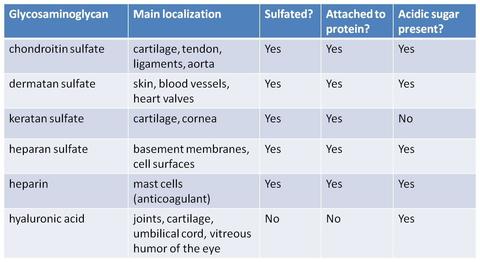
- (SEE REGISTER also)
- *Only non-sulfated GAG: hyaluronic acid (MAIN FUNCTION: LUBRICANT &SHOCK ABSORBER)
- *ALL: are covalently attached to protein to form proteoglycans EXCEPT: hyaluronic acid but ALL proteoglycan monomers associate with hyaluronic acid to form: PROTEOGLYCAN AGGREGATES.
- KERATAN SULFATE: has galactoseis present inpalace of acidic sugar
-
-
SYNTHESIS & DEGRADATION of GAGS
- synthesized IN GOLGI APPARATUS
- POLYSACCHARIDE chains are elongated by the sequential adding of alternating acidic and amino sugars--> donated by: their UDP derivatives
- LAST STEP: sulfation if need be according to GAG (SOURCE OF SULFATE: 3-phosphoadenosyl-5'-phosphosulfate)
- DEGRADATION:
- in lysosomes (by LYSOSOMAL HYDROLASES)
- FIRST: broken down to oligosaccharide
- DEFICIENCY OF THIS HYDROLASE--> MUCOPOLYSACHARIDOSES (GAGS will accumulate in tissues eg; skeletal and ECM deformities and mental retardation) eg: HUNTER, HURLER, MORQUIO, SANFILLIPO SYNDROME)
-
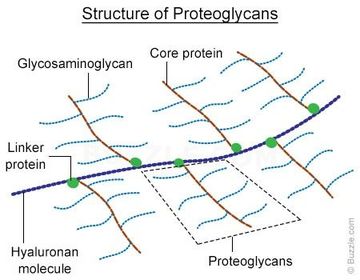
- Have a "BRUSH BORDER" appearance
- composed of a core protein which is linked to GAGS
- multiple such proteoglycan monomers are brought together and linked by means of hyaluronic acid to form PROTEOGLYCAN AGGREGATES
-
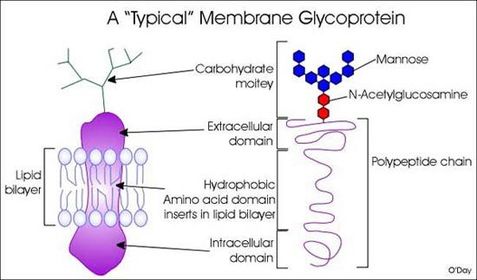
- Proteins to which oligosachharides are covalently attached. Length of sugar chain is usually short (2 to 20 residues) usually variable(eg: IgG: 4%carbs & mucin contains: >80% carbs), branched (differeing it from GAGS), may or may not contain negative charge)
- FUNCTIONS:
- cell surface recognition (by other cells, hormones, viruses) & cell surface antigenicity (eg: blood group)
- as component of ECM (laminin, fibronectin: adhesive glycoproteins. chondronectin and osteonectin: in cartilage and bones respectively)
- as component of mucin in GIT and Urinary tract
- almost all GLOBULAR PROTEINS in plasma: (albumin, globulin, igG, etc)
-
- synthesized in ER, and Golgi
- precursors: nucleotide sugars
- I-CELL DISEASE: inabiltiy to transfer glycoprotein to lysosomes b/c of defieciency of enzyme that phosphorylates mannose)
- Degradation by lysosomes by acid hydrolases
- deficiency of these enzymes: causes--> oligosaccharidosis--> glycoprotein storage disease
-
- Mnemonics:
- Type I: BONE |
- Type II: carTWOlage.
- Type III: ArTHREE (Artery).
- Type IV: Under the floor (basement membrane)
Información
- Descripción
- Diapositivas sobre Sin título, creado por Sarah Khan el 26/12/2016.
- Creado por
- Sarah Khan
- Visitas
- 0
- Valoración