
Fichas
Introduction to Computer Systems Lecture 7 Input/Output
Fichas del conjunto (26)
- 1What is I/O speedData rate measured by bit per second
- 2State one input, output and one I/O deviceKeyboard is input and has a data rate of 0.01
laser printer is a output and has a data rate of 100
Wireless network is a I/O with a data rate of 50,000 KB/s - 3What is the CPU and i/O speed mismatch ? and why is there a mismatch>1 GHz microporcessor with 1 billion load/store insturctions per second, 4 million KB/s data rate
I/O device data rates range from 0.01 to 200,000 KB/s
Input: device may not be ready to send data as fast as the processor loads it
Output: device not ready to accept data as fast as processor stores it - 4What do you need to make I/O workVariety of peripherals, delivering different amounts of data at slower speeds than CPU and RAM
Need to connect lots of devices, control them, and transfer data and a way to present them to user programs
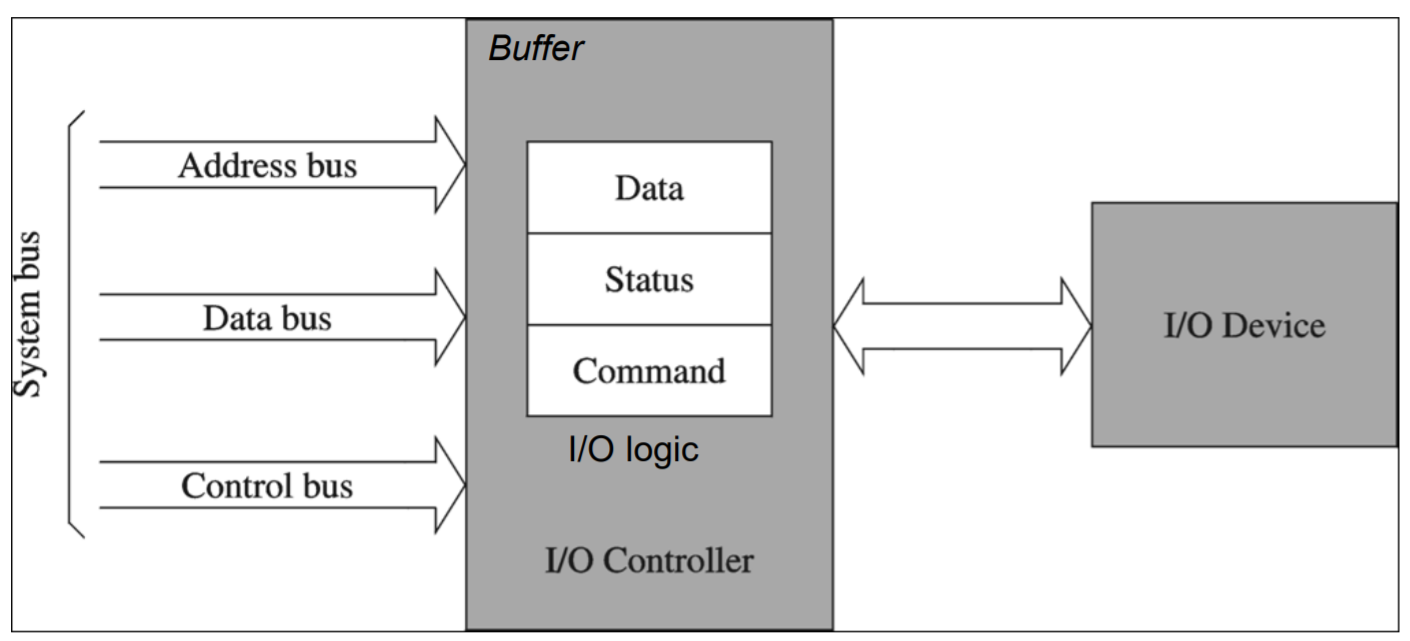
Need a I/O controller (interface) - 5Draw a I/O controller diagram
- 6What are the functions of the I/O controllerRecognizes messages from devices addressed to it & accepts commands from the CPU
Provide buffer to hold data from memory until it can be transferred to device
Copy this data to device
Provide necessary registers and control for a direct memory transfer
Control device and communicate with CPU - 7What is isolated I/OWhen procesors have special input and output insturctions to access I/O device
- 8What is memory-mapped input/output?Users load for input, store for output used by MIPS
- 9State the three techinques to make I/O work1. Programmed I/O (cpu controlled I/O)
2.Interrupt Driven I/O (I/O hardware signals CPU)
3. Direct Memory Access Controllers transfer data between main memory and device, bypassing CPU - 10State the method for polling/ programmed I/O running a insturction Processor executes an I/O instruction by issuing a command to the appropriate I/O controller;
Each device is given a unique identifier or address;
I/O controller performs the requested action and sets the appropriate bits in I/O status registers;
The processor periodically check the status of I/O controller until it finds the operation is completed;
One word transfer per I/O instruction. - 11Define pollingThe process of periodically checking the status of a I/O device to determine the need to server the device
- 12Summarise pollingCPU has direct control over I/O
• Sensing status;
• Read/write commands;
• Transferring data
CPU waits for I/O controller to complete operation
The simplest way for an IO device to communicatewith processor
Wasteful to have processor spend most ofits time “spin-waiting” for I/O to be ready - 13What is interrupt drivenInterrupt the CPU while carrying out its program when the I/O device is ready and return to program when done with data transfer
No repeated CPU checking of device - 14What is the read operation for the interrupt driven I/O• CPU issues a read command to an I/O controller
• The I/O controller gets data from a peripheral whilst CPU does other work
• I/O controller interrupts CPU
• CPU requests data
• I/O controller transfers data - 15What are interrupt handlers?the prgram that services the interrupt nown as the interrupt routine
- 16What is context and why is it important in interrupt driven I/O?It saves registers of the program before control is transferred to the interuppt handlers
Important as it allows the porgam to carry on where it left off - 17What happens when there are multiple interrupts?Each interrupt line has a priority
Lower priority interrupt lines have to wait - 18What is the disadvantage of interrupt driven I/O?Transfer rare is limited
The CPU is tied up - 19What is Direct Memory Access?It transfers large blocks of data to and from memory
CPU is not involved in the transfer
DMA controller takes over the CPU's role - 20What is a DMA controller?a specialized controller that transfers
data between an I/O device and memory independent of
CPU. - 21How does the DMA controller work>CPU instructs the DMA controller to read/write, device address, starting address of memory block for data and amount of data to be transferred
DMA controller deals with transfer adn sends interrupt when finished - 22What ind of device does DMA work best onHigh performance devices such as hard disks, graphics card network cards etc
- 23What is a magnetic disk?A computer memory where info is stored by a magnetising material on the surface of a rotating disk
Provides nonvoltatile storage - 24Give a two examples of a magnetic diskFloppy disks (slow, less dense, removable)
Hard Disk Drives (faster, more dense, non-removable) , provides long-term cheap storage for files and a backup for main memory - 25What is optical storage?Optical disc which is portable and is written and read by a laser
- 26Name 4 forms of optical storage?CD-ROM (audio)
CD-Recordable
DVD (multi-layer, high capacity of 4.7GB, WORM)
Blu-ray Disc (dual later, capacity of 50GB)
Información
- Descripción
- Computer Science Fichas sobre Introduction to Computer Systems Lecture 7 Input/Output, creado por Nisha K el 10/01/2018.
- Creado por
- Nisha K
- Visitas
- 41
- Valoración