
Fichas
Process Engineering Exam
Fichas del conjunto (81)
- 1What do you understand by plant?A plant is a system for the realization of a physical, chemical or biological process. The aim of the process is to convert raw materials into a desired product. The plant consists of equipment, piping and instrumentation
- 2What do you understand by equipment?Equipment means reactors, columns, heat exchangers and so on. The main equipment of a plant is often a reactor. In the reactor, chemical or biological reactions are performed. In order to get a high yield and selectivity, the process variables such as temperature, pH-value or medium composition have to be maintained at an optimum level
- 3What are the objectives of the following company: Engineering company Give an exampleObjective: Design and construction of process plants (turn key plants)
Examples:
Jacobs Engineering, Pasadena, California
LSMW, Stuttgart, Germany - 4What are the objectives of the following company: Equipment manufacturers Give an exampleObjective:
Development and manufacturing of equipment
Examples:
Sartorius Stedim
Bioengineering
GE Healthcare - 5What are the objectives of the following company: Chemical or pharmaceutical companies Give an exampleObjective:
Development and manufacturing of chemical and pharmaceutical products
Examples:
BASF
Roche
Nestle - 6What do you understand by feasibility study?A feasibility study is a preliminary study undertaken to evaluate a project's viability. The term feasibility study can also refer to the resulting document. The outcome of the feasibility study is used to make a decision whether to proceed with the project, or drop it.
- 7What information is provided by the market analysis?Market volume
Market share
Market growth
Market price - 8Name three methods which are used for a market analysis?Utilization of market studies
Statistical year books
Customer interviews - 9Cost correlationC=c*x1^(m1)
C=c*x1^(m1)*x2^(m2)
C=Equipment cost
x1,x2=capacity parameter
c,m1,m2=constant - 102.3 Degression exponentC=C0*(x/x0)^m
C=Eq. cost C0=Eq. cost of base size
x=capacity parameter
x0=cap. param. of basic size
m=degression exponent - 112.4 Cost indexesC=C0*(I/I0)
C=cost of eq. at present time
C0=cost of eq. at previous time
I=cost index at present time
I0=cost index at previous time - 122.5 Factored estimate procedureCp=Ceq*f
Cp=total plant cost
Ceq=total costs of major equipment
f=multiplication factor - 13Name the two methods used to estimate the profitability. When are they applied?Cost comparison, is applied to evaluate different alternatives for the same objective or to check if a modification is economical
Profitability is used to evaluate whether its economical to build or operate a plant
Profitability=(Profit/capital)*100%
P=(S-C)/(Cp+Cw)*100% - 14What is the objective of process development?The objective of process development is to establish a process to produce a desired product in an industrial scale taking into account economic, ecological and safety boundary conditions.
- 15What are the two objectives of product characterization?Identification of the product
characterization of the product
The identification of the product is like a fingerprint of the product and can be used later on to clarify the reasons for problems during comiss. and operation of the plant - 16Name five types of product propertiesBiological properties
Chemical properties
Mechanical properties
Thermal properties
Safety properties
Toxicity properties - 17What two decisions are influenced by the product behavior?Product properties -> Behavior
Equipment selection
Operating conditions - 18What is the objective of equipment selection?The objective of equipment selection is to choose the most suitable equipment for an individual unit operation
- 19Name the essential criteria for equipment selectionOperating data
Product data
Equipment data
Material data
Laws and regulations - 20Name three methods for equipment selectionExperience
Decision trees
Decision charts
Expert systems - 21What are the two objectives for equipment design?Determination of the equipment size
Determination of the operating conditions - 22Name the essential criteria for equipment design?Operating data
Product data
Equipment data - 23Name the to methods for equipment design?Approximate design
early in proc.dev., quick to make, limited data needed
Detailed design
advanced stage in p.d., based on models, made on computers reliable data needed - 24What is the objective of conceptual design?The objective of conceptual design is to develop a concept for the plant to be built. Potential solutions e.g. alternative sites for the plant are evaluated and a specification for the plant is developed. Provides the basis for the basic design
- 25Name three documents produced throughout conceptual design?Block flow diagram
Functional layout
Personnel and material flow
Process simulation
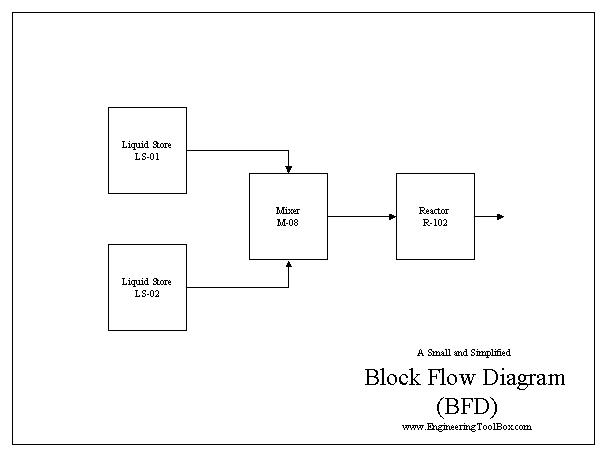
Cost estimation - 26What is a block flow diagram?BFDs are used for illustrating a process or plant in a simple form. They consist of rectangular blocks connected by lines. Blocks represent process steps, lines represent material and energy flows
- 27Drawing of a simple Block Flow Diagram
- 28What is the objective of basic design?Objective is development of a basic design for the plant to be built. It's based on conceptual design, focuses on type and dimensions of major equipment, design temperatures, pressures, materials.
Establishment of plant layout - 29Name three documents produced throughout basic designProcess flow diagram
Equipment list
Process data sheets
Plant layout
Utilities distribution scheme
Electrical equipment list
Soil report - 30What is a process flow diagram? (What is it used for? What does it consist of?)PFDs are used for illustrating a process in more detail. It consists of standardized symbols which are connected by lines. Symbols represent major eq. (reactor, pump, heat exch.) Lines represent material and energy flow.
- 31What document is used for the specification of equipment?Process data sheets
The size of equipment depends on flow rates or amounts of material or energy to be handled. These design data are entered in process data sheets, which contain all relevant specifications for the equipment - 32What is the objective of detail design?In detail design the project team prepares detailed flow sheets, equipment drawings, eq. data sheets, piping drawings, piping specifications and layouts so actual production step can begin
- 33Name three documents produced throughout detail design?Piping and Instrumentation Diagram
Piping specification
Final plant layout
Detailed flow sheets
Detailed eq. data sheets - 34What is a piping and instrumentation diagram? (What is it used for? What does it consist of?)P&ID is based on PFD. It represents the technical realization of a process. It consists of graphical symbols for eq. and piping together with graphical symbols for measurement and control functions
- 35Meaning of letter codes for instrument functions: TI PDI TIC PDICTemperature Indication
Pressure Difference Indication
Temperature Indication Controlling
Pressure Difference Indication Controlling - 36What type of drawing is used to depict pipe runs?Piping drawing that show both the geometry of the run and its location in the plant. Diagram with a single pipe run and its components, along with measurement and control devices and piping supports.
- 37What are the four main tasks of a project manager throughout project execution?Establishment of project organization
Coordination of subtasks
Direction if subtasks
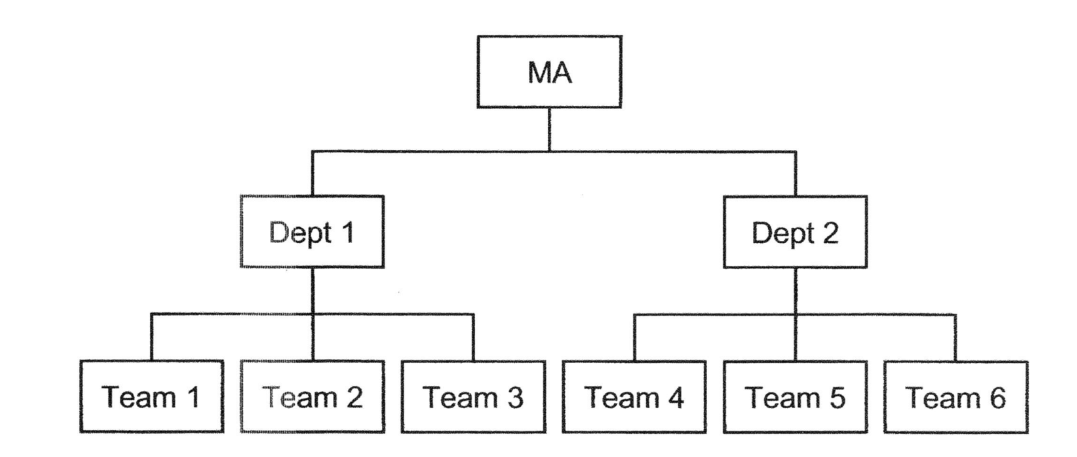
Monitoring and control of subtasks - 38Describe a structural organizationThe structural organization illustrates the departments and teams of a company and the relationships between them.
- 39Describe process organizationThe proc.org. illustrates the work flow of a business process. The work flow consist of an input, activities and an output
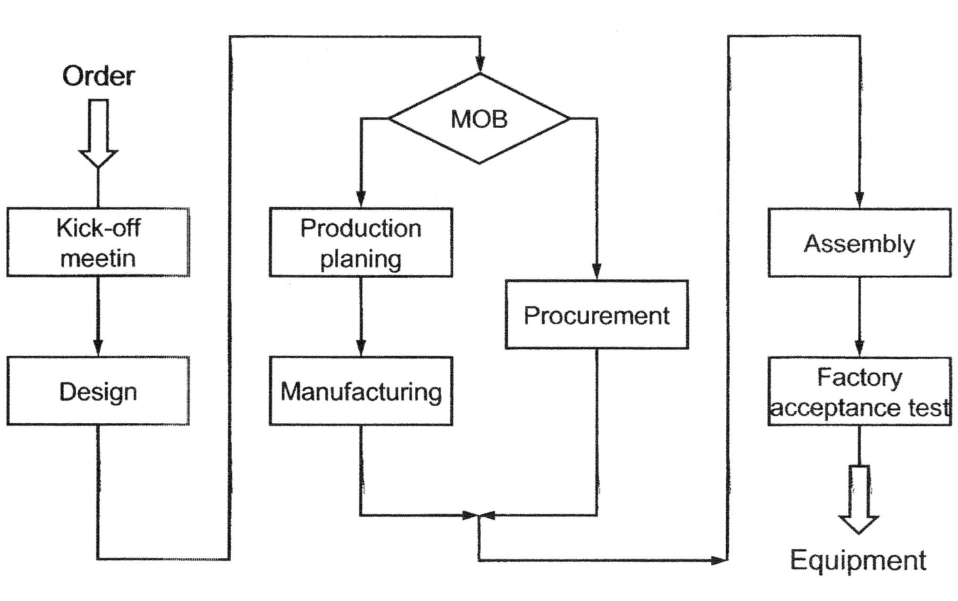
- 40Explain the three types of structural organizationsFunctional organization: structured according to functions, well suited for companies with a single or dominant core product
Divisional organization: number of self-managed divisions, each operates as a profit center (business units). Based on product or market. Centrally provided financing and HR.
Matrix organization: Overlay of the two previous, combines product with geographical. Employees have two bosses. - 41What two types of project organizations can be distinguished?First for large projects (PO1) Project manager with executive authority. P members are exclusively assigned to the P team for the duration of the P. P members report to PM
Second for smaller projects(PO2). P members are not exclusive to the P team. PM has dotted line authority. P members report to their department M. - 42Name three consequences of delaysReq. of additional personal resources
Incurring of additional costs
Payment of penalties
Claim to consequential damages
Loss of reputation - 43What is a network diagram?Illustration of a complex project in form of a netwrok(arrows and nodes), which can be used for a structural nalysis and optimization of the work flow
- 44What are the two phases in network planning?Planning phase: breakdown of the overall project into smaller activities and definition of the dependencies between activities
Scheduling phase: Estimation of the durations and finish dates for overall activities - 45Three most important network diagram methods?CPM
Critical path method (activity on arrow)
MPM
Meta potential method (activity on node)
PERT
Program evaluation and review technique (event on node method) - 46What are the two main consequences of cost overruns?Reduction of profit of engineering company building the plant
Reduction of profit of manufacturing company operating the plant
Procurement has a key role in lowering costs. - 47Two methods of cost controlCost tables for the manufacturing and installation of eq.
Cost diagrams - 48Three types of documentation for the plantExecution (for technical and commercial execution)
Technical (about design and function of indiv. eq. and total plant)
Operating (docs about operation of indiv. eq. and total plant) - 49What is the objective of construction?The objective of construction is to build a plant. It includes all activities from excavation to mechanical completion
- 50What are the main tasks during construction of a plant?Procurement of eq., materials, services
Construction of the building
Erection and installation of eq.
Installation of electrical system, measuring and control equiment
Functional test of equipment - 51Main tasks of procurement?Purchase of equipment, materials, services
Expediting during fabrication of eq. (Cost Time Quality)
Shipping of eq. and materials to construction site - 52What are the three basic types of shipping?Land, Sea and Air.
Land- Trucks, Train- versatile
Sea still requires land transport (harbor)- cheap
Air also requires Land transport (Airport)-quick - 53Mechanical completionWhen functional tests have been successful, mechanical completion is achieved. Generally, a plant is mechanically completed when subsequent commissioning will not be delayed or disrupted by installation work and that the safety of the plant is guaranteed.
- 54What is the objective of commissioning?To assure the proper function of the plant and that the contractual guarantees are achieved. It includes all activities from mechanical completion until hand over of the plant.
- 55Main tasks during commissioning of a plant?Test run of eq. with water (cold comiss.)
Test run with product (warm comiss.)
Test run complete plant
Proof of compliance with guarantees
Training personnel - 56What is a contract?A legally binding exchange of promises or agreements between parties that will be enforced by law
- 57What types of contracts can be distinguished according to contractual obligations?Sales contract (Seller-Buyer)
Rental or lease (Lessor - Lessee)
Loan contract (Lender - Borrower)
Employment contract (Employer-Employee)
Work contract (Contractor-Buyer) - 58What types of contracts can be distinguished according to the scope of work?Consulting contract
Engineering contract
Supply contract
Construction contract
Commissioning contract
Service contract
License contract - 59What types of contracts can be distinguished according to the mode of paymentLumpsum contract
Target cost contract
Cost contract
Measure and value contract - 60Elements of a contractNames, addresses, roles of parties
Preamble
Deadlines
Insurances
Prices, terms of payment
Warranties
Penalties
Duration of contract
Termination of contract
Confidentiality
Signatures - 61What are the two possible conclusions of a contractContract signed by all parties (few disagreements)
Offer-order-order confirmation (more disagreement) - 62Two kinds of warranties for a process plantProcess warranty : assurance of defined processes (Production capacity, Product quality, energy consumption)
Mechanical warranty: Assurance of function of parts (excluding wear parts) during warranty period (limited usually 12 months max 18) - 63Name three elements which a notification of defects shall containDescription of defect
Request to remedy the defect
Time limit for remedy of said defect - 64Three possibilities to protect an engineering company against inability of paymentAdvance payment
Letter of credit
Export credit guarantee - 65How to avoid currency riskHedging currency risks (exchange rate guarantee)
- 66What do you understand by quality assurance systemQAS cover all organisational and technical elements needed to achieve required quality
Requirements for QAS are defined in standards like ISO 9000 - ISO 9004
Quality of product not only after production, but throughout entire production - 67Name five elements of a quality assurance systemManagement responsibility
Quality system
Contract review
Design Control
Document control
Product ID and Trace
Process Control
Inspection and testing
Quality records
Training - 68Extend these abbreviations: QMS QA QC SOP FDA EMEAQuality management system
Quality assurance
Quality control
Standard operating procedure
Food and Drug Administration
European Medicines Agency - 69Extend these abbreviations: GMP cGMP GAMP GLP GCPGood Manufacturing Practice
current Good Manufacturing Practice
Good Automated Manufacturing Practice
Good Laboratory Practice
Good Clinical Practice - 70What do you understand by GMPGMP is a term that is recognized worldwide for the management and control of manufacturing food and pharmaceutical products. It consists of a set of principles and regulations that are followed by manufacturers of food and pharma. products in order to ensure high quality
- 71What do you understand by validationDocumented verification that a process, operated within the established parameters, is performing effectively and is reproducible in order to produce an intermediate or active pharma. ingredient meeting its predetermined specifications and quality attributes
- 72What do you understand by qualificationDocumented verification that an equipment or system is properly designed (DQ), properly installed (IQ), works correctly (OQ) and actually leads to the expected result (PQ)
- 73What three types of validation can be distinguished according to the time of execution?Prospective validation
Concurrent validation
Retrospective validation - 74Six steps of validationValidation master plan (VMP)
Risk analysis (RA)
Design Qualification
Installation Qualification
Operation Qualification
Performance Qualification - 75Extend thee abbreviations VMP RA DQ IQ OQ PQValidation Master Plan
Risk Analysis
Design Qualification
Installation Qualification
Operating Qualification
Performance Qualification - 76What is a validation master plan?The VMP provides the essential framework for performing the validation process it includes:
Steps of validation
Allocation of responsibilities
Establishment of time-schedule
Organisation of documentation - 77Objective of risk analysisTo identify critical process steps an parameters, and estimate their impact on product quality
FMEA (failure mode and effect analysis)
RPZ=AxBxE
Risk priority number= likelihood of appearance*Importance of system*Likelihood of discovery - 78Objective of design qualificationDocumented verification that the proposed design of an equipment or system is suitable for the intended purpose
- 79Objective of Installation QualificationDocumented verification that the equipment or system, as installed or modified, complies with the approved design, the manufacturers recommendations and/or user requirements
- 80objective of Operation QualificationDocumented verification that the equipment or system, as installed or modified, operates as intended throughout the anticipated operating ranges
- 81Objective of Performance QualificationDocumented verification that the equipment and systems, as connected together, perform effectively and are reproducible, based on the approved process method and specifications
Información
- Descripción
- Flash cards for process engineering at HSWT
- Creado por
- Márton András Nagy · ene 2018
- Actualizado
- 7 mar 2018
- Visitas
- 78
- Etiquetas
- Valoración