
Fichas
machine code
Fichas del conjunto (17)
- 1first computerthe difference engine, created by charles babbage.
- 2programmingColossus wasn’t “programmable” by today’s standards, although it could change its function.
Changing it’s operating instruction required manual reconfiguration of its electronics. - 3colossusColossus created to crack German encryption.
Simple instructions fed to it with punched tape.
Could perform simple tasks way faster than a human. - 4machine code in colossusColossus used tape with holes to represent 0 and solid to represent 1
5 bit values were fed through the computer at up to 2000 characters per second - 5programming of colossusColossus wasn’t “programmable” by today’s standards, although it could change its function.
Changing it’s operating instruction required manual reconfiguration of its electronics. - 6first programmable computerENIAC was completed in 1946
Programmed by setting switches to on or off - 7Tape programmable computerThe Harvard Mark 1 used punch tape for both program and data.
A bit pattern represents each different instruction
These were fed through the computer at the same time as the data - 8machine codeThe basic principals of machine code have not changed.
A bit pattern to represent an instruction and a bit pattern to represent a value are still fed to the CPU
Electronic memory has replaced punch tape - 9software
- 10software continuedThe binary that stores the instruction is called the opcode
The binary that stores the value is called the operand - 11opcodes and operandsThe Opcodes and Operands are generally stored in separate parts of memory (or in Harvard Architecture machines, in separate memory chips)
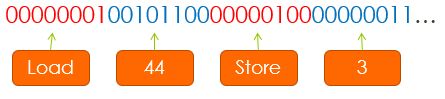
They are fed to the CPU alternately – opcode, operand, opcode, operand, opcode, operand… - 12opcodesEach different CPU has a different set of opcodes
For example (made up):
- 13opcodes continued
- 14opcodes continuedAs each opcode is followed by an operand, instructions are sent to the CPU
For example, 00000010 00001001 would be the instruction “Load 9 into the accumulator” - 15opcodes continuedOne bit in an opcode indicates the Addressing Mode:
Immediate Addressing: The operand is the data to be used
Direct Addressing: The operand is the address of a memory location that contains the data to be used
For example:
00000010 00001001 would be the instruction “Load 9 into the accumulator”
00000011 00001001 would be the instruction “Load the value in memory location 9 into the accumulator” - 16AssemblyProgramming in machine code is very difficult and time consuming
As computers progressed, Assembly language was developed
Assembly simply uses easy to read words for the opcodes, and relies on an assembler to translate each one to its bit pattern to feed to a CPU - 17—
Información
- Descripción
- Fichas sobre machine code, creado por Will Aitkens el 06/01/2020.
- Creado por
- Will Aitkens
- Visitas
- 0
- Valoración