
Computer Architecture and the CPU
1,601 resources created by 1,258 users
This Computer Architecture and the CPU page on GoConqr gathers community-made mind maps, quizzes, flashcards and notes, from the system bus and the fetch, decode and execute cycle to registers, RISC and CISC, and Little Man Computer. It's built for school students revising a topic, university students filling gaps, and teachers after ready-made material. There are over 1,500 resources here, including more than 130 quizzes, over 800 mind maps and more than 400 flashcard decks. Pick a topic, try a quiz to find your gaps, then make your own set.
Top Computer Architecture and the CPU resources
-
31 questionsCPSC313 Midterm Sample 1a) The classic RISC pipeline consists of 5 stages, what are they?
-
70 cardsCSI2334 computer systems fall 2023 how many different characters can be represented with ASCII
-
9 questions1.1.1 Structure and function of the processor What is the general name of the small memory located in a processor?
-
12 cardsChapter 1 Review Questions List and briefly define the four main elements of a computer.
-
15 cardsCPU registers and buses. What are the 3 buses in the CPU?
-
Mind map CPU computer science - CPU
-
Mind map System Bus computer architecture chapter 6
-
Mind map CPU - Components
Quizzes
See all 148 quizzes-
31 questionsCPSC313 Midterm Sample 1a) The classic RISC pipeline consists of 5 stages, what are they?
-
9 questions1.1.1 Structure and function of the processor What is the general name of the small memory located in a processor?
-
200 questionsos What is not a main structural element of a computer system?
-
8 questionsCISC AND RISC Which of CISC OR RISC has more basic hardware?
-
5 questionsLMC questions In the CPU what are registers?
-
106 questionsCSA IITU PART 2 (235) 109. What is a “Kernel” in Cache Memory?
-
118 questionsCSA IITU Part 1 (235) 130. How many bytes equals Petabyte (PB)?
-
95 questionsБАЗА 1(Questions 91-185) A branch-prediction cache that stores the predicted address for the next instruction after a branch
Mind maps
See all 890 mind maps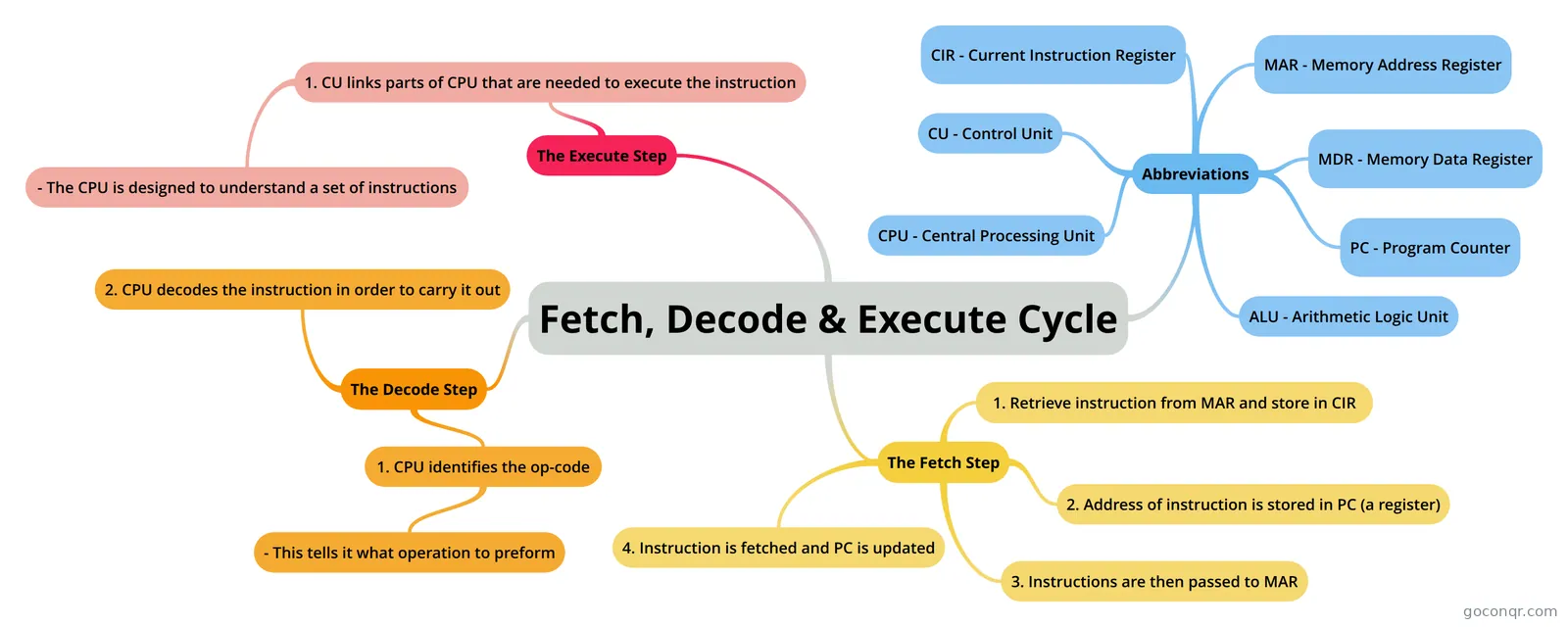
Flashcards
See all 465 flashcards-
70 cardsCSI2334 computer systems fall 2023 how many different characters can be represented with ASCII
-
12 cardsChapter 1 Review Questions List and briefly define the four main elements of a computer.
-
15 cardsCPU registers and buses. What are the 3 buses in the CPU?
-
9 cardsCPU Identify as many ways as you can to increase the performance of your CPU
-
9 cardsCPU and Hardware Flash Cards GCSE Computing CPU + Hardware Revision Cards
-
7 cardsLittle Man Computer terms
-
101 cardsComputer Organization ib slides
-
68 cardsComputer science topic 5 computer oganisation What does the control bus do?
Flowcharts
See all 34 flowchartsNotes
See all 54 notes-
MICROPROCESSOR A Microprocessor -- also known as a CPU or central processing unit -- is a complete computation engine that is fabricated on a single chip. The first microprocessor was the Intel 4004, introd...
-
Von Neumann Architecture Von Neumann Architecture Von Neumann architecture is a way of setting up a computer. Below is an illustrated diagram showing the basic setup Basic facts: Von neumann architecture is a sequential processing machine mea...
-
Harvard Architecture Harvard Architecture Harvard Architecture Disclaimer: I (Charlotte Turner) am in no way responsible for anything written here It got worse after I copied and pasted Von neumann: Most desktop computers Harvard - used t...
-
Memory Memory Mapping•uses the same address bus to access both memory and I/O devices ‒ the memory and registers of the I/O devices are mapped to (associated with) address values. •when an address is accessed by the CPU, it ...
-
Differences Between Von Neumann and Harvard Differences Between Von Neumann and Harvard Difference between Harvard Architecture and Von Neumann architectureHarvard architecture has separate data and instruction busses, allowing transfers to be performed simulta...
-
CPU CPU- central processing unit (the brain)the function of the CPU is fetching and executing of instructions stored in memory.it fetches the memory from the ram and stores it in its own temporary memory.CPU decodes (work...
-
A Level Computer Science CPU:Carries out all the instructions in a computer.Made up of billions of transistors.Clock speed is used to measure the speed at which the CPU works.Clock speed is measured in Gigahertz.Registers are memory locations...
More Computing and ICT (programming, computer science, digital skills, educational technology) topics
About Computer Architecture and the CPU
GoConqr OriginalWhat the resources cover
The page centres on the processor and how it works with memory. The mind map CPU breaks the processor into the Control Unit, the Arithmetic and Logic Unit and primary memory. CPU - Components looks at what the Control Unit does, including timing of operations. System Bus covers the data bus, address bus and control bus, bus hierarchy and PCI Express.
Notes and decks widen the picture. Harvard Architecture and Von Neumann Architecture compare two ways of organising a computer. There are also resources on pipelining, interrupts, NUMA, GPUs and assembly language, including Little Man Computer terms.
Where to start
- Open the mind map CPU to get the main parts in view.
- Move to Fetch, Decode & Execute Cycle, which walks through the fetch step and the registers involved, such as the MAR and the PC.
- Read CPU registers and the deck CPU registers and buses. to fix the vocabulary.
- Add System Bus, then compare RISC vs CISC.
Using quizzes and maps together
Look at a map first, then test yourself. The quiz 1.1.1 Structure and function of the processor asks about registers and how they serve the ALU and CU. CISC AND RISC and LMC questions suit later practice. University students can try the pipeline and memory quizzes from the CPSC313 sets. Wrong answers show you which map to reopen.
Resources mention GCSE Computer Science, A-level Computer Science, OCR A-level Computer Science, AQA AS Computing and IB, so school students can look for material close to their course. Teachers can use maps and decks as ready-made starters.
Where it sits
This unit belongs to the Computer Systems strand of Computing and ICT. It is the place to understand how the processor runs instructions before moving on to other parts of the strand.
Choose one map today, take a quiz on it, and see what you remember.
Frequently asked questions
Which resource should I open first?
Start with the mind map CPU. It sets out the Control Unit, the Arithmetic and Logic Unit and primary memory in one view. Then open Fetch, Decode & Execute Cycle to see how instructions move through the registers. After that, a quiz will show what has stuck.
What do the mind maps on this page cover?
They cover the parts of the CPU, registers, the system bus with its data, address and control lines, the fetch, decode and execute cycle, assembly language, RISC and CISC, memory, GPUs and NUMA. Some are short overviews, others follow university textbook chapters.
Are the resources free to use?
Yes. Every resource listed here is free to open, study and take, with no account needed. They were made by GoConqr users, not by GoConqr itself, so styles and depth vary. A free account lets you save quiz scores and make your own quizzes, maps, flashcards and notes.
Which levels and exams do they suit?
The mix is mostly school-level, with a good share of university material. Listed resources mention GCSE Computer Science, A-level Computer Science, OCR A-level Computer Science, AQA AS Computing and IB. University students will find pipelining and memory quizzes and lecture-based decks.
Is there anything on Von Neumann and Harvard architecture?
Yes. There are notes called Harvard Architecture and Von Neumann Architecture, plus a note on the differences between the two. There is also a quiz called Von Neumann and Harvard, so you can read first and then check your understanding.
What if I can't find the topic I need?
Try related titles, such as registers, buses, pipelining or memory, since topics often appear under several names. If nothing fits, make your own mind map, deck or quiz on the gap. Your own set can be tailored to your course.