
Fichas
Chap.4: Fundamentals of Material Balances

Fichas del conjunto (34)
- 1Batch ProcessThe feed (charge) enters the tank all at once. Once the reaction is complete, the product is removed all at once.
- 2Continuous processfeed is always flowing in with a high amount of reactant and effluent is always coming out with a high concentration of product. (Product is constantly withdrawn from the rxtr)
- 3Semi-batch processNot continuous nor batch
ex. One reactant is added to a vessel and then later, another one is slowly added. - 4Steady-StateA continuous process where process variables like:
-flow rate
-temperature
-pressure, etc...
operate at nominally (by name) consistent values - 5Transient (Unsteady-state)A process with changing process variables. By nature, semi-batch and batch processes are transient while continuous processes could be either or.
- 6General Balance equationInput - Output + Generation - Consumption = Accumulation
- 7Gen. Balance Eqn for Non-reactive systemThere's no generation or consumption in a non-reactive system so:
Input - Output = Accumulation - 8General Balance eqn for reactive processesGeneration and Consumption depend on the balance at hand.
If balance is on a total mass or atomic species, there is no generation or consumption since mass is neither created nor destroyed. - 9FlowchartUsing boxes and other symbols to represent process units and lined with arrows to represent input and output.
- 10ScalingMasses and NOT mass fractions of all streams can be multiplied by a common factor and the process would remain balanced.
*scaling up/ scaling down - 11Basis of CalculationAn amount (in either mass or moles) of flow rate of one stream or stream component in a process. Usually use 1 or 100.
- 12Degrees of FreedomDOF<0 underspecified and not solvable
DOF=0 solution is possible
DOF>0 overspecified and not solvable - 13DOF for non-reactive process+unknowns
-material balances (species)
-relationships
*For multiple units, ensquare each subsystem and do a DOF analysis - 14RaffinateThe phase rich in the diluent (water for example)
- 15ExtractPhase rich in the solvent.
- 16Stoichiometric ProportionThe ratio of two reactants A and B in a balanced eqn.
- 17Limiting reactantA reactant is limiting is it is present in less than its stoichiometric proportion relative to every other reactant.
- 18Fractional ExcessFor percentage excess, multiply by 100.
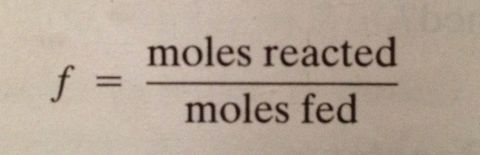
- 19Fractional Conversion
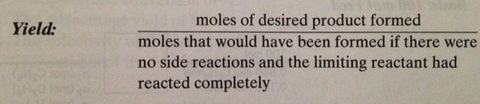
- 20Yield
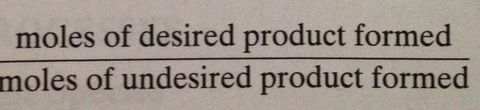
- 21Selectivity
- 22DOF for Reactive Molecular species balance+No. unknown labeled variables
+No. independent chem reactions (cannot mult./add one eqn to get the other)
-No. independent molecular species
-No.relationships - 23DOF for Atomic species balance+No. identified/labeled unknowns
- No. independent atomic species
-No. non-reactive species
-No. other relationships - 24DOF for extent of reaction+No. labeled unknowns
+No. independent chemical rxns
-No. independent reactive species
-No.independent non-reactive species
-No. other relationships - 25CombustionRxn of a fuel with oxygen to produce CO2 and H2O
- 26Partial/Incomplete CombustionA combustion reaction where CO is formed from a hydrocarbon.
- 27Composition on a Wet BasisComponent moles fractions of a gas that contains water.
- 28Composition on a dry basisThe component mole fractions of a gas without water.
- 29Stack gas / Flue gasProduct gas that leaves a combustion furnace
- 30Theoretical OxygenAmount of oxygen produced based on the balanced equation
- 31Percent excess airTrick: If 50% excess, then 1.5 (moles air)theo

- 32Excess airThe amount of air fed to the reactor that exceeds the theoretical air.
- 33Molecular Weight ( MW ) of air29.00 (kg air/kmol, lbm air/lb-mole, etc...)
- 34Composition of Air0.21 mol O2/mol air
0.79 mol N2/mol air
Información
- Descripción
- From Felder and Rousseau
- Creado por
- Amirah Hill
- Visitas
- 62
- Etiquetas
- Valoración