
Fichas
Geochem
Fichas del conjunto (199)
- 1element losing electrons - Oxidizing or reducing?Oxidizing
- 2element losing electrons -Reducing agent or oxidizing agent?Reducing agent
- 3Metals are electron donors or acceptors?electron donors
- 4Non-metals: electron donors or acceptors?Acceptors
- 5Balance redox reaction: Fe + Cl2 -> Fe3+ + 2 Cl-2 Fe + 3 Cl2 -> 2 Fe3+ + +Cl-
- 6Rules for Balancing Reactions1) valance nr of all elements in pure form is zero.
2) valence nr of H is +1 except in metal hydrides (LiH) where it is -1.
3) valance nr of O is -2 except in peroxides (H2O2) where it is -1.
4) sum of valence nr. of netral molecule should be zero, or equal the charge of a charged ion. - 7Why do redox reactions occur?- because elements can attain different valance states
- variable valance states allows elements to participate in many geochem/biochemical reactions
- elements react to geochemical environment and adapt valance state dictated by environment
-valence state of an element controls the physical/chemical properties of these minerals in nature. - 8Describe the process of formation of sandstone hosted uranium deposits1) Oxidizing hydrothermal solutions dissolve U from source rocks and concentrate it in solution as U6+ ions.
2) When U6+ bearing solution encounter a reducing environment, U6+ is reduced to U4+, which is insoluble and thus precipitates as uranium bearing mineral like uranite (UO2) - 9Describe challenges associated with disposal of radioactive waste.- Waste from nuclear power plant contains uranium.
- They are typically stored in canisters at the site.
- Long term goal is to bury the waste in subsurface repositories.
-Need to ensure that the environmental conditions at the repository is not oxidizing so that U is not mobilized easily in the event of a breach in the canisters. - 10Oxidation states of iron.Fe2+ (ferrous iron) - soluble
Fe3+ (ferric iron) - insoluble - 11What are BIFs?Banded Iron Formations
- Are sedimentary rocks that contain at least 15 wt% Fe and that consist of alternating layers of iron (hematite, magnetite) and layers that poor in iron (SiO2 rich layers - chert).
- They are the largest source of iron ore.
- They are thought to have occurred as a result of oxidation of iron initially present - 12Model of BIF formation- Fe is input into oceans from submarine volcanoes.
- In the deep anoxic water Fe2+ is in solution.
-Ocean upwellings cause Fe2+ rich waters upward.
- Fe2+ is oxidized when it reaches oxidizing conditions and Fe is precipitated as Fe3+ bearing minerals.
- The deposition occurs in layers due to the upwellings happing cyclically: periods of Fe deposition alternating with periods of SiO2 deposition. - 13Talk about the oceanic environment needed for BIF deposition.-BIF formation required a stratified ocean: bottom-ocean needed to be anoxic to build high concentrations of Fe2+ in solution.
-This was only possible in an oxygen poor atmosphere.
-When atmosphere became oxygen-rich, oceans became oxygen-rich as well.
-Oxygen-rich oceans cannot have high amounts of dissolved Fe to generate BIF-type deposits.
-Lack of BIFs since 1.8 Ga in rock record indicate that oceans became oxygen-rich by that time. - 14What is acid mine drainage?Outflow of acidic water from metal mines or coal mines.
- 15Causes of acid mine drainage.Accelerated oxidation of iron pyrite (FeS2) and other sulphidic minerals resulting from exposure of these minerals to oxygen and water.
In the oxidation of pyrite equation, SO4 2- and H+ are lost to the environment by movement of water, so the equation never achieves equilibrium and reaction continues until all pyrite is consumed -> lots of H+ is produced. - 16Pyrite oxidation properties:- Pyrite oxidation occurs naturally during pyrite weathering at or near the surface of Earth.
- Pyrite oxidation is accelerated by mining or quarrying.
- Pyrite is the most abundant sulphide and many metals occur chiefly as sulphide ores associated with pyrite.
- Coal deposits contain variable amounts of pyritic-sulphur (generally 1-20%).
- Contaminated water flowing from abandoned coal mines is one of the most significant contributors to water pollution in coal-producing areas. - 17What is emf?emf is force required to push electrons through external circuit.
It is used to characterize flow of electrons. - 18Equation relating ΔG° to E°.ΔG° = nFE°
- 19Why is E° negative and positive sometimes?Because it relates to ΔG° being negative or positive.
- 20Nernst Equation:E = E° + (0.05916/n) logQ
- 21What is Eh?emf generated (total cell voltage) between an electrode in any state and a standard electrode (H2 electrode) in standard state.
- 22Why do we need standard electrode?We can measure the voltage of both sides of a cell, and thus need to use a standard to measure each half cell.
Once standard equals zero, total voltage is known, therefore it must come from the other half cell. - 23Which way do the electrons move when Eh is positive or negative?Eh = +ve
electrons move from SHE to the other electrode
Eh = -ve
electrons move from the other electrode to SHE - 24What type of environment if Eh = +veEh = +ve
electrons move from SHE to the system
oxidizing environment - 25What type of environment if Eh = -veEh = -ve
electrons move from the system to SHE
reducing environment - 26In a reducing environment, are there few or many electrons?many electrons
- 27What are the upper and lower boundaries for in Eh-pH diagrams?They are for water, since it is restricted to these environments.
- 28On a Eh-pH diagram, where do AMD (acid mine drainage), basalt coated in ferric hydroxides and serpentinization plot on Eh-pH diagram.AMD - upper left corner
Basalt - central (~ pH 7) upper (oxidizing Eh>0) part
Serpentinization - to the right (~pH 9-10) lower (reducing Eh<0) part - 29What do Eh-pH diagrams show?Also known as Pourbaix Diagrams.
Show the thermodynamic stability areas of different species in an aqueous solution. - 30What is nucleosynthesis?Formation of nucleus of elements.
- 31Through what nuclear process is nucleosynthesis achieved?Nuclear fusion
- 32What must be overcome in order for nucleosynthesis to occur?repulsion of protons
- 33What conditions are needed for nucleosysnthesis to occur?Very high temperatures needed for fusion to occur.
Conditions on Earth are no favourable for formation of elements. - 34What are the four fundamental forces in nature?1. Gravity
2. Electromagnetic force
3. Weak nuclear
4. Strong nuclear - 35What is electromagnetic force?force experienced by charges
- 36What is weak nuclear force?Force that governs radioactive decay
- 37What is strong nuclear force?Force that holds the nucleus together.
- 38What is the name of the theory that combines electricity, magnetism, weak and strong nuclear forces?Grand Unified Theory
- 39What did Big Bang expand from?Singularity
- 40How old is the universe?13.8 billion yrs
- 41What is the order of decoupling of forces and how long did this process take?1. Gravity decouples from other forces
2. Strong and Electroweak forces
3. Electroweak splits into electromagnetic and weak nuclear force
This was done within first second. - 42After Big Bang, when did first atomic nuclei form?At 3 min after Big Bang
- 43What conditions allowed first atomic nuclei to form?Temperatures were sufficiently low for protons and neutrons to form lighter elements
- 44What are the stages of nucleosynthesis?1. Big Bang Nucleosynthesis
2. Stellar Nucleosynthesis
3. Supernovae or explosive Nucleosynthesis - 45What are other names for Big Bang Nucleosynthesis?Primordial Nucleosynthesis
Cosmological Nucleosynthesis - 46What elements were produced during stage 1 nucleosynthesis and include their percentages?H - 75%
He - 25%
some Li - trace amounts - 47How many isotopes were produced in Big Bang Nucleosynthesis?H - 3 isotopes (proton, deterium, tritium)
He - 2 isotoopes
Li - 1 isotope - 48Theough what process were tritium and 7Li produced?radioactive decay
- 49What is the process leading to the formation of deuterium?neutron + proton -> deuterium + gamma-ray
- 50What is the nucleon gap? Show how it can occur.No stable nucleides of mass 5 and 8.
Hypothetical combination of 1H + 4He leads to mass 5, which is unstable.
Hypothetical combination of 4He + 4He leads to mass 8, which is unstable. - 51When does the formation of galaxies first occur? How were galaxies and stars formed?after 1 billion years
gravitation acted on gas/dust and lead to formation of galaxies, and collapse of molecular clouds formed stars - 52In a few words describe how a star forms.Collapse of interstellar cloud.
Cloud at centre grown dense and becomes the star. - 53How is nucleosynthesis achieved in stars?Gravitational contraction of stars results in heating of the core of the stars where temperatures may reach what is required to fuse hydrogen.
- 54Describe the proton-proton chain reaction.Two protons (p) fuse, forming one deuterium (d).
One p and one d fuse, forming 3He, a light helium nucleus.
Two 3He fuse producing one 4He two p, and energy. - 55In what type of stars does Proton-Proton Chain Rxn occur?characteristic of stars similar in size to Sun, and that only have H and He from primordial nuclosynthesis.
i.e. first generation stars - 56In proton-proton chain reaction, what element is being burned?Hydrogen
- 57What does CNO cycle mean?CNO cycle- Carbon-Nitrogen-Oxygen cycle
- 58What does CNO cycle involve?CNO cycle involves the fusion of 4 protons using C, N, O as catalysts and can only occur in 2nd generation stars that have carbon in them.
- 59What type of star is our Sun and what process does it use?Sun is a 2nd generation star, it has carbon, but it is not hot enough to use CNO cycle, so has only proton-proton process.
- 60Describe the process through which stars go that burn Helium in their core.- 1H becomes depleted in core
- 1H + 1H collisions become too rare to drive PP chain fast enough to maintain thermal pressure
- core collapses
- temperature in core rises to the point where He burning becomes possible
-H fusion could occur as a shell - 61What other name is there for Helium-Burning?Triple - alpha process
- 62Describe Triple-alpha process?Three He atoms are fused rapidly to produce a 12C atom. This requires particle velocities high enough that reaction rate exceeds the decay rate of 8Be.
- 63List the 3 fusion reactions occurring in stars.1. 1He + 3H = 4He
2. 4He + 8Be = 12C
3. 12C + 4He = 16O - 64What is the relationship between the mass of stars and heaviest element fused?They are proportionally related. Heaviest elements can only be fused in stars.
- 65How is the duration of fusion process related to heaviest element fused in stars?As mass of element increases, duration of fusion process decreases.
- 66In a massive star with many layers, what is the order of elements burning in each layer in the star?From outer shell to inner core:
Hydrogen Burning
Helium Burning
Carbon Burning
Oxygen Burning
Silicon Burning
Iron Core - 67What is the heaviest atom produced by stellar nucleosynthesis?56Ni, which decays to 56Co and then to 56Fe.
- 68How are elements heavier than Fe produced?Through Supernoae or explosive Nucleosynthesis.
- 69What are the 2 processes within Supernovae Nucleosynthesis?Neutron Capture Process
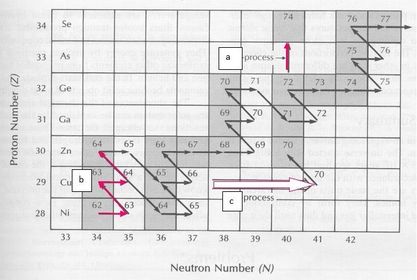
Proton Capture Process - 70What is neutron capture process?It involves addition of neutrons to pre-existing nuclide during supernovae followed by the decay of the neutron-rich nuclide to a new heavier element.
- 71What is s-process?Slow neutron capture.
Rate of addition of neutrons is slow.
After addition of a neutron, nuclear decay occurs. - 72What are the two neutron capture processes?s-process
r-process - 73What is r-process?rapid neutron capture
Involves rapid addition of multiple neutrons to a pre-existing nuclide before nuclide decay occurs. - 74What is p-process? Describe it.addition of protons
Is a proton capture process.
Some nuclides that exist in nature are by-passed by both s-process and r-process and can only be explained by the capture of protons by a pre-existing nuclide. - 75—a) p-process
b) s-process
c) r-process - 76What elements are produced in Big Bang, Stellar Nucleosynthesis, and Supernova Nucleosynthesis?Big Bang - H, He, Li
Stellar Nucleosynthesis - up to 56Fe
Supernova Nucleosynthesis - heavier elements than Fe - 77What is cosmogenic nuclide formation?Cosmic rays interact with atoms in atmosphere or crust to form cosmogenic radionuclide.
This involves the bombardment of nuclides in space or in the atmosphere by cosmic radiation, causing nuclear spallation reactions where nuclides are broken or modified.
ex: 14N + n -> p + 14C
Cosmic radiation is composed of protons, alpha particles, etc that originate from outer space. - 78Cosmogenic nuclide formation is important for the formation of what elements?B, Be, Li
They are produced by cosmogenic interactions in galaxies.
Some Li is produced in Big Bang nucleosynthesis, but B and Be is not produced by Big Bang, Stellar nor Supernova processes. - 79What are the 4 processes by which all elements are produced?1. Big Bang Nucleosynthesis
2. Stellar Nucleosynthesis
3. Supernovae or explosive Nucleosynthesis
4. Cosmogenic Nuclide Formation - 80What are Faunhofer lines?Absorption lines in the visible spectrum of solar radiation produced by absorption of certain wavelengths by elements present in the Sun's photosphere.
- 81What are most primitive materials in the solar system?Meteorites
- 82What is the difference between meteor and meteorite?Meteor - burns up by friction from high speed of entry within atmosphere
Meteorite - lands on surface of Earth - 83Where do meteorites come from?- Asteroid belt - asteroids are thought to be plenetesimals that never combined successfully into a planet
- Comets - from Kuiper Belt and Oort Cloud
- Moon -
- Mars - they are brought from collisions (ejecta) - 84What is the difference between meteorite fall and find?Meteorite fall - specimens recovered from an observed fall of meteorite through atmosphere
Meteorite find - specimens that are not attributed to an observed entry of meteorite into Earth's atmosphere
(most are finds) - 85List the 4 ways of identifying a meteorite?1) Most meteorites have a high metallic iron content and unusually high Ni content. (high density, magnetic)
2) Meteorites often have a thin dark fusion crust.
3) Presence of Regmaglypts. (depressions)
4) Presence of Chondrules. - 86What are Regmaglypts?ablation pits that are often thumb-print like, and that result from atmospheric transport.
- 87What are chondrules?Rounded to sub-rounded aggregates of minerals, glass, and metal.
Are observed in some meteorites. - 88How are meteorites classified?Undifferentiated/unmelted
Differentiated/melted - 89What are undifferentiated/unmelted meteorites?Meteorites from parent bodies that did not undergo metal/silicate differentiation.
- Parent bodies that did not undergo melting to produce a core.
- Are smaller parent bodies. - 90What are differentiated/melted meteorites?Meteorites from differentiated parent bodies that underwent metal/silicate differentiation.
- Parent bodies underwent melting to produce a differentiated core from silica part.
- Are larger parent bodies. - 91What is another name for undifferentiated meteorites?Chondrites
- 92What are the 3 types of Chondrites?a) Carbonaceous
b) Ordinary
c) Enstatite - 93What are some properties of chondrites?- most abundant type of meteorite
- are stony meteorites:
- with some metal in them
- means they are primarily composed of silicate minerals - 94Components in Chondrites.1) Chondrules - spheroidal ultramafic melt droplets (mm size diameter), containing olivine, pyroxene, glass, metal
2) CAI (Calcium Alluminum-rich inclusions) - refractory inclusions (hibonite, perovskite); are direct condensates from solar nebula
3) Matrix - porous, fine-grained mineral matter, often contianing fragments of CAIs and chondules - 95List some properties of carbonaceous chondrites.- contain organic compounds but not necessarily from biological origins
-carbonaceous chondrites have lower abundance of CAIs than other classes.
- -carbonaceous chondrites have lowest metal content. - 96What is meteorite group classification based on (i.e. what does each chondrite group have in common)samples originate from similar parent bodies
- 97What is special about Charbonaceous chondrite Ivuna-type?CI - Are most primitive meteorites, underwent minimal reprocessing and alteration
- 98A property of ordinary chondrites.Most abundant class of Chondrites.
- 99A property of Enstatite-class Chondrites.Most common silicate mineral in them is enstatite.
- 100What are the 2 classes of igneous meteorites?a) Achondrites
b) Irons
c) Stony irons - 101What are achondrites?- A class of igneous meteorites stony meteorites derived from silicate-rich part of a differentiated parent body
- 102What are iron meteorites?-primarily composed of Fe-Ni alloys
- come from segregated metallic iron core of meteorite parent body
- many show complex intergrowths of 2 minerals called Widmanstatten pattern
- basic minerals: komacite, taenite, minor amounts of non-metals and sulfides - 103How many groups of Iron Meteorites?3
- 104What do stony-iron meteorites consist of?Consist of almost equal amounts of nickel-iron alloy and silicate minerals.
Pallasite group consists of: olivine crystals surrounded by nickel-iron
Mesosiderite group consists of: plagioclase and pyroxene silicates intermixed with metal alloy. - 105Which meteorite type gives the most primitive composition?Undifferentiated/unmelted
- 106Why can we use of meteorites as representative of bulk Earth composition?Earth formed from the primitive materials of solar nebula just like the chondrites did.
Chondrites are within the inner solar system, and are good representatives of composition of Earth.
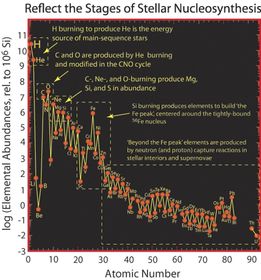
Earth differentiated from chondritic composition. - 107Patterns in abundance of elements in Solar System. (lighter elements)1. H and He are most abundant elements in solar system.
2. Abundances of Li, B, Be are anomalously low compared to other light elements because stellar nucleosynthesis bypasses the formation of these elements - they form by interactions with cosmic rays.
3. Abundances of first 50 elements decrease exponentially. - 108Patterns in abundance of elements in Solar System. (trends and heavy elements)4. Abundance of Fe is notably higher than other elements with similar atomic numbers, due to stability of Fe (highest NBE).
5. Abundance of elements with atomic nr greater than 50 is very low and do not vary appreciably with increasing atomic # - produced by neutron and proton capture
6. Elements with even atomic # are more abundant than neighbouring elements with odd atomic # - Oddo-Harkins rule (due to pairing of e- in shells with even atomic #) - 109—Li, B, Be form from interaction of cosmic rays
- 110Fractionation occurs in what type of minerals?- Major and minor elements
- Trace elements
- Isotopes - 111When can fractionation occur?- during melting and crystallization
- during weathering - 112What is the definition of compatible and incompatible elements?Compatible elements - Elements that preferentially partition into minerals
Incompatible elements - Elements that preferentially partition into melt - 113Give an example of an element fractionated during weathering?i.e. % SiO2 is less in saprolite than in original rock.
- 114Definition of a major and minor element.Major element - abundance of wt% > 1
Minor elements -
abundance between 0.1 and 1 wt % - 115Important uses of major elements in geochem?1) Classification
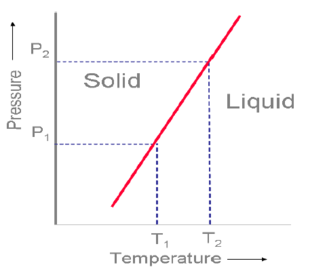
2) Using chemical composition to understand processes. - 116Draw the melting curve of a pure solid.
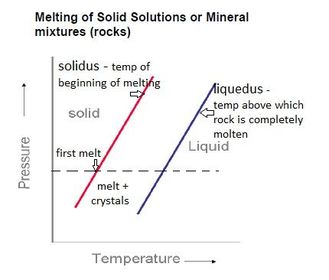
- 117Draw the melting curve(s) of solid solutions or mineral mixtures.
- 118How do different types of elements fractionate during partial melting?Fusible elements cluster in melt.
Refractory elements cluster in residue. - 119What are the processes leading to variation in chemical composition of igneous rocks?1. Partial melting - not a magma differentiation process
Magma differentiation processes
2. Fractional Crystallization
3. Assimilation
4. Magma mixing - 120State definitions of magma differentiation processes.1. Fractional crystallization - removal of crystals from a magma can produce residual melts of different chemical compositions.
2. Assimilation - incorporation of country rocks into melt during melt transportation or emplacement.
3. Magma mixing - mixing of melt from different sources to produce a hybrid melt. - 121State definitions of primary, primitive/parental and evolved magmas.Primary magma - magma that has not undergone any differentiation.
Primitive/Parental magma - most primitive magma composition in a suite of generally related rocks from which other rocks evolved by differentiation (represents least amount of differentiation in a magma suite)
Evolved magma - magma hat has undergone a significant degree of differentiation. - 122Plot primary, primitive/parental and evolved magmas.
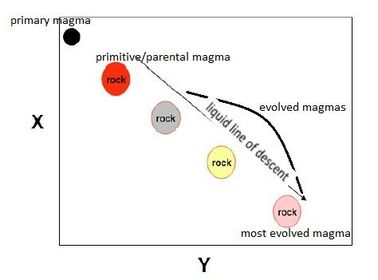
- 123What are Harker Diagrams?Are bivariate plots of elements or elemental oxides of igneous rocks.
Are used for a suite of related rocks, and can tell us processes that occurred during the evolution of the magma.
Trends on Harker Diagrams imply that the rocks are genetically related.
Bends/kinks in liquid line of descent indicate a change in the fractionating mineral assemblage. - 124Definition of trace elements and some characteristics.Trace elements are present in a rock in concentrations less than 0.1 wt%.
- Do not form minerals of their own.
- Substitute for major elements in mineral structures.
- Their substitution depends on affinity of a mineral to a particular trace element or vice versa. - 125What is bulk distribution (partition) coefficient equation?D = ∑WKd
where:
WA = weight fraction of the mineral A
Kdi = partition coefficient of element i in mineral A - 126What are LILE elements?LILE = Large Ion Lithophile Elements
i.e. Cs, Rb, K, Ba, Sr, Pb
- are cations with z/r ratio < 2
- large ions with small charge, which makes them incompatible
- are mobile during weathering, can be transported by fluids - 127What are HFSE elements?HFSE = High Field Strength Elements
i.e. Sc, Y, Th, U, Pb, Zr, Hf, Ti, Nb, Ta, REE
- have z/r ratio > 2
- small cations with larger charges
- incompatible due to their high charge
- are not mobilized in fluids, not mobile in weathering (insensitive to weathering) - 128What are REE?REE = Rare Earth Elements
i.e. La, Ce, Pr, Nd, (Pm), Sm, Eu, Gd, Tb, Dy, Ho, Er, Tm, Yb, Lu
- are HFSE elements
- usual valence state 3+
- incompatible, except in specific minerals
- different REE have different behaviours
- nearly insensitive (immobile) to weathering - 129Breakdown of REE elements.
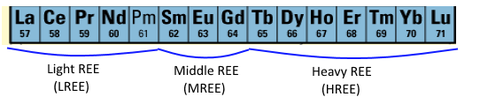
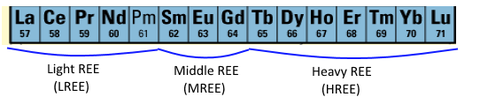
- 130What is the compatibility of REE elements?REE are incompatible.
But HREE are slightly more compatible than LREE due to their smaller size. - 131What is this trend called?
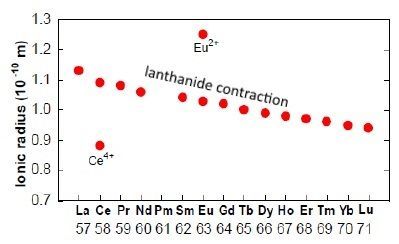
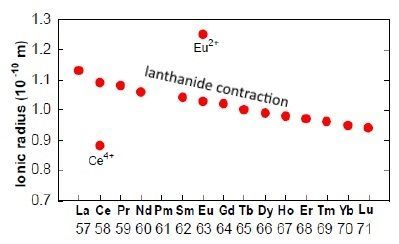
- 132Describe the trends in these REEs.HREE are compatible in garnet and to some extent in amphiboles.
HREE in general are slightly more compatible.
Europium in Eu2+ state can substitute for Ca2+ in plagioclase structure, therefore Kd for Eu is higher than neighbouring Sm and Gd.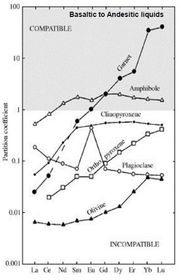
- 133How do you remove Oddo-Harkins effect in REE diagrams?Divide concentration of REE in rock by REE concentration in chondrites (normalized to concentrations in chondrites).
- 134Descibe REE pattern.a) highly fractionated REE pattern (LREE separation from HREE occurred during the formation of the sample).
b) moderately fractionated REE pattern; enrichment in LREE and some depletion in HREE.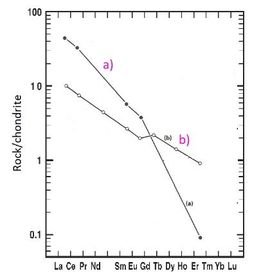
- 135Describe REE pattern.LREE depleted with flat MREE-HREE pattern.
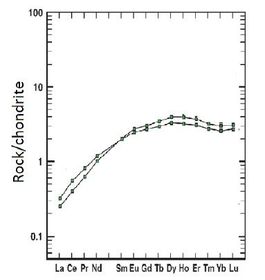
- 136—left: negative Eu anomaly
right: positive Eu anomaly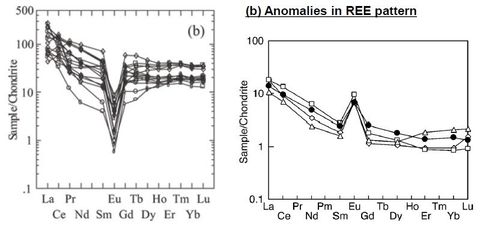
- 137What processes can cause fractionation in REE?Fractional crystallization
Partial melting - 138—Because of the degree of melting and fractionation processes involved in MORB and OIB, the differences in REE pattern indicate nature of source region.
OIBs (Ocean Island Basalt) are derived from a LREE-enriched (more fertile) mantle.
MORB (Mid-Ocean Ridge Basalt) is generated from LREE depleted mantle, a mantle that has undergone previous melt extraction.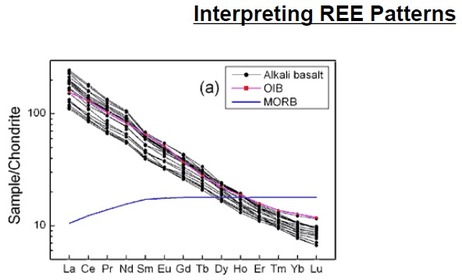
- 139What are Spider Diagrams?are multi-element diagrams that consider all incompatible elements, both LILe and HFSE.
- 140Describe similarities/ differences in patterns.MORB-normalized spider diagrams for subduction-zone basalts.
SZ basalts exhibit similar trace element patterns regardless of their location.
Similarity in pattern indicate similarity in processes that produce them.
SZ basalts are enriched in LILE relative to MORB.
Similar abundance in HFSE in MORB and SZ basalts.
Decoupling of LILE and HFSE during SZ basalt formation.
SZ basalts show negative Nb, Ta anomalies, sometimes also in To.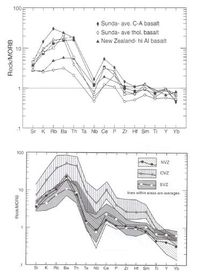
- 141Source of differences in SZ and MORB spider diagrams?LILE are enriched in the mantle source region of basalts in SZ by fluids from the subducting oceanic crust.
HFSE is not affected during this hydration process.
Negative Nb, Ta anomalies are thought to result from fractionation of minerals like titanite and/or rutile in which these elements are compatible.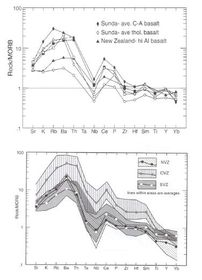
- 142Similarities/differences in patterns leading to what conclusions?Left:
No Nb, Ta anomalies
Both LILE and HFSE are abundant relative to MORB
Conclusion:
indicate that OIBs are generated from a fertile mantle source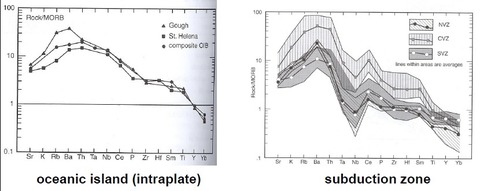
- 143What controls element fractionation in nature?Electronic structure,
which determined ionic radii and charge, which in turn controls compatibility of an element in a given structure. - 144What controls isotopic fractionation in nature?Magnitude of fractionation controlled by mass difference between two isotopes.
Also, fractionation is stringer at lower temperatures. Lighter elements vibrate more vigorously at lower temperatures, and equally as much as heavier elements at higher temperatures. - 145How is relative mass difference calculated in isotopes?(heavy mass - light mass) / (light mass)
- 146What are difference in extent of isotopic fractionation between lighter and heavier elements attributed to?Relative mass difference between isotopes of heavier elements are much smaller than those of lighter elements. Thus in nature, isotopes of lighter elements are fractionated more than isotopes of heavier elements.
- 147What is radioactive decay rate dependent on and independent from?Decay rate is dependent only on energy state of nuclide.
Decay rate is independent of pressure, temperature, and chemical composition. - 148What are the types of radioactive decay?1. Beta decay
2. Positron decay
3. Electron capture decay
4. Alpha decay
5. Nucler fission - 149Describe beta decay, write formula and give an example.Is decay of a neutron into a proton and an electron (called negatron).
This electron is ejected from nucleus along with energy in the form of anti-neutrino.
neutron → proton + ß− + ν-
- 150For beta decay, in which direction move the isotopes on the diagram? Where is negatron emission on diagram compared to valley of stability ?Diagonally up and to the left.
below valley of stability - 151Describe positron decay, write formula and give an example.Is decay of a proton into a neutron and a positively charged electron (called positron).
This positron is ejected from nucleus along with energy in the form of neutrino.
proton → neutron + ß+ + ν
- 152For positron/electron capture decay, in which direction move the isotopes on the diagram? Where is positron emission/electron capture on diagram compared to valley of stability?Diagonally down and to the right.
below valley of stability - 153Describe electron capture decay, write formula and give an example.An electron from inner electronic shell is captured by the radioactive nuclide.
The captured electron combines with proton in nucleus to form a neutron.
- 154What is the difference between positron decay and electron capture decay.Positron decay occurs in isotopes when there is a large difference in energy between parent and daughter product.
Electron capture occurs when energy difference is small between parent and daughter. - 155What is another name for beta decay, positron decay, electron capture decay?Isobaric decay. - produce isobar of original parent nuclide.
- 156Describe alpha decay and give an example.Involves the ejection of alpha particles (equivalent to 2^4He nucleus).
Occurs typically in heavier nuclides that are quite further away from the valley of stability.
Parent and daughter differ in mass by 4.
- 157For alpha decay, in which direction move the isotopes on the diagram?Down and to the left of parent isotope, with difference of 4.
- 158What is nuclear fission?Spontaneous nuclear fission - nucleus breaks into two fragments of unequal weight, forming two fission product nuclei
neutron + nuclide -> 2 nuclides + 3 neutrons - 159How are gamma rays produced during radioactive decay?After radioactive decay, the daughter isotope is left in an excited state and as the daughter isotope drops down in energy to its ground level, it emits gamma rays.
- 160What is decay constant?probability that a given radioactive nuclide will decay at a given time.
is measured experimentally
units = /yr - 161Write-out the derivation of radioactive decay equation.Look in notes.
- 162What is the geochronological equation?
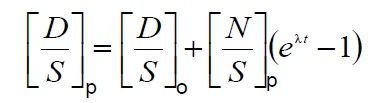
- 163How are isotopic abundances reported?Parent and daughter isotopes are measured with mass spectrometers which only measure ratios accurately, thus a third stable, non-radiogenic stable nuclide of daughter isotope is used to present isotopic abundances as ratios.
- 164What are some methods of radiometric dating?1. Assume Do is zero.
2. Isochron Method
3. U-Pb Condordia Method
4. Radiocarbon dating - 165Discuss the "Do is zero assumption" in radiometric dating.It is valid if when a mineral forms the daughter element is not incorporated into the mineral structure.
i.e. 40K -> 40Ar
Ar being a gas is exluded from the lattice of most mineral at the time of formation. So ay Ar in mineral can be assumed to be from decay of 40K. - 166Discuss isochron method for radiometric dating.It i useful in cases where some daughter element is incorporated into the material (mineral or rock).
Co-genic samples will fall along a straight line called isochron, which is proportional to age.
Slope of line = e^(λt) -1 and can be used to solve for t.
Intercept gives us (D/S)o - initial daughter isotopic composition.
Because isotope fractionation is negligible for low mass difference and because isotopic fractionation is low at high temp, minerals crystallizing from same magma will have same initial daughter isotope composition. - 167Draw a labelled graph for isochron method.
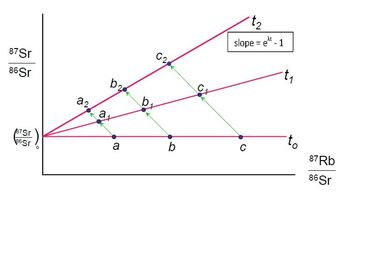
- 168Name the different types of isochron lines.mineral isochron
whole rock isochron
mixed isochron - 169What are some assumptions in radiometric dating?1. The number of parent and daughter atoms have changed only by decay of parent to daughter (ie no diffusion of parent or daughter)
2. No daughter isotope was present in the system to start with, or if some was present, the amount can be determined.
3. The decay constant is known accurately.
4. The analytical data are accurate. - 170What is half life? Give formula for it. Typical number of half-lives that can be measured.Time it takes for half of parent isotope to decay to daughter isotope.
T = 0.693 / λ
~ 7-8 - 171In general, decay scheme with what type of half-lives are used for dating older and younger rocks?For old rocks, use isotopes with longer half-lives.
For younger rocks, use isotopes with shorted half-lives - 172Describe C-14 production and pathwayCosmic rays interact with N-14 to produce C-14.
Since C-14 is highly reactive, it reacts with oxygen to produce CO2.
Plants, animals and humans acquire C-14.
While organisms are alive, they continue to intake C-14, so 14C/12C ratio is fixed in organisms, but when organisms die they do not take in C-14 anymore and radioactive clock starts. - 173How is age calculated by radiocarbon dating (i.e. what formula used)?
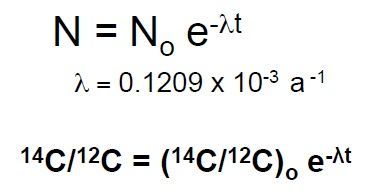
- 174What is typical limit of carbon-14 dating?~45,000 years, but improvements in technology have pushed the limit past 50,000 yrs, and even to 60,000 yr.
- 175What is carbon-14 dating used to date?- archaeological, paleotological events
- can use charcoal, wood, seeds, nuts, grass, paper, bone, shells, etc. -> organic materials
- cannot be used to date inorganic materials - 176What are some issues with carbon-14 dating?Variations in cosmic ray flux:
Production rate of C-14 has not been constant, inferring that cosmic ray flux has not been constant, due to variations in the intensity of Earth's magnetic field over time.
Human activities:
Atomic bomb tests in the '50s and '60 more than doubled C-14 in atmosphere.
CO2 from combustion of fossil fuels is enriched in C-12, leading to a decrease in 14C/12C ratio since industrial revolution, especially in the last 50 yrs. - 177How is Carbon-14 calibrated?Raw carbon age (non-calibrated) are reported in yrs before present (BP), that is nr of carbon yrs before 1950.
Radicarbon calibration is performed by C-14 dating samples that can also be dated by independent, absolute dating methods.
Samples used for calibration:
1. tree rings
2. macrofossils from anually laminated sediments (corals)
3. spaleotherms - cave deposits - 178What exactly is dated using isotopic systems (i.e. the calculated age is the age of what event)?Age that is calculated is time at which a mineral becomes closed to diffusion of parent and daughter isotopes.
We date the time at which closure temperature is reached. - 179How can cooling rate be determined through radiometric dating?Knowing closure temperature of various minerals, through radiometric dating we establish their age (time of closure of minerals), and by comparing the age of these minerals, we can compute a cooling curve.
- 180How can metamorphic event be determined through radiometric dating?Isotopic systems are disturbed if rocks are heated above closure temperature of minerals used in radiometric dating.
Minerals that remain closed the entire lifetime of rock give original time of crystallization.
Metamorphic event can be dated if temperature reaches higher than closure temp of a mineral, provided that all daughter left the system at that time (full disturbance).
Age is meaningless if isotopic system was partially disturbed, but if system was completely reset, then mineral gives time of metamorphic event. - 181Minerals with what type of closure temperature are preferentially used for radiometric dating?minerals with high closure temp
ie zircon for U-Pb dating - 182What are some types of disturbances that can occur in isotopic systems, and what are their effects on the derived dates?
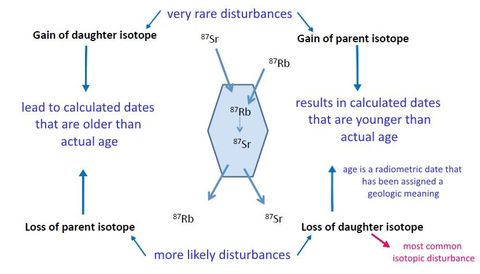
- 183What is secular equilibrium?Condition in which isotopic decay of intermediate daughters is the same as the parent isotope.
Once secular equilibrium is reached in a decay chain, parent isotope can be considered to decay directly to the final stable daughter.
Secular equilibrium is only attained if the half life of parent is much larger than the intermediate daughter isotopes. - 184What are concordant / discordant dates in U-Pb, Th-Pb? What causes disturbance, and what type most commonly occurring?There are 3 decay schemes which can yield 3 independent rock age determinations.
If all the date agree with each other, they are concordant.
If dates disagree, they are discordant.
Cause of disturbance: isotopic system did not remain closed.
Type of disturbance: loss of Pb or intermediate doughters - 185Why is zircon commonly used for U-Pb dating?- high closure temp
- does not incorporate initial daughter
- incorporates uranium when forming
- very hard, stays intact as rock eroded/transported, survives in sedimentary rocks for very long time
- common accessory mineral in igneous and metamorphic rocks - 186What does U-Pb concordia curve show?Curve that shows the evolution of Pb in a uranium bearing system that remains closed.
- 187If a point falls on the concordia curve, what does that mean?A system that has remained closed to differences in U and Pb will fall on the concordia curve.
A concordant point on curve directly gives the age of crystallization of grains. - 188What is discordia line?A line that connects analytical points that are discordant.
- 189Discuss discordia graph, ie intercepts, points on/off curve.
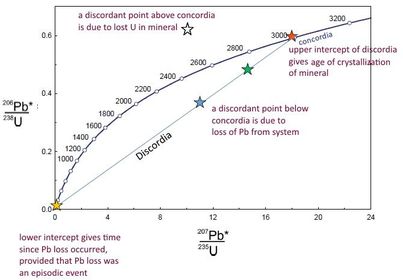
- 190What is the difference between episodic versus continuous Pb loss?Episodic loss:
Loss of Pb is associated with a specific time, like a metamorphic event.
Continuous loss:
Loss of Pb is continuous from mineral. - 191Advantages of U-Pb concordia method?Two different isotopic decay systems offer as a check to each other.
Meaningful geochronological info can be derived even if system behaved as an open system (as long as it was an episodic event). - 192What are the properties of some commonly used isotopes by stable isotope geochemists? Give some examples.1. They have low atomic mass.
2. The relative mass difference between isotopes is large.
3. Abundance of the rare isotope is sufficiently high (tenths of a percent) to facilitate analysis.
ex: H, C, N, O, S - 193What influences the way different isotopes respond to physical processes?Differences in vibrational energy
Differences in bond strength - 194What influences the way different isotopes respond to physical processes?Differences in vibrational energy
Differences in bond strength - 195Heavy isotopes make ... chemical bonds than lighter isotopes.Stronger
- 196What are the 2 different types of mass dependent isotope fractionation?1) Equilibrium Isotope Fractionation
2) Kinetic Isotope Fractionation - 197What is equilibrium isotope fractionation?Isotopic fractionation that occurs during reversible reactions at equilibrium (ie when phases are in equilibrium with each other).
- 198What is the governing rule of equilibrium isotope fractionation?Heavy isotopes make stronger chemical bonds than light isotopes and thus prefer to be in a phase where bonding is strong.
- 199Equilibrium isotope fractionation between 2 phases is based on differences in what?Bond strength of different isotopes of an element.
Información
- Descripción
- 1 Geochem Fichas sobre Geochem, creado por f390de84 el 05/04/2015.
- Creado por
- f390de84
- Visitas
- 129
- Valoración