
Fichas
Earth Sciences Exam Revision
Fichas del conjunto (33)
- 1Name and Describe the features of the UniversePlanets
Stars
Nebula
Galaxies
Atomic gas
Asteroids/meteors/comets
Moons
Dust
Ice - 2Origins of the UniverseThe universe has always existed and we see space as it was in the past and what it will look like in the future
The big bang theory states that the universe was very small and compact until one day it exploded and formed the universe as it is today - 3What is the closest star to earththe closest star is 150 million km
(approx. 6 months to reach in a shuttle)
Approx. 88 l.y. away - 4What is the second closest star to earthThe next closest star to us is 41 Trillion km away
- 5What is a light yearthe distance that light will travel in one year
- 6How do you calculate a light yearno. of secs in a min x no. of min in a day x no. of hrs in a day x no. of days in a yr
e.g. l.y. = 60 x 60 x 24 x 365.25 = 31 557 600 sec or 3.1 x 10⁷S - 7How is distance of a light year calculatedd = 3.1 x 107 x 3 x 108 = 9.5 x 10 to the 15th meters
- 8how many light years does it take to reach the furthest starThe furthest star is 360 light years away
- 9when you look at stars are you looking back in timeyes, the light transmitted from the closest star of the southern cross left that star approx. 88 years ago
- 10whats another way of calculating light yearsanother commonly used astronomical unit of length is the parsec, equivalent to 3.26 l.y.
Distance in Parsecs = dis. in l.y. over 3.26
to convert from parsecs to l.y. multiply by 3.26: distance in l.y. = dis. in parsecs x 3.26 - 11What are some of the constellations that you can nameCorona Australis
Southern cross
Saucepan
Leo
Orion
Taurus
Aquarius
Scorpio
Pisces
Emu - 12How are stars named based on their brightnessThe brightest star is called the alpha star
The second Beta
Then Gamma
Then Delta
etc - 13What are stars made up ofhydrogen
helium
boron
carbon
nitrogen - 14What is the fusion reactionreaction that occurs in stars involves the fusion of hydrogen nuclei to provide helium
fusion reactions occur in the sun where 655 million tonnes of hydrogen are converted to 650 million tonnes of helium every second
the 5 million tonnes of hydrogen that is used up releases 4.5 x 10 to the 26th joules of energy every second
that's enough to power all Australia's power stations for 7 billion yrs - 15What's Einstein's conversion from mass to energyE=mc2
E = energy
M = mass
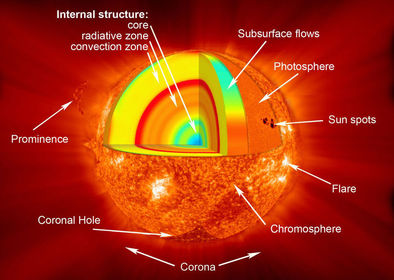
C = speed of light - 16Label the parts of the sun
- 17Color and Temperature of StarsThe hottest stars give off a white to blue light
The coolest stars give off a red light
astronomers are able to calculate the surface temperature of stars by measuring the wavelength of light given off, hotter objects emit shorter wavelengths and they will appear to be bluer in color and vice versa - 18What law is used to calculate the temperature of starsWein's law is used to calculate the temperature of stars
- 19Brightness and size of starsThe brightness and the color of the star are important factors in determining the size and life expectancy of the star
the brightness is determined by the size of the star, larger stars are brighter - 20Life cycles of starsStars are born in nebulas
Protostars are formed
stars of small size follow a path that turns them into red giants, the life of the small star then leads them to being a small dwarf planet and it will eventually die out
medium size stars grow until they are red supergiants, after that a supernova is formed and medium stars will turn into a neutron star
large size stars also turn into red supergiants and after their life supernovas are formed and then a black hole is formed - 21Name the earth's four spheres(Moving outwards from earth) Troposphere, Stratosphere, Stratopause, Mesosphere, Mesopause, Thermosphere
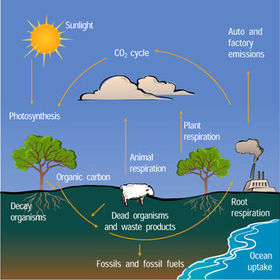
- 22The Carbon Cycle
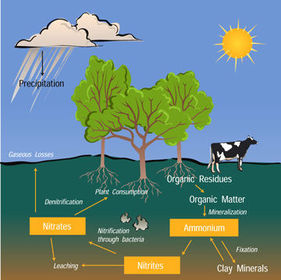
- 23The Nitrogen Cycle
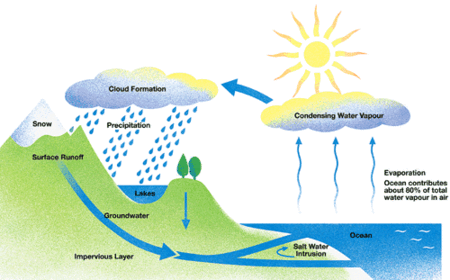
- 24The Water Cycle
- 25Troposphere's characteristicsTroposphere - layer is unstable and contains most of the atmosphere’s water vapour, dust, cloud and pollution. the temperature decreases on average by 6.4 degrees c with every 100m increase in altitude.
- 26Stratosphere's CharacteristicsStratosphere - steady increase in temperature caused by ozone (O3) Ozone absorbs incoming ultra-violet radiation from the sun. Protests earth from meteorites which usually burn out before they enter the earth’s gravitational field
- 27Mesosphere's Characteristic'sMesosphere - due to no vapor, cloud, dust or ozone to absorb incoming radiation, there’s a rapid drop in temperature. Coldest layer of the atmosphere at -90 degrees and strongest winds, nearly 3000km per hr
- 28Thermosphere's characteristicsThermosphere - temperatures rise rapidly to as much as 1500 degrees c, this is because of increased amounts of atomic oxygen which absorbs incoming ultra-violet radiation.
- 29Atmosphere's gasesAtmosphere gases: Nitrogen 78%, Oxygen 21%, Argon 0.9%, other gases like carbon dioxide, helium and ozone 0.1%
- 30Ozone Layer's characteristicsfound naturally with other gases in the atmosphere and its concentration is greatest in the lower stratosphere. Ozone molecules are formed when UV radiation from the sun strikes an oxygen molecule. With a series of reactions ozone is formed and splits apart absorbing UV in the process.
- 31The Greenhouse EffectThe greenhouse effect is a natural process that warms the Earth's surface. When the Sun's energy reaches the Earth's atmosphere, some of it is reflected back to space and the rest is absorbed and re-radiated by greenhouse gases.
- 32The enhanced greenhouse effectreferred to as climate change or global warming, is the impact on the climate from the additional heat retained due to the increased amounts of carbon dioxide and other greenhouse gases that humans have released into the earths atmosphere since the industrial revolution.
- 33Climate change - evidence of and impacts such as sea level risea change in global or regional climate patterns, in particular a change apparent from the mid to late 20th century onwards and attributed largely to the increased levels of atmospheric carbon dioxide produced by the use of fossil fuels. The ice in Antarctica used to be 3 to four times as large as it is today, now its growing smaller because of greenhouse gasses being released and affecting the ozone layer which is making the ice melt in Antarctica because of how thin the layer is above Antarctica.
Información
- Descripción
- Year 10 Earth Science Fichas sobre Earth Sciences Exam Revision, creado por Olivia Gniadek el 22/11/2015.
- Creado por
- Olivia Gniadek
- Visitas
- 8
- Etiquetas
- Valoración