
Fichas
F214.4 Respiration Biology Revision Cards
Fichas del conjunto (36)
- 1Why do living organisms need to respire?Organisms need to respire to release the energy to make ATP. This drives their biological processes or metabolism. Metabolic processes include active transport, secretion, endocytosis and movement.
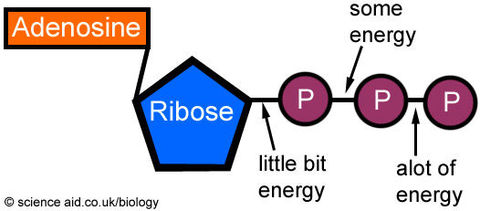
- 2What is the structure of ATP?
- 3What are the stages of aerobic respiration?1. Glycolysis
2. The Link Reaction
3. The Krebs Cycle
4. Oxidative Phosphorylation - 4What happens when an ATP is hydrolysed?The molecule splits into an ADP molecule and a phosphate molecule (Pi)
- 5Where does glycolysis take place?In the cell cytoplasm
- 6What is used up during glycolysis?A glucose molecule and two ATP molecules
- 7What is created during glycolysis?2 ATP molecules (although 4 are actually created but two are used up), 2 reduced NAD molecules and 2 molecules of pyruvate.
- 8What are the four stages of glycolysis?1. Formation of hexose 1,6-bisphosphate
2. Splitting of hexose 1,6-bisphosphate
3. Oxidation of triose phosphate
4. Conversion of triose phosphate - 9What happens during stage 1 of glycolysis?Glucose is converted to glucose-6-phosphate by adding a phosphate group. This is changed into fructose-6-phosphate. Another phosphate group is added forming fructose 1,6-bisphosphate. This is then converted into hexose 1,6-bisphosphate.
- 10What happens during stage 2 of glycolysis?The hexose 1,6-bisphosphate is split into two molecules of triose phosphate (TP)
- 11What happens during stage 3 of glycolysis?The triose phosphate is oxidised to a three carbon compound by removing two electrons (which are accepted by NAD) and in the process creates an ATP molecule
- 12What happens during stage 4 of glycolysis?The 3 carbon compound undergoes four enzyme catalysed reactions converts it to pyruvate. This also forms an ATP molecule.
- 13Why are co-enzymes important for respiration?They aid oxidation and reduction reactions, as enzymes aren't good at catalysing them. NAD accepts two hydrogen atoms to become reduced NAD and carries these to the electron transport chains. Coenzyme A carries acetate from the Link Reaction to the Krebs Cycle.
- 14Describe the structure of a mitochondria
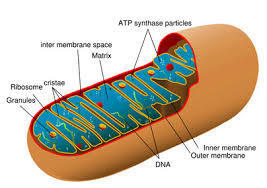
- 15How is the outer membrane of the mitochondria adapted to its role?It contains many channel proteins and carriers which allow pyruvate into the mitochondria from the cell cytoplasm.
- 16How is the inner membrane of the mitochondria adapted to its role?It is impermeable to protons so in chemiosmosis it ensures that the protons only flow through the ATP synthase particles, meaning ATP is generated effectively. The cristae increase surface area so there are more electron chains. There are electron carriers and ATP synthase channels embedded in the membrane.
- 17How is the matrix of the mitochondria adapted to its role?The Link Reaction and Krebs cycle take place here so they contain the enzymes to catalyse these reactions. NAD, oxaloacetate, mitochondrial DNA and ribosomes are all found here.
- 18What is an electron carrier?An enzyme that is associated with a co-factor. These co-factors are haem groups and contain iron ions. These can accept and donate electrons because they can change oxidation state.
- 19Where does the Link Reaction and the Krebs Cycle take place?In the mitochondrial matrix.
- 20What enzymes are involved in the link reaction? What starts the link reaction?The pyruvate is actively transported to the mitochondria.
Pyruvate dehydrogenase removes hydrogen atoms from pyruvate (with NAD).
Pyruvate decarboxylase removes a carboxyl group (which become CO2) - 21What roles do NAD and Coenzyme A play in the Link Reaction?NAD accepts hydrogen atoms becoming reduced NAD.
CoA accepts acetate becoming acetyl coenzyme A, which is transported to the Krebs Cycle. - 22What are the products of the link reaction? (per glucose molecule)2 x Carbon Dioxide
2 x Reduced NAD
2 x acetyl CoA - 23Describe the Krebs Cycle
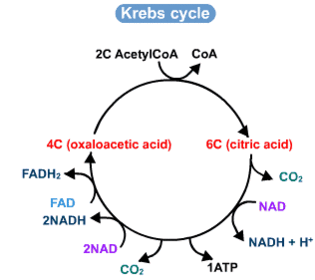
- 24What are the products of the Krebs Cycle? (per glucose molecule)4 x Carbon Dioxide
2 x ATP
6 x Reduced NAD
2 x Reduced FAD - 25Which is the first electron carrier?Complex 1- accepts electrons from reduced NAD , whilst the protons go into the matrix.
- 26Describe ChemiosmosisAs the electrons travel through the electron carriers, energy is released. This energy causes protons to be pumped from the matrix into the intermembrane space. Once here a proton gradient builds and there is a large amount of chemical potential energy. The protons can only leave the intermembrane space via channels associated with the enzyme ATP synthase.
- 27Describe Oxidative PhosphorylationAs the protons flow through the ATP synthase channels they cause part of the molecule to rotate, meaning that ATP is fromed from ADP and Pi. This only occurs in the presence of oxygen.
- 28How is water formed in Oxidative Phosphorylation?Once the electrons have left the electron transport chain they combine with the oxygen in the matrix and the protons which have been pumped back into the matrix, forming water.
- 29What happens to the reduced FAD in Oxidative Phosphorylation?The electrons are not used for chemiosmosis (only those from reduced FAD do that) but they (and the ones from reduced NAD) combine with protons and oxygen to form water. And also take part in the electron transport chain.
- 30Theoretically, how much ATP can be made from one glucose molecule?The 10 molecules of reduced NAD (two from glycolysis, two from the link reaction and six from the Krebs Cycle) can produce 26 ATP molecules. Two ATP molecules are also made in glycolysis and two are made in the Krebs cycle, meaning the theoretical value is 30.
- 31Why is the theoretical yield of ATP rarely achieved?Some protons leak across the membrane in oxidative phosphorylation meaning there is less proton force to drive the reaction of making ATP. Some ATP is also required to actively transport the pyruvate and reduced NAD from the cytoplasm to the mitochondria.
- 32Why does anaerobic respiration occur?Where there is no oxygen available, it cannot act as the final electron acceptor, meaning that the Link Reaction, the Krebs Cycle and Oxidative Phosphorylation all stop, leaving only glycolysis.
- 33Describe lactate fermentation.This process occurs in animals (like humans). The pyruvate created from glycolysis accepts the hydrogen atoms from the reduced NAD, meaning that more hydrogen can be accepted and glycolysis can continue. This produces two molecules of ATP. Lactate is also formed which is stored in the liver until oxygen is available. The reaction is catalysed by lactate dehydrogenase.
- 34Describe alcoholic fermentationPyruvate is decarboxylase using pyruvate decarboxylase (not found in animals) and a CO2 is removed, producing ethanal. The ethanal is then oxidised to ethanol using the enzyme ethanol dehydrogenase, which accepts hydrogen from reduced NAD. The NAD can then accept more hydrogen, producing some ATP. This occurs in fungi, like yeast.
- 35Respiratory Substrate (definition)An organic substance that can be used for respiration.
- 36Which molecules have the highest energy values as respiratory substances?Lipids > Proteins > Carbohydrates
The more protons a molecule has, the more these protons can flow through ATP synthase channels creating more ATP.
Información
- Descripción
- A Levels (A2 Biology) Biology Fichas sobre F214.4 Respiration Biology Revision Cards, creado por Laura Perry el 07/05/2016.
- Creado por
- Laura Perry
- Visitas
- 28
- Etiquetas
- Valoración