
Fichas
Hydrosphere
Fichas del conjunto (26)
- 1THE HYDROSPHERE Water on EarthWhen the Earth cooled down until, around 4 billion years ago, water vapour condensed and precipitated. This created primitive seas and oceans.
- 2Earth: water in three statesThe mass of water that forms part of the Earth's surface is called the hydrosphere. This includes water in all three states:
- Solid: Glaciers (snow and ice)
- Liquid: Oceans, seas, rivers, lakes and groundwater.
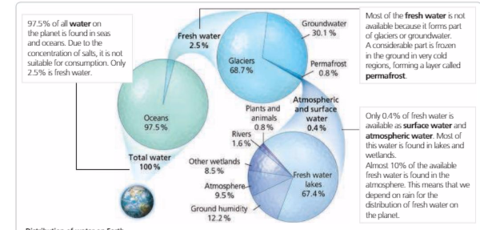
- Gaseous: Water vapour. Atmosphere. - 3Distribution of water on Earth
- 4Salt waterThe water in seas and oceans is call salt water and has an average salinity of 35 grams of salts for every litre of water (35 g/L).
- 5Fresh waterFresh water includes water that has an average salinity lower than 35 g/L.
- 6GlaciersGlaciers arte the biggest reserves of fresh water on Earth.
- Ice sheets: Continental-sized pieces of ices. Greenland or Antartic.
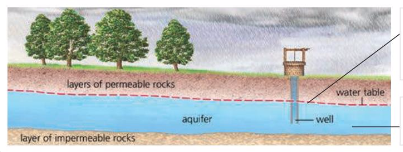
- Valley glaciers: High mountain areas. - 7Groundwater
- 8Surface water- Lakes and lagoons
- Wetlands
- Rivers
- Torrents - 9Properties of waterWater is a molecule formed by the combination of two hydrogen atoms and one oxygen atom (H2 O).
Pure liquid water is a colourless, odourless and tasteless.
At room temperature, water is liquid. - 10Changes of waterWhen water is heated:
- Fusion: Solid to liquid.
- Sublimation: Solid into gas.
- Vaporisation: Liquid to gas.
When water cools:
- Condensation: Gas to liquid.
- Inverse sublimation: Gas to solid.
- Solidification: Liquid to solid.
Melting point of water is 0 degrees C.
Boiling point of water is 100 degrees C. - 11Other properties of water- Density of water is lower in a solid state.
- Universal solvent.
- High heat capacity.
- Participatees in many chemical reactions.
- High adhesive capacity.
- Capillarity, incompressibility and surface tension. - 12The importance of water for Living thingsIt's important by its high density in a liquid state, its solvent power, high heat capacity and high adhesive capacity.
- 13Life under iceIce is less dense that liquid water. For this reason ice floats in water and life continues to exist in winter in lakes and rivers.
- 14The universal solventTransport substances and contains disolved oxygen.
- 15Thermal regulatorTo heat or cool water we need to increase or decrease the temperature by many degrees.
Water regules temperature. - 16Hugh adhesive capacityThe adhesive force of water molecules allows water, with the substances dissolved in it, to rise up narrow diameter tubes or vessels.
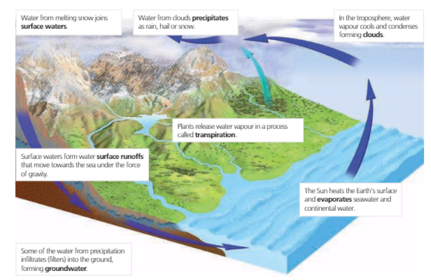
- 17THE WATER CYCLEThe water cycle is the group of processes that allow water to change state and travel between the atmosphere an the Earth's surface in a cyclical movement.
- The Sun allows water to change state by providing heat.
The force of gravity causes precipitation, which returns to the water to the Earth's surface. - 18Graphic of the water cycle
- 19The water cycle and the atmosphereWater is found in the atmosphere in the form of vapour.
When there is a large amount of water vapour in the atmosphere, the temperature remains more constant. - 20The water cycle and the geosphereWater changes the surface of the continental crust by participating in the shaping of relief and modifying landscapes.
- 21The water cycle and the biosphereWater is essential for living things.
- 22Uses of waterConsumptive use of water is when the water we use is not returned to the water cycle.
- Industrial use
- Agricultural use
- Domestic use
Non-consumptive use of water is when the water used is returned to the water cycle without a significant alteration in its quality. - 23Water pollutionWater pollution is the alteration in the composition of water that makes it inadequate for its intende use.
- Pollution from agriculture and livestock farming.
- Domestic pollution (wastewater).
- Industrial pollution. - 24Clean water and healthThe consumption of good quality water is essential for our health.
- 25Drinking water treatmentDrinking water treatment is the process by which water is treated to make it suitable for human consumption.
1.- Grilles and filters
2. Sedimentation tanks.
3. Flocculation.
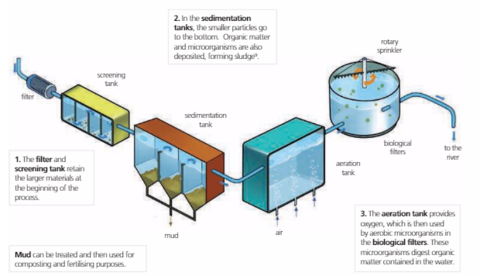
4. Disinfection. - 26Wastewater treatmentWastewater treatment is the process that eliminates toxic substances and other substances dangerous to the environment.
Información
- Descripción
- The Hydrosphere. Geology 1 ESO.
- Creado por
- gomezolvega007
- Visitas
- 138
- Etiquetas
- Valoración