Fichas
P7
Fichas del conjunto (86)
- 1What is a sidereal day?A sidereal day is the time it takes for the Earth to rotate 360 degrees.
- 2How long is a sidereal day?23 hours 56 minutes
- 3What is a solar day?The time taken for the Sun to reach the highest point in the sky on two successive occasions.
- 4How long is a solar day?24 hours
- 5Why is a solar day longer than a side real day?The Earth is rotating on its axis and orbiting the Sun. It needs to rotate about another degree further to be back in the same position it was in previously.
- 6How long is a lunar month?29.5 days
- 7What is a solar eclipse?A solar eclipse occurs when the orbit of the Moon takes it directly between the Earth and the Sun, and the Moon's shadow falls upon the Earth.
- 8What is a lunar eclipse?A lunar eclipse is when the Moon's orbit causes it to pass into the Earth's shadow. A lunar eclipse covers the entire Moon and can be seen from anywhere where the Moon would be visible on Earth.
- 9Why are eclipses rare?> For an eclipse to occur, the Earth, Sun and Moon must align perfectly.
> The Moon's orbit is tilted relative to the plane of Earth's orbit around the Sun. - 10What planets can be seen with the naked eye?Mercury, Venus and Mars (as they are the closest to Earth)
Jupiter and Saturn (as they are very big) - 11Define 'Retrograde Motion'the backward motion of a planet, over a number of days, as seen against the background of stars
- 12True or false: Planets orbit the Sun at the same speedFalse. They orbit at different speeds.
This is because the force of gravity/attraction of the Sun's gravity changes with the distance and mass of a planet. - 13Why do some planets sometimes appear to move towards us and sometimes appear to be moving away?It is to do with the difference in speed and their positions relative to the Earth and the Sun.
- 14What is meant by 'declination'?the angular distance of a point north or south of the celestial equator - measured in degrees, minutes and seconds.
- 15What is the celestial equator?the projection into space of the earth's equator; an imaginary circle equidistant from the celestial poles.
- 16What is meant by 'right ascension'?the distance of a point east of the vernal equinox , measured along the celestial equator and expressed in hours, minutes, and seconds.
- 17What is the 'vernal equinox'?The reference point for where the Sun moves into the northern hemisphere
- 18What is the celestial sphere?An imaginary dome that stretched over the Earth and has light from every astronomical object projected onto it.
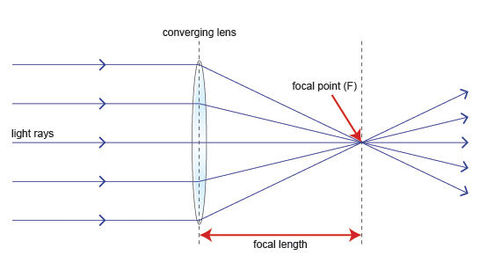
- 19Describe a converging lens
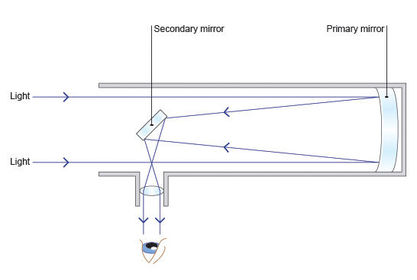
- 20Describe a reflecting telescope
- 21Power of a lenspower of lens (dioptres) =
1
-----------------------------------------
focal length of lens (metres) - 22Magnification of a lensMagnification =
focal length obj. lens
---------------------------------
focal length eye piece lens - 23RefractionThe change in direction of a wave as it travels from one medium to another, due to the change in wave speed. This due to materials having different densities, the greater the number of particles the slower the light can move and therefore the more it refracts.
- 24What is chromatic aberration?the effect produced by the refraction of different wavelengths of light through slightly different angles, resulting in different focal lengths, which results ina failure to focus.
- 25Advantages of mirrors- lighter
- easier to support
- They can be made very smooth, resulting in undistorted images.
- Suitable reflectors can be used to focus all types of electromagnetic radiation.
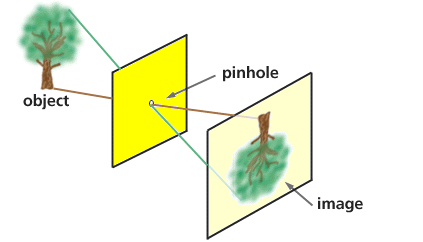
- Mirrors reflect rays of all colours in the same way. - 26Draw a ray diagram
- 27What is the focal length?the distance between the centre of a lens or curved mirror and its focus.
- 28How can you estimate focal length when looking at a lens?More of a Curve ( ) means shorter focal length
Less of a Curve () means longer focal length - 29How does a telescope with two converging lenses work? Draw a diagram
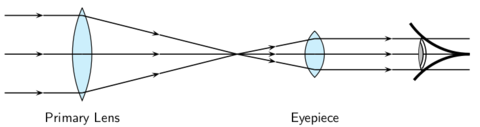
- 30Explain how a converging telescope works.- Objective lens collects light from distant object
- Parallel rays of light enter the objective lens
- Each parallel line is focused by the obj. lens
- A real image is formed
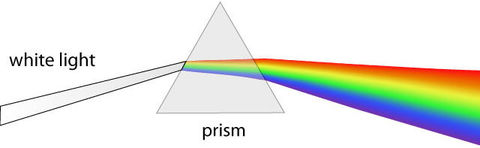
- The eye piece magnifies the real image - 31DispersionThe splitting of light into colours
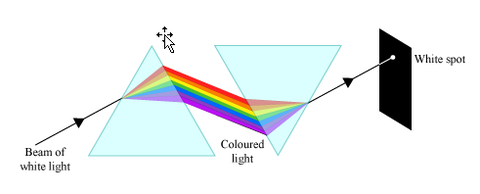
- 32What happens if you shine white light through 2 prisms?The spectrum colours recombine to form white light again.
- 33What does a spectrometer contain?A prism
- 34What does a spectrometer measure?It measures the relative brightness of each part of the spectrum by dividing up a beam of light into a spectrum.
- 35What is a grating?A thin piece of glass which has a set of vey narrow, evenly spaced parallel lines ruled onto it. When light shines on it, several spectra are produced.
- 36Why must mirrors be parabolic?In order to bring light to a point.
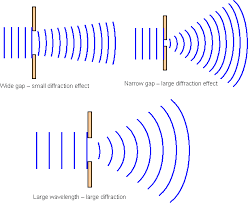
- 37What is 'diffraction'?It is what happens when a wave hits the edge of a barrier or passes through a gap in a barrier. The waves bend.
- 38What radiation does the atmosphere transmit (allow through)?Visible light, microwaves, radio waves, some infrared and UV.
- 39What radiation does the atmosphere absorb?X-Rays, Gamma and Infrared and UV.
- 40Calculating distance (in parsecs) equationDistance (parsecs) = _______1_______
parallax angle (sec) - 41What is the parallax angle?
- 42How long is a parsec?3.1 x 10^13 km
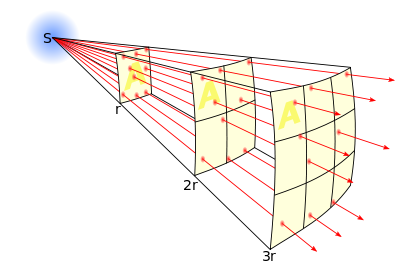
- 43Inverse Square LawLight spreads out, so the more distant a source is the less bright it appears.
- 44What is luminosity?The luminosity of a star is its power output.
- 45What does a stars luminosity depend on?Temperature -
[Hotter = More energy radiating of surface](p/s)
Size -
[Bigger surface area radiating energy] - 46What is observed brightness?A measure of the light reaching a telescope from a star.
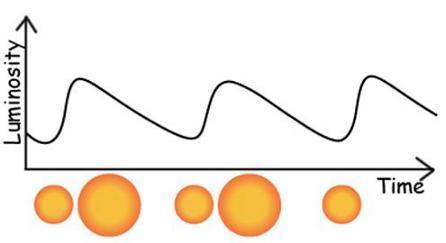
- 47What is a Cepheid variable?A star whose brightness varies regularly, over a period of days.
- 48Describe a Cepheid variable graph
- 49Curtis's idea about the Milky Way- 30,000 light years in diameter
- Sun is at centre of the galaxy
- Nebulae > High red shift therefore they're outside our galaxy
- Our galaxy is one of many in the universe
- Nebulae are a system of stars - 50Shapley's idea about the Milky Way- 300,000 light years in diameter
- Globar nebula are more clustered on one side of the sky > Sun cannot be at the centre
- Galaxy is so large > nebulae must be inside it
- Our galaxy is the whole universe
- Nebulae are dust clouds - 51Define: CometA rocky lump, held together by frozen gases and water, that orbit the Sun.
- 52Define: AsteroidRocks, generally orbiting the Sun between Mars and Jupiter.
- 53Define: Planetary NebulaA ring shaped formed by an expanding shell of gas round an ageing star.
- 54Define: NebulaA cloud of gas and dust in outer space. A star is reborn.
- 55Define: SupernovaA dying star that explodes violently, producing an extremely bright astronomical object.
- 56Define: PulsarA rapidly rotating neutron star that emits regular pulses of radio waves and other EM radiation
- 57Define: QuasarA galaxy thought to contain black holes that draw in materials from their surroundings. [Emits large amounts of radiation]
- 58Speed of recession equationspeed of recession =
Hubble constant x distance - 59What is speed of recession?The speed of which a galaxy is moving away from us.
- 60Complete the sentence: ,The more distance the galaxy, the _____________ its speed of recession.The more distance the galaxy, the GREATER its speed of recession.
- 61Match these up: Warm object High Frequency Red Hot Object Low Frequency White Hot Object Medium FrequencyRefer to diagram to check your answers
- 62Explain what this showsHotter Star
> Area under graph is greater; this shows luminosity is greater
> The peak frequency is greater; it produces a greater proportion of radiation of higher frequencies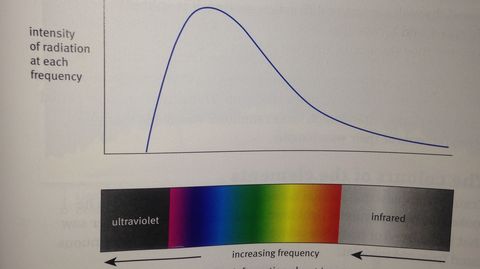
- 63What is this and what does it show?Absorption Spectrum.
Shows which elements have been absorbed.
- 64What is this and what does it show?Emmission Spectrum.
Shows which elements have been emitted.
- 65How do atoms emit light?> Electrons in an atom have certain values of energy (ENERGY LEVELS)
> When an electron drops from one energy level to another, it looses energy
> As it does, it emits a single photon of light.
> Energy in the photon = difference in energy between the two energy levels - 66How do atoms absorb light?> White light consists of photons with all possible values of energy
> An electron in a low energy level, can only absorb a photon whose energy is just right to lift it to a higher level
> White light is now missing photons which have been absorbed, these correspond to dark lines on absorption spectrum. - 67Symbol for positron0
e+
+1 - 68What is the 'strong nuclear force'?A strong attractive force between nucleons in the atomic nucleus that holds the nucleus together.
- 69What is 'electrostatic repulsion'?Electrostatic repulsion refers to two particles of the same charge that drive away each other. For example, a positively charged particle will repel another positively charged particle.
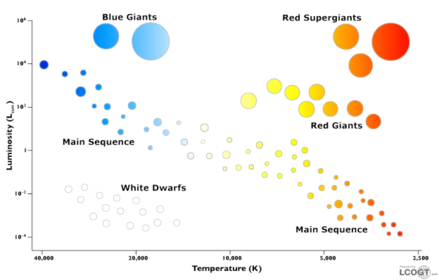
- 70Describe the Hertzsprung-Russell diagram. (REFER TO IMAGE FOR ANSWERS)
- 71What is the ISM?Interstellar Medium
Very low density gas, between the stars in our galaxy. The gas is mostly Hydrogen and Helium, with small amounts of other elements. - 72In what 4 ways can you describe a gas?Volume - space it occupies
Mass - the amount of matter
Pressure - the force it exerts
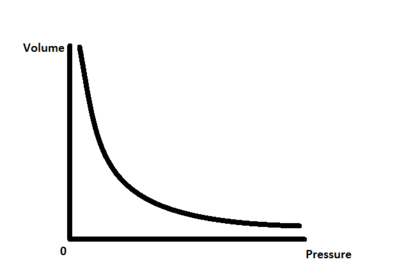
Temperature - how hot it is - 73Pressure eqautionPressure x volume = constant
- 74Describe the pressure-volume graph
- 75Absolute Zero0 Kelvin
-273 Celcius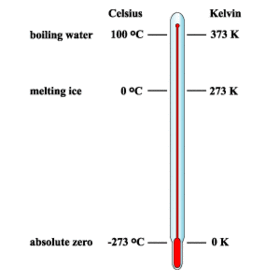
- 76Boyle's LawsP1 x V1 = P2 x V2
- 77Charles' LawV1 V2
_________ = _________
T1 T2 - 78How do stars form? (5 steps)> Cold clouds of dust and gas are pulled together by gravity
> Break into smaller clouds
> Each cloud contracts towards its centre
> Each particle attracts every other particle and starts to rotate
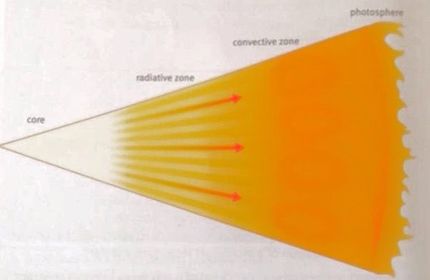
> As particles are attracted, they move towards centre, move faster and get hotter - 79Describe the structure of a star like our Sun
- 80Describe the life of a star.
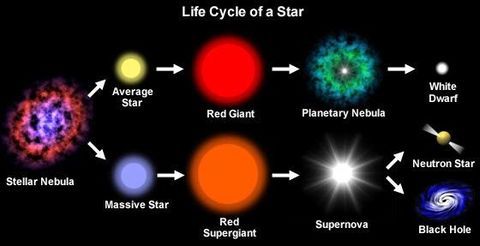
- 81What is a neutron star?The collapsed remnant of a massive star, after a supernova. They are extremely dense and made almost entirely of neutrons.
- 82What is a black hole?A mass so great its gravity prevents anything from escaping it, including light. Some black holes are collapsed remnants of massive stars.
- 83What does SETI mean?Search for Extra-Terrestrial Intelligence
- 84What is an exoplanet?The planet of any star apart from the Sun.
- 85How can exoplanets be detected?Dips in brightness of a star as the planet passes across/infront of it.
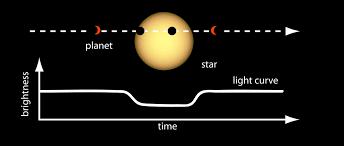
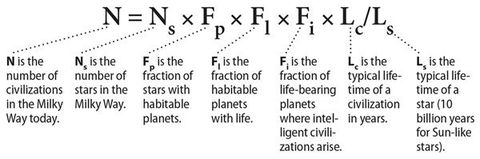
- 86What is the Drake Equation (with explanation)