
14127179
Description

Flashcards by Bridonie Nicholson , updated more than 1 year ago

|
Created by Bridonie Nicholson
over 7 years ago
|
|
| Question | Answer |
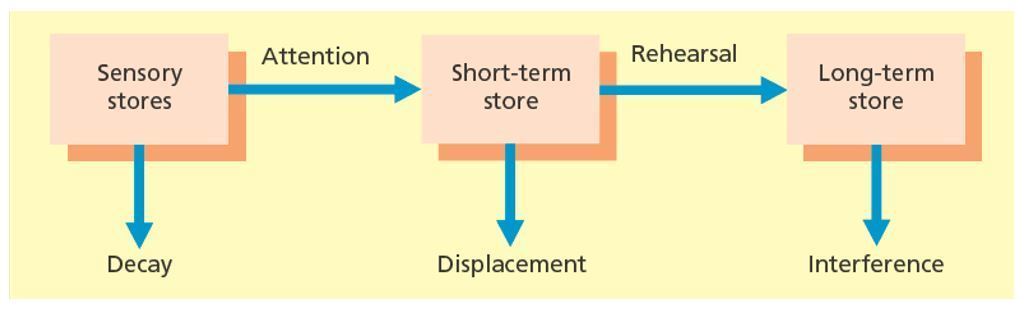
| Draw the original multistore model of memory, annotate functions. | Sensory store: info in original modality STM: limited capacity, fragile storage LTM: unlimited capacity, long duration |
| What are the criticisms of the multistore memory model? | - impairmint of STM not = to LTM - Rehearsal not crucial - over emphasises structural aspects of memory - STM not one-way gate to LTM -too unitary; actually has more subcomponents |
| How do patient KF and amnesics provide evidence for STM & LTM independence? | With damage to different areas of the brain Amnesics have impaired LTM but intact STM. Patient KF has the opposite. To be impaired independently they must function so. STM isn't necessarily the only way to LTM |
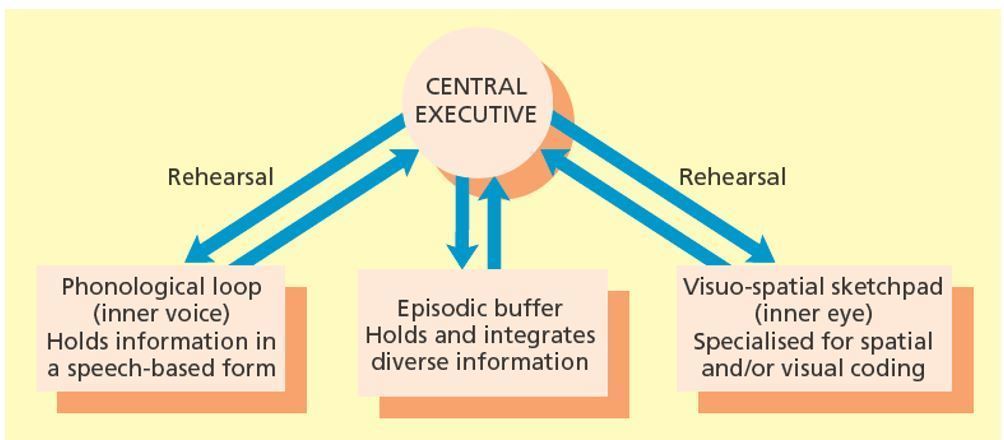
| Who proposed the working memory model? Draw. What is the central executive? What do all components share? | Braddeley and Hitch. The CE is like attention, co-ordinating other systems. All have limited capacity and relatively independent. (2 tasks same component can't be performed together) |
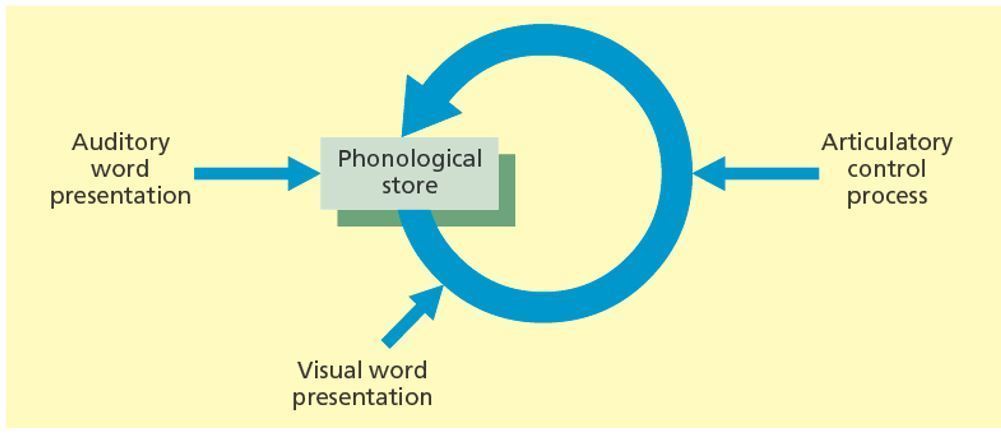
| What is the Phonological Loop System? How does it work? | passively stores info in verbal form. Articulatory control process maintains info by rehearsal (subvocal speech). Auditory info has direct access, visual indirect via control process. used for memory, and learning new words. capacity predicts vocab size |
| What do the phonological similarity effect and word length effect tell us about working memory/ phonological loop? | P.S.E: errors in recalling letters were acousitic. even for visual stimuli a phonological code is used (remembered as sounds not symbols). speech based recall. W.L.E: words that take longer to say are harder to recall. phon loop Capacity limited by articulatory duration. different languages have different digit span |
| What does articulatory suppression effect? why? | Articulatory suppression (saying meaningless over and over during task) prevents subvocal rehearsal for visual stim but not auditory; which has direct access to phon loop. W.L.E; eliminates cross language diffs in digit span |
| What is the visio-spatial sketchpad? | Stores spatial and visual info temporarily. 2 parts: visual Cache (form & colour) and Inner scribe (spatial and movement); rehearses cache and transfers to C.E |
| Why was the episodic buffer added to Baddeley's model? | Model was too separate in functioning, didn't explain LTM influence on recall (chunking). Acts to integrate info from a range of sources, intermediary between phonological loop & visio-spatial sketchpad |
| What was Norman and Shallice's view of attentional control? | Supervisory Attentional System. Basically C.E. conscious selection of schemas for a task. involved when routine control isn't enough (ie stroop task) = contention scheduling |
| What are the Executive functions? What are some strengths and limitations of the central executive? | Inhibition function, shifting function, updating function. S: brings together evidence regarding inhibtion, task shifting etc. L: not one single but multiple frontal cort processes. proccesses in healthy people don't line up as well as patient studies |
| Why does the operation span task correlate better with working memory than STM? | task involves reading a maths problem, stating correctness and a word. Working memory involves sustaining a few tasks at once where STM is more specific. Working mem capacity correlates better with higher cog functions according to this task |
Want to create your own Flashcards for free with GoConqr? Learn more.