
1415130
Description

Flashcards by 41elocnehpets, updated more than 1 year ago

|
Created by 41elocnehpets
about 11 years ago
|
|
| Question | Answer |
| At half neutralisation of a weak acid the pH is equal to what? | The pKa of the acid |
| Define the term pH. | pH=–log10[H+] (the 10 is a subscript!) |
| For a strong acid-strong base reaction which indicator(s) could you use? | Phenolphthalein, methyl orange |
| For a strong acid-weak base titration which indicator(s) could you use? | Methyl orange |
| For a weak acid-strong base titration which indicator(s) could you use? | Phenolphthalein |
| Give an equation for the ionic product of water. | Kw=[H+][OH-] |
| How can you find pH given the concentration of hydroxide ions in a solution at 298K? | [H+]=Kw/[OH-]; pH=-log10[H+] |
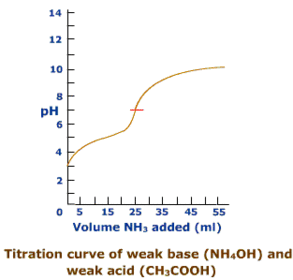
| Sketch a pH curve for a titration in which ammonia is added to ethanoic acid. | |
| Sketch a pH curve for a titration in which ammonia is added to hydrochloric acid. |
Image:
sawb_titration (image/jpg)
|
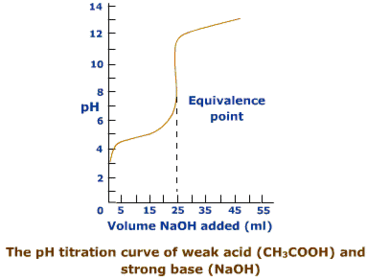
| Sketch a pH curve for a titration in which sodium hydroxide is added to ethanoic acid. | |
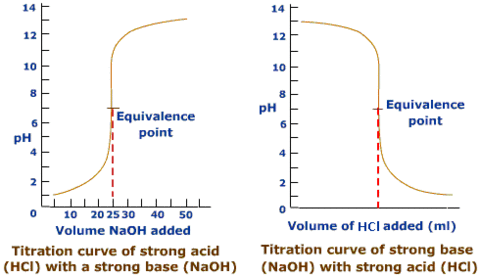
| Sketch a pH curve for a titration in which sodium hydroxide is added to hydrochloric acid. | |
| What is a base? | A proton acceptor |
| What is a basic buffer made up of? | A weak base and one of its salts (e.g. ammonia and ammonium chloride) |
| What is a buffer solution? | A solution that resists changes in pH when small amounts of acid or alkali are added. |
| What is an acid? | A proton donor |
| What is an acidic buffer made up of? | A weak acid and one of its salts (e.g. ethanoic acid and sodium ethanoate) |
| What is meant by the term strong when referring to an acid? | Fully dissociates in solution |
| What is meant by the term weak when referring to an acid? | Only slightly dissociates in solution |
| Why can a weak acid not be titrated against a weak base? | There is no equivalence point/pH does not change sharply |
| Write an equation for the acid dissociation constant of a weak acid. | Ka=[H+][A-]/[HA] |
| Write an equation to show how the dissociation constant of a weak acid can be estimated given the pH of a solution of known concentration. | Ka=[H+]2/[HA] |
| Write an equation to show the hydrogen ion concentration of a buffer solution. | [H+]=Ka[HA]/[A-] |
| Phenolphthalein has a pH range of 8.3-10.0 and methyl orange has a pH range of 3.1-4.4. Which indicator(s) could you use to titrate sodium hydroxide against hydrochloric acid and why? | Either would work. As it is a strong acid-strong base titration, at equivalence the pH will sharply increase from around 3 to around 11. Both phenolphthalein and methyl orange change colour over this pH range. |
| Phenolphthalein has a pH range of 8.3-10.0 and methyl orange has a pH range of 3.1-4.4. Which indicator(s) could you use to titrate sodium hydroxide against ethanoic acid and why? | Phenolphthalein. As it is a weak acid-strong base titration, at equivalence the pH will sharply increase from around 5 to around 11. Only phenolphthalein changes colour over this pH range. |
| Phenolphthalein has a pH range of 8.3-10.0 and methyl orange has a pH range of 3.1-4.4. Which indicator(s) could you use to titrate ammonia against hydrochloric acid and why? | Methyl orange. As it is a strong acid-weak base titration, at equivalence the pH will sharply increase from around 3 to around 8. Only methyl orange changes colour over this pH range. |
| A buffer solution is made up of the acid HA and its salt NaA. Explain why this buffer will resist a decrease in pH if a small amount of hydrochloric acid is added. | To oppose the increase in [H+], the equilibrium HA <=> H+ + A- will shift to the left, i.e. A- ions will react with the added H+ ions to form HA, thus restoring [H+] and hence pH. |
| A buffer solution is made up of the acid HA and its salt NaA. Explain why this buffer will resist an increase in pH if a small amount of sodium hydroxide is added. | The added OH- ions react with H+ ions to form water. To oppose the decrease in [H+], the equilibrium HA <=> H+ + A- will shift to the right, i.e. HA will dissociate, thus restoring [H+] and hence pH. |
| What is a monoprotic acid? | An acid which donates one proton |
| What is a diprotic acid? | An acid which donates two protons |
| What is a monobasic base? | A base which accepts two protons |
| What is a dibasic base? | A base which accepts two bases |
Want to create your own Flashcards for free with GoConqr? Learn more.