
1491018


| Question | Answer |
| Name 5 hazards that could increase the chances of severe or possibly fatal electrical shocks. | Frayed cables- damaged insulation can expose 'live' wires Long cables- likely to get damaged or trip people up Damaged to plugs or any insulating casing water around electrical sockets pushing metal objects into mains socket |
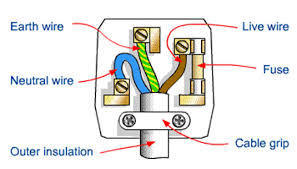
| Draw a diagram of the wiring in the plug. |
Image:
images (image/jpg)
|
| Name 5 safety features in a plug. | Insulation Double insulation Earthing wire Fuses Circuit breakers |
| How does insulation increase the safety of a plug? | Prevents the spate conductors (live, neutral and earth) from touching and prevents anyone from touching a 'live' wire |
| What is double insulation? What are the benefits of double insulation? Give an example of an object that has double insulation? | As well as the wiring being insulated the outer casing of the appliance is made of an insulating material (usually plastic) No chance of electric shock from the casing Electric kettles; power tools e.g. electric drill |
| What does the earthing wire do? | The earth wire ensures that the outer casing is held at 0V and provides a low resistance path for current in the event of a fault in which the live wire touches the casing. If this happens the fault current will be very big and blow the fuse immediately- breaking circuit. |
| What are fuses? | Cartridge fuses are ceramic, heat proof tubes containing a wire designed to melt when a specified current is exceeded, therefore cutting off the live supply. Fuses have to be replaced when they have blown. |
| What are circuit breakers? | Used in domestic consumer units rather than fuses. Perform same job- break the live connection when specified current size is exceeded. Operated magnetically and may be reset buy pressing a button. |
| Name some items which use the useful conversion of electrical energy into heat. What do fuses prevent? | electric irons, cookers, hairdryers, kettle to stop cables overheating and reduce the risk of fire |
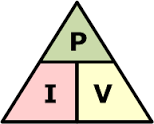
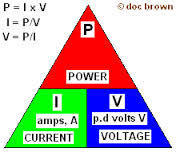
| How do you calculate power (in watts)? | current (amps) x voltage (volts) |
| Power formula triangle |
p= power- watts
I= current- amps
V= voltage- volts
Image:
power (image/png)
|
| What is power? | The rate at which electrical energy is converted in an appliance |
| How do you calculate energy from power? | energy (joules)= power (watts) x time (seconds) |
| Calculate current from energy, voltage and time. | energy= power x time energy= current x voltage x time current= energy /(voltage x time) |
| What is AC and DC current? | AC- used in mains supply, causes current to change continuously, with electricity flowing in one direction then the other= alternating current DC- used in batteries, makes electricity flow in in one direction= direct current |
| What are conductors? What are insulators? | Conductors=materials that conduct electricity well e.g. copper, silver, gold, Insulators= materials that do not conduct electricity e.g. rubber, glass, plastic |
| What is static electricity? | Where objects have an overall charge and there is no path for it to move from or through the object |
| Unlike charges ................, like charges .................. . | attract, repel |
| Explain the process of charging by friction | When rubbing two materials together some electrons are lost from the surface of one material and transferred to the other Material which loses electrons has a net positive charge Material that gained electrons has more negative charge than positive so is negatively charged |
| Name 4 uses of static electricity. | Inkjet printers Photocopiers Paint spraying Electrostatic precipitators |
| Explain how inkjet printers work. | Charged ink droplets are directed to particular places on the paper by deflecting them between charged plates |
| Explain how photocopiers work. | A statically charged drum is exposed to light, reflected from the document to be copied., which discharges the drum everywhere except where the dark print doesn't reflect light. The charged part of the drum attract the toner which is transferred to the printing paper. heat binds the toner particles to the paper. |
| Explain how paint spraying works. | Tiny droplets of paint are given static charge and the object to be painted given the opposite charge, This causes the paint droplets to be attracted to the object and the amount of wasted paint is reduced and a more even finished produced. |
| Explain how electrostatic precipitators work. | Small particles of soot and dust produced in burning materials are given static charge and passed through highly charged grid which attracts the particles and stops them escaping into the atmosphere. |
| Name 3 problems with static electricity. | Electric shocks Fuelling tankers and aircrafts Handling microprocessors and computer 'chips' |
| Explain the problems with static electricity and electric shocks. | Cars become charged with static electricity (especially on dry days) from the friction and gives unpleasant shock when someone touches the car. |
| Explain the problems with static electricity and fuelling tankers and aircraft. | When fuelling it is possible for the static charge to build up on planes/tankers and should a spark occur a fire/explosion could result. prevented by earthing the planes/tankers to discharge them. |
| Explain the problems with static electricity and handling microprocessors and computer 'chips.' | Workers handling them must take charge not to become charged by static as this can easily destroy the expensive component. They wear earthing straps and work on earthed metal benches to prevent this. |
| Definition of electric current. | Rate of flow of electric charge through a conductor. |
| How do you calculate current (in amps) from the charge. | charge (in coulombs)/ time (seconds) |
| Define voltage. What is 1 volt? |
Batteries, dynamos etc. provide the energy needed to make electric charge move around a circuit. The 'strength' of this is measured in volts.
1 volt means 1 joule per coulomb
Image:
charge (image/jpg)
|
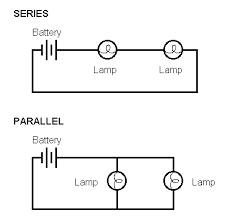
| Draw a parallel and series circuit. |
Image:
cicuits (image/png)
|
|
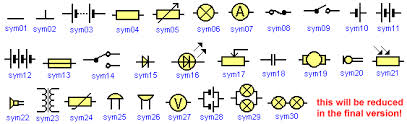
Name symbols 5,6, 7, 8, 9, 10, 11, 13, 15, 16, 21, 24, 27
Image:
symbols (image/png)
|
5= variable resistor, 6= indictor lamp, 7= ammeter, 8= close switch, 9= open switch, 10= cell, 11= battery, 13=fuse, 15= diode, 16=LED, 21= light-dependent resistor, 24=thermistor, 27= voltmeter |
| What will happen is a lamp blows in a) a series circuit? b) a parallel circuit? | a) The current will stop flowing (break in the circuit) and all the lamps will turn off b) the other lamps will remain unaffected (unless on the same route) and the size of current from the battery will decrease |
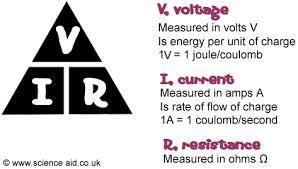
| What is resistance? How do you calculate it? | How easily current is allowed to flow voltage (Volts)= current (Amps) x resistance (Ohms) |
| Resistance formula triangle |
Image:
resistance (image/jpg)
|
| Give a use for a variable resistor. | Lamp dimmer circuits, speed control in slot car games, volume control in audio equipment |
| What is a thermistor? | A resistor whose resistance decreases as the temperature increase. Used in in temperature sensing circuits. |
| What is a light-dependent resistor (LDR)? | a resistor who resistance decreases with more light. Used in light sensitive circuits e.g. street lights |
| What is a diode and a LED? | Only allow electric current to pass in the direction of the arrow. One direction they have a huge resistance, in the other very little. LED's light up when a current passes through them. Diodes control direction in which current can flow. Used in power supplies for DC equipment. |
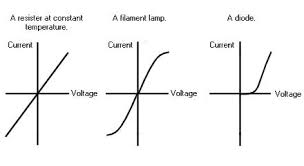
| Draw 3 current-voltage graphs. a) resistors and wires b) filament in a lamp c) diodes |
Image:
IV_graphs (image/png)
|
Want to create your own Flashcards for free with GoConqr? Learn more.