
Flashcards
Ch3 - Consumer behaviour - Learning and Memory
Cards in this deck (32)
- 1LearningA relatively permanent change in behaviour caused by experience
- 2What are the two types of learning?- incidental learning
- ongoing process - 3Products + Memory =brand equity/loyalty
- 4what are the five behavioural learning theories? (5) R, CC, IC, CL, OL1. repetition
2. classical conditioning
3. instrumental conditioning
4. cognitive learning
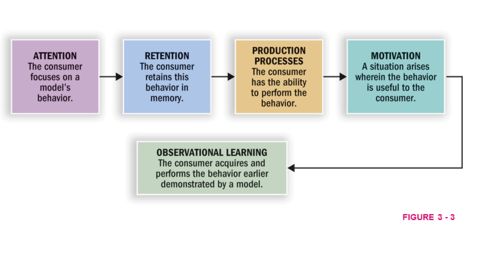
5. observational learning - 5does repetition increase learning?yes
- 6when does extinction occur?when exposure decreases
- 7what creates greater brand awareness?more exposure
- 8can too much exposure lead to advertising wear outyes
- 9less exposure can result in _ _ _ _ _decay
- 10What is the tendency for stimuli similar to conditioned stimulus (keys jangling resemble bell) to evoke similar, unconditional responses?Stimulus generalization
- 11these are examples of what? - family branding - product line extensions -licensing - look-alike packagingstimulus generalization
- 12what is stimulus discrimination?only buying brand names
- 13- Behaviours = positive outcomes or negative outcomes - Deliberate behaviour to obtain a goal Positive reinforcement - Frequency marketing, thank you letters, rebates, follow-up phone calls - Negative reinforcement: Punishment, Extinction Shaping: Desired behaviour learned over timeinstrumental conditioning
- 14Fixed-interval (seasonal sales) Variable-interval (secret shoppers) Fixed-ratio (frequent flyer programs) Variable-ratio (slot machines) Frequency marketing Are examples of?Reinforcement Schedules
- 15what is cognitive learning theory?This theory stresses internal mental processes vs. behavioural theories
People are problem solvers using information to master their environment
Creativity and insight play a key role
Cognitive learning is the result of listening, watching, touching or experiencing. - 16learning is an ___________ ____________? Direct experience, making errors, and looking for solutions are vital for the assimilation and accommodation of information. How information is presented is important. When information is introduced as an aid to problem solving, it functions as a tool rather than an isolated arbitrary fact.active process
- 17Observational Learning _______________ Learning occurs when learners see and or hear a learning situation for which they are not the addresses and do not interact with the observed learner nor the observed learner's instructionVicarious Learning
- 18What is modelling?imitating others' behaviour (celebrities/athletes)
- 19—Observational Learning
- 20Acquiring information and storing it over time so that it will be available when needed is?memory
- 21information processing approach Mind = computer and data =input/output
- 22why do we encode?we encode information to help us retain it later
- 23colours and shapes are examples ofsensory meaning
- 24symbolic associations are examples ofsemantic meaning
- 25there is three times of memorysensory memory
short-term memory
long-term memory - 26- Informational unit in short-term (STM) memory - Brand names -Area code and telephone number -Phone numbers were designed with three or 4 “chunks” for optimum recall this is an example of?chunking
- 27what is associative networks?it is activation models of memory
an associative network of related information
- A means of representing relational knowledge as a labeled directed graph. Each vertex of the graph represents a concept and each label represents a relation between concepts
Knowledge structures of interconnected nodes
Hierarchical processing model - 28_ _ _ _ _ _ _ _ _ is the process of accessing information from long-term memory factorsretrevial
- 29what are some appropriate factors/cues for retrieval?- State-dependent retrieval/mood congruence effect
- Familiarity
- Salience and Recall effect (mystery ads)
- Visual memory versus verbal memory - 30what are some factors that influence forgetting? (4) - DIRP- decay
- interference
- retroactive versus proactive
- part-list cueing effect - 31what are some problems with memory measures?1. response biases
2. memory lapses
3. memory or fact vs. feelings - 32Furniture, visual art and photos call forth memories of the past Autobiographical memories Power of nostalgia Retro brands Nostalgia Index these are examples of?products as memory makers
Information
- Description
- Flashcards on Ch3 - Consumer behaviour - Learning and Memory, created by Faria Islam on 28/10/2014.
- Created by
- Faria Islam
- Views
- 133
- Tags
- Rating