
16361910
Description

Flashcards by AsimAli Rehman , updated more than 1 year ago

|
Created by AsimAli Rehman
about 7 years ago
|
|
| Question | Answer |
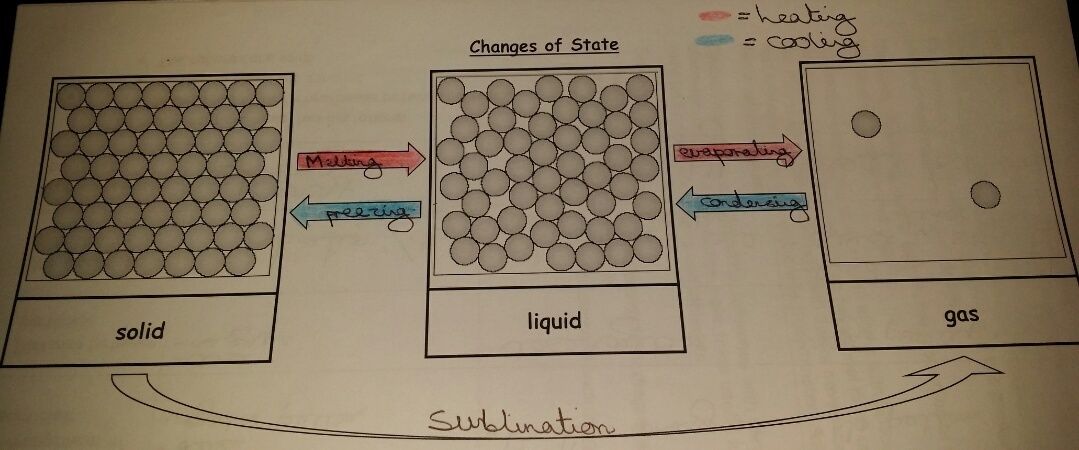
| What is the melting point? | The melting point is the tempreture at which a substance melts or freezes at. (i.e turns from a solid to a liquid or a liquid back to a solid) |
| What is the boiling point? | The boiling point is the tempreture at which a substance boils or condenses at (i.e turns from a liquid to a gas or a gas back to a liquid) |
| When is a substance a liquid? | When it is lower than the boiling point but higher than the melting point. |
| When is a substance a gas? | If the tempreture is higher than the boiling point the substance is a gas |
| A | |
| When is a substance a solid? | If the tempreture is lower than the melting point, the substance is a solid. |
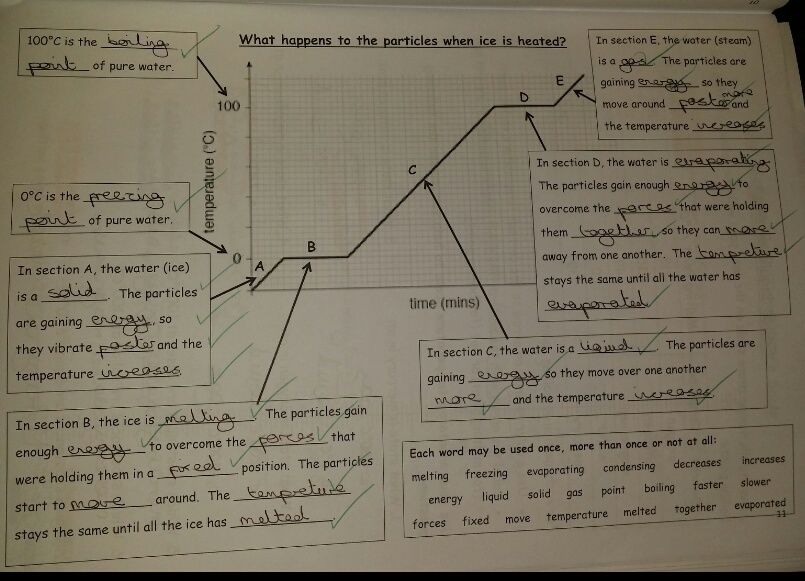
| The graph of ice melting and its key stages. | |
| The structure of an ionic compound. | They have a high melting and boiling point. When soluble (liquid) can conduct electricity as they are free flowing so can move and carry charges. However it does not conduct electricity when it is a solid. It is hard and the ions are held together by strong electrostatic forces. They have a positive and a negative. |
| Ionic compounds have a very high melting and boiling points but why? | This is because it takes alot of energy to break the bonds. |
| Ionic compounds are insulators of electricity when they are solid. Why? | This is because the ions are in a fixed position so cannot move to carry a charge. |
| Ionic compounds are conductors of electricity when molten (melted) or in solution. Why? | As the ions can move freely to carry a charge. |
| Why are Ionic compounds hard? | As they are held together by strong electrostatic forces. |
| Why do atoms form chemical bonds? | As the elements want to get a full outer electron shell so will form chemical bonds |
| What are the two types of bonding? | Ionic (between metals and non - metals) and covalent (two non metals) |
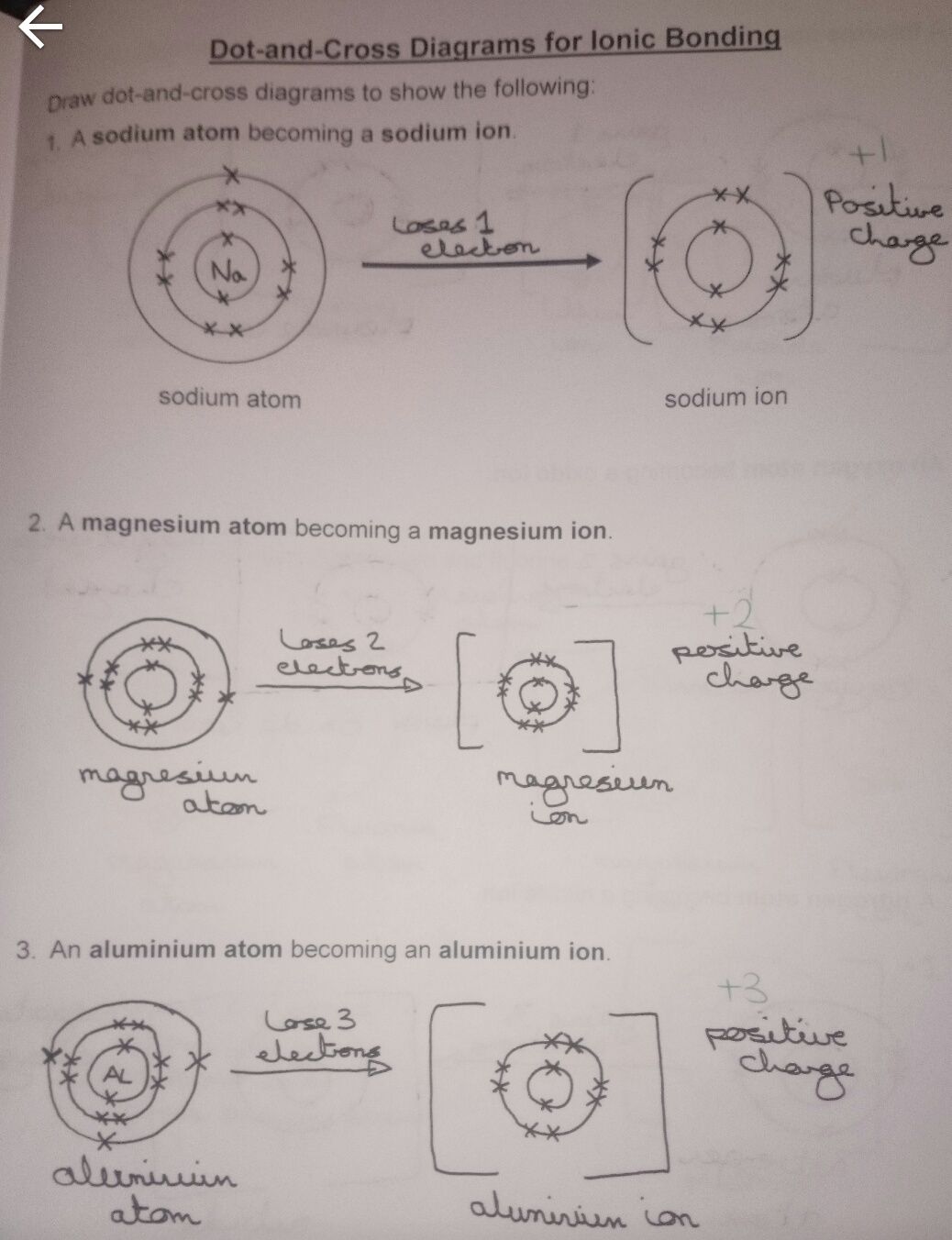
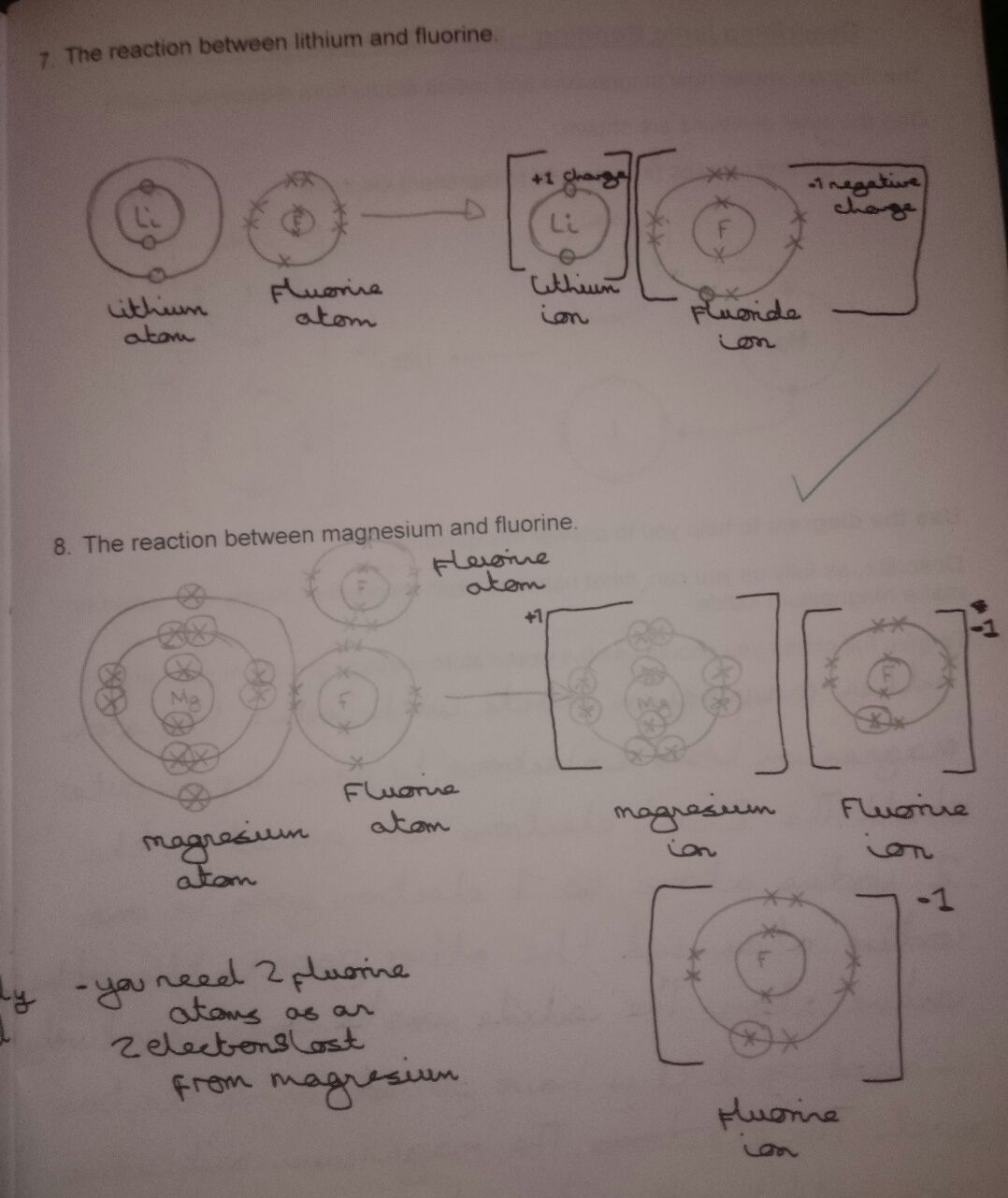
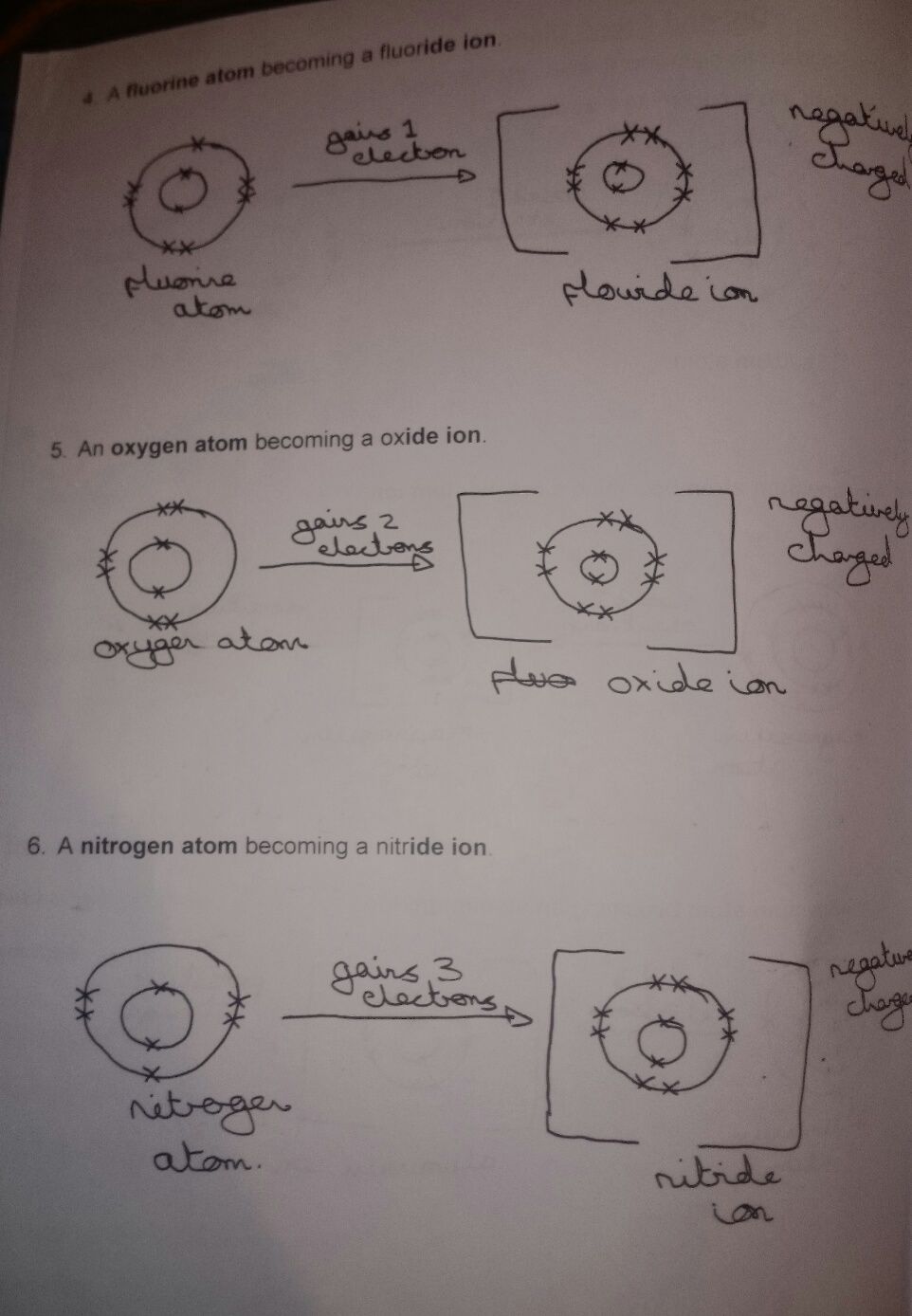
| What takes place in ionic bonding? | The metal atoms lose the electron from their outer shell leaving behind only full shells. They become positively charged ions because there are more protons than electrons. The non metals gain electrons to fill up their outer shells. They become negatively charged ions because there are more electrons than protons. Ionic bonds are the strong electorstatic forces of attraction between the oppositely charged metal and non metal ions. |
| Note to self | To see if an element loses or gains electrons you just see whatever is easier to do so Eg Sodium which is in group one and has one electron in its outer shell, it will be easier for it to lose 1 electron rather than gain 7. If an element loses electrons it becomes positively charged and vice versa. |
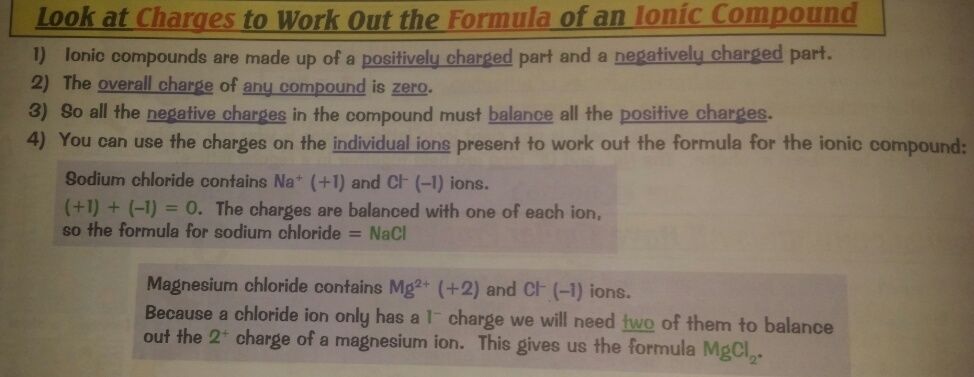
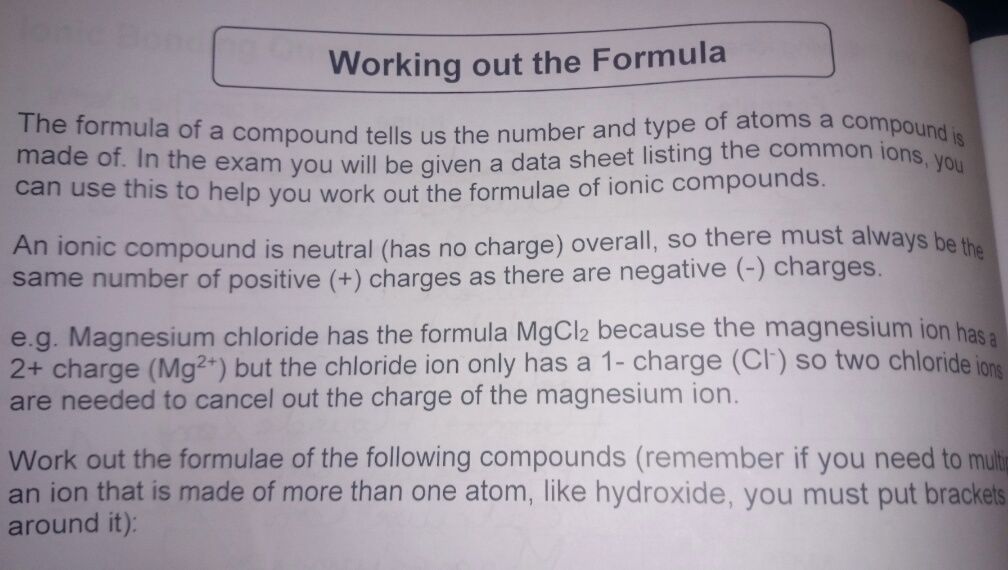
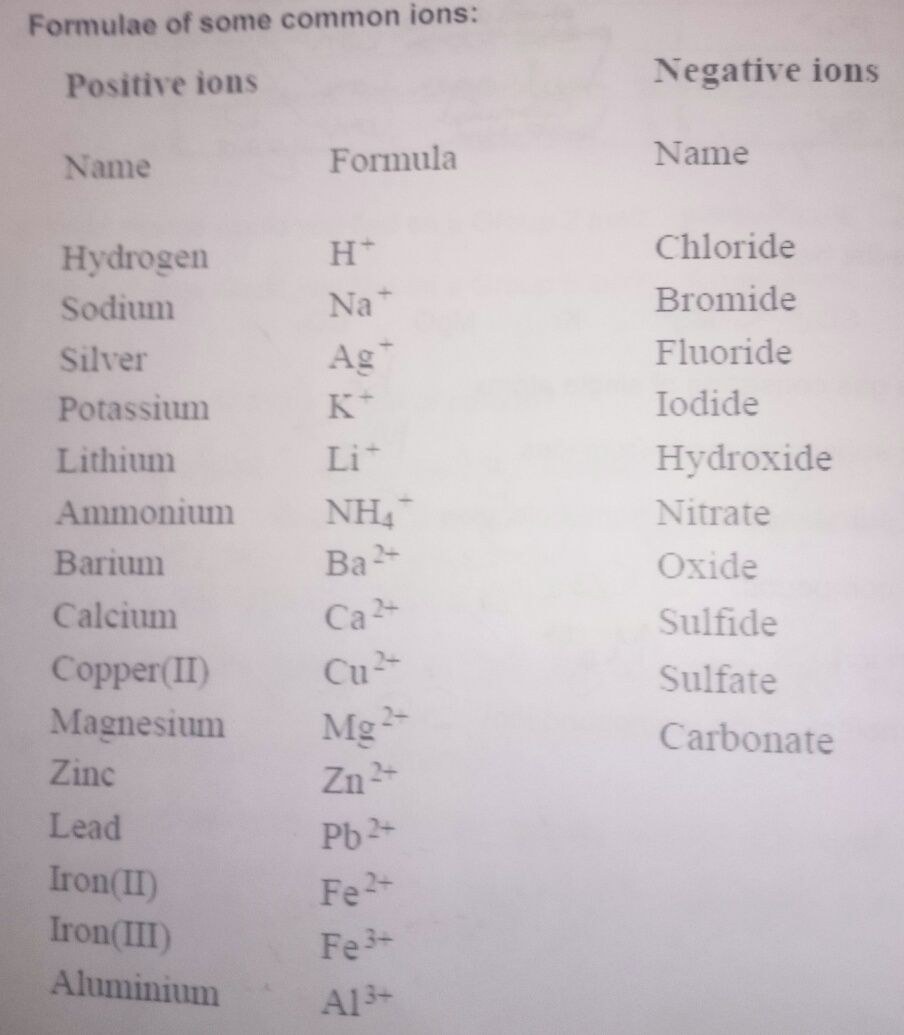
| Ions and their formula. | Just look at the charge to see the formula so if it is in group 1 it will lose its electron to become a + charge and if in group 2 a 2+ charge as it will lose 2 electrons. For negative ions if it is in group 6 it will have a 2- charge as it has gained 2 electrons to become negative. |
| Note to self. | When representing the ions just use a big square bracket around it and put the charge so + or - . |
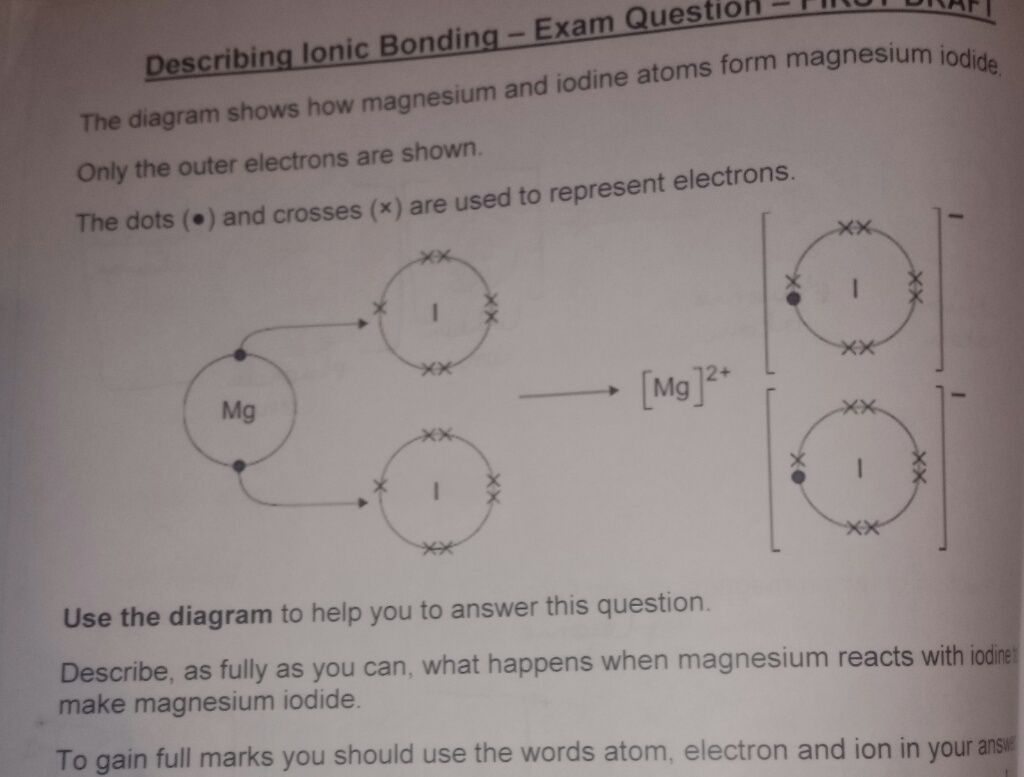
| Examples of diagrams. | |
| When magnesium reacts with iodine the atom magnesium loses 2 electrons to gain a full outet shell. The magnesium becomes a positively chared ion. The 2 lost electrons are gained in the two iodine atoms so 1 electron goes to one iodine atom and the other goes to the other iodine atom. The iodine ions becomes negatively charged as they have gained an electron each. The magnesium and iodine are held together by strong electrostatic forces. | |
| What is cation? | Cation is positive. |
| What is anion? | Anion is negative. |
| What is covalent bonding? | Covalent bonding takes place between two non-metal atoms only. The atoms share electrons to fill up their outer electron shells. A covalent bond is a shared pair of electrons and is very strong. The number of covalent bonds an atom makes is the same as the number of electrons it needs to fill up its outer shell. For example a group 7 atoms has 7 electrons in its outer shell, it needs 1 more so makes 1 covalent bond. A small group of atoms joined together by covalent bonds is called a molecule. |
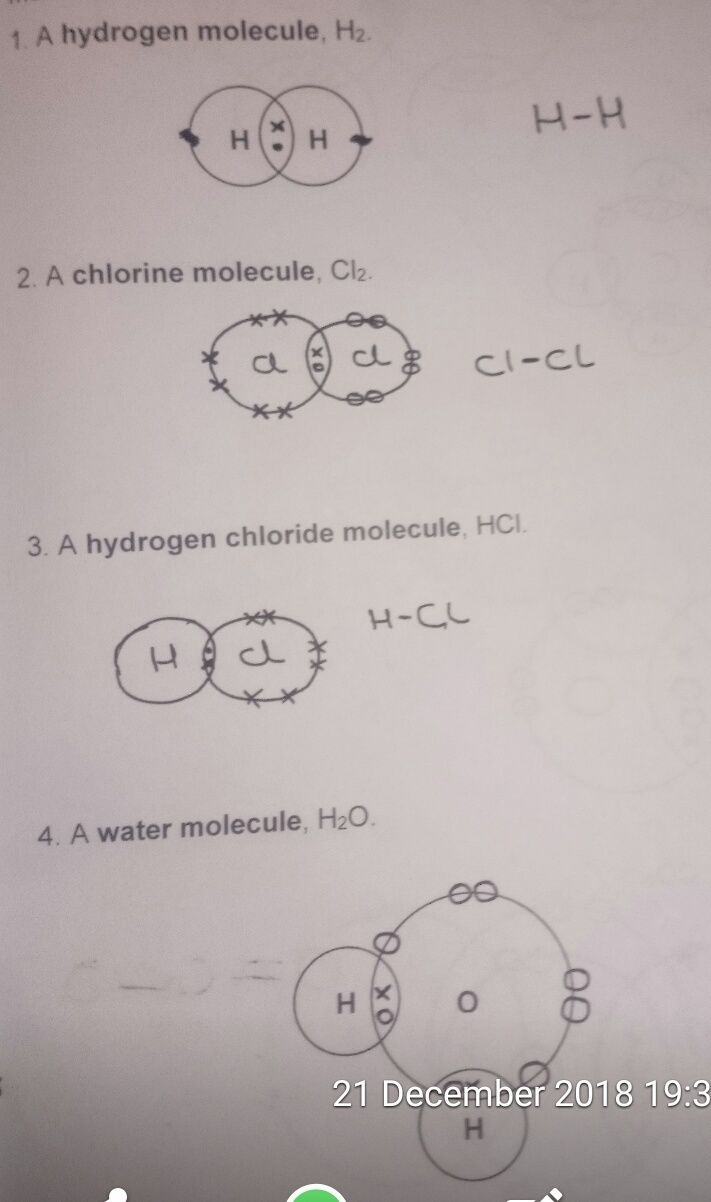
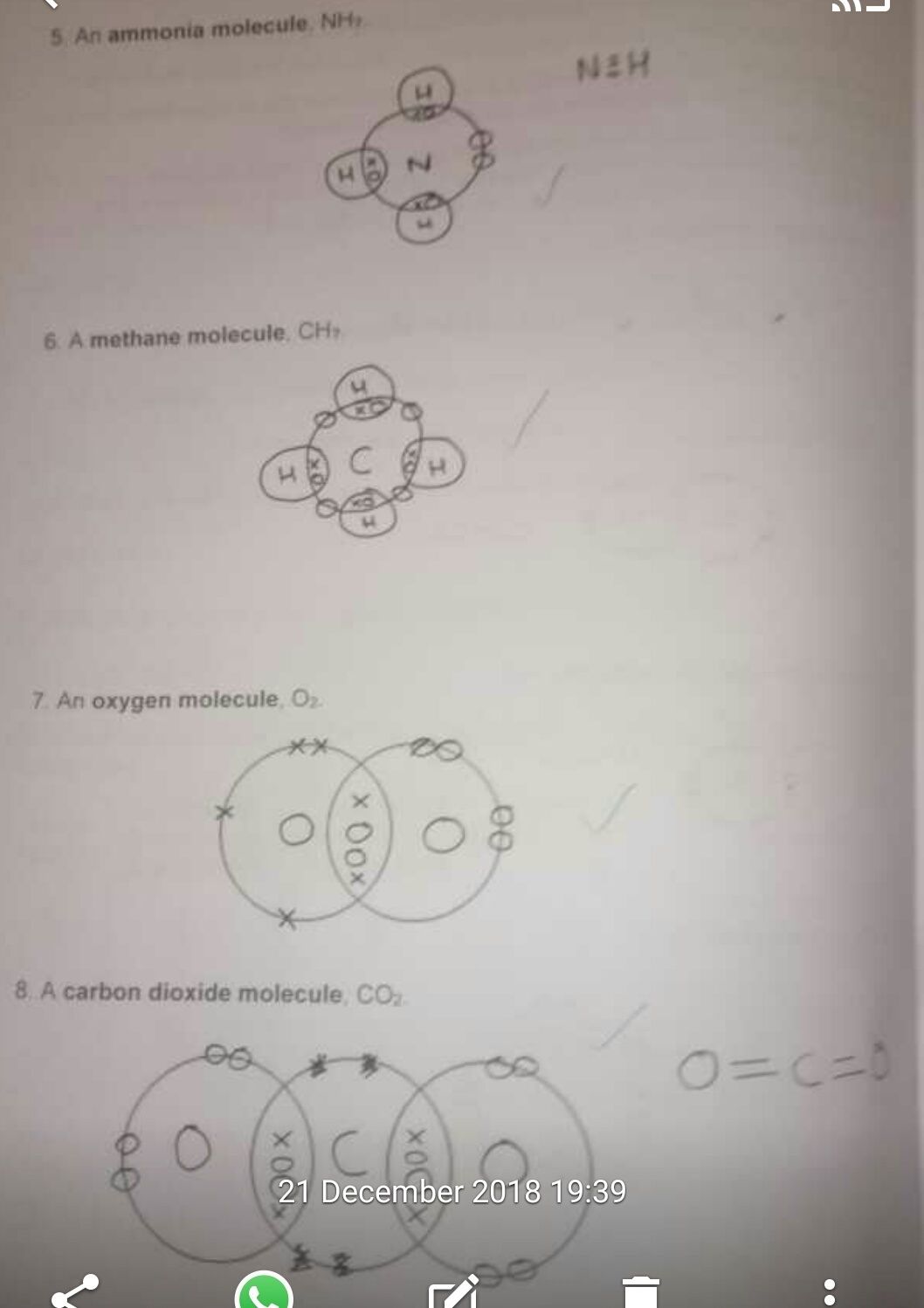
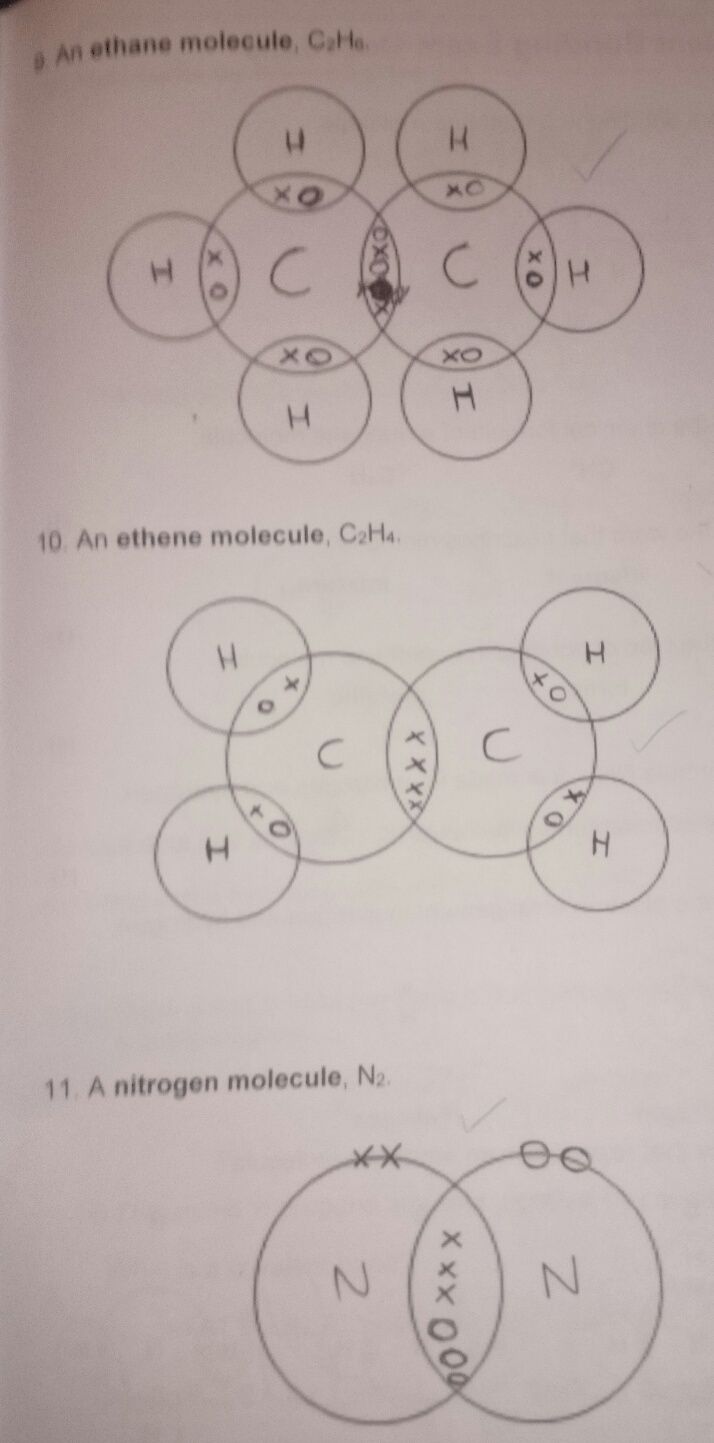
| Dot and cross diagrams for covalent bonds Rules. | Remeber to use dots to represent the electrons from one type of atom and crosses from the other. ONLY SHOW THE OUTER ELECTRONS SHELLS. |
| Examples | |
| What is a molecule? | A molecule are a small group of atoms joined together by covalent bonds. |
| Simple covalent molecules have low melting a boiling points. Why? | As they have weak intermolecular forces, it is easy to break the bonds so less energy is required to break them. |
| Large molecules have higher boiling points than small molecules. Why? | Larger molecules have more interomlecular forces so more energy is required to break these bonds. |
| Simple covalent molecules such as pure water do not conduct electricity. Why? | As there are no free electrons/ions so they cannot carry a charge. |
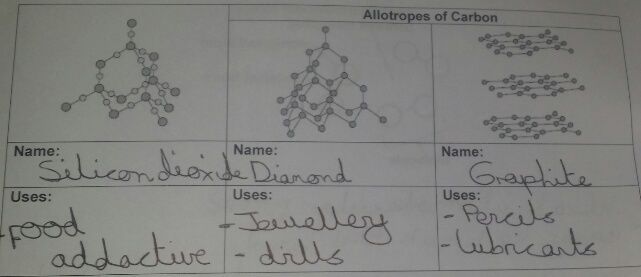
| Giant covalent structures | A |
| What holds the atoms together in giant covalent structures? | Strong covalent bonds. |
| why do giant covalent substances like diamond have very high melting points? | As it takes alot of energy to break the bonds as they have strong covalent bonds. |
| Graphite can be used to lubricate the moving parts of machinery because it is soft and slippery. Why? | As they have layers so can move over one other |
| Why is graphite a good conductor of electricity? | As it has delocalised (free electrons) so it can carry a charge. |
| Why do diamonds not conduct electricity? | As they do not have delocalised electrons so it cant carry a charge. |
| Diamonds can be used on the tips of drill bits. Why is it so hard? | Diamond is hard because it is made up of alot of strong covalent bonds so there is alot of energy needed to break the bonds. |
| What is graphene and how was it discovered? | It is a substance made up of carbon atoms. (Single layer of graphite). It was discovered by accident in 2004 at the university of Manchester. |
| What properties does graphene have? | Graphene is extremely thin but is extremely strong due to the strong covalent bonds. It is transparent- only one cell thick. It is a thermal and electrical conductor as it has a delocalised electron so can move and carry a charge. |
| Why does graphenes properties make it useful? | For electronics (Eg touch screens) |
| What is buckminster fullerenes chemical formula? | C60 |
| What are fullerenes used for? | - For delivery of drug into specific parts of the body. - In lubricates to reduce friction. - As catalysts. |
| What is the stucture of fullerenes? | The structure of fullerenes is based on molecules of carbon atoms with hollow shapes based on hexagon rings of carbon atoms. They all have a hollow part in the centre. |
| Why are nanotubes strong but light weight? | As they have a very high length to diameter ratio. |
| What are the uses of carbon nanotubes? | They are used in tennis racquets and golf clubs. Also in electronics. |
| Why do carbon nanotubes conduct electricity and heat? | As they have delocalised electrons so can carry a charge. |
| What are the properties of fullerenes and carbon nanotubes? | Strong - all atoms are joined together by strong covalent bonds. - Conducts electricity- one electron from each carbon atom is delocalised so can move through the entire structure and carry an electric charge. Light weight as they are hollow. |
| Why are pure metals soft and easily bent into shape? | Pure metals are malleable because they have delocalised electrons within them which form layers that can slide over one another due to the regular pattern shape. |
| Why are alloys much harder and stronger than pure metals? | Alloys are harder and stronger because they contain different sizes of atoms so cannot slide over one another as they are not in regular pattern making them harder to break. |
| Why is gold jewellery often made from alloys of gold rather than pure gold? | So that it is more resistant to corrosion so will last longer and keep its shine for longer. |
| What is the structure of metals? | In a metal there are layers of positively charged metal ions and a negatively charged sea of delocalised electrons. |
| Why do metals conduct heat and electricity? | Metals can conduct heat and electricity because they have delocalised electrons which can move to carry a charge. |
| Why do metals have high melting points? | Metals have high melting points because it takes alot of energy to break the strong forces of attraction between positive nad negatively charged ions. |
| What type of compound is calcium oxide? | A base. |
| Describe the structure and bonding in sillicon dioxide and explain why it is a suitable material for making welding blankets. | It is a giant covalent structure. It has a high melting point. It takes alot of energy to break the strong covalent bonds. |
Want to create your own Flashcards for free with GoConqr? Learn more.