
18162284
Description

Flashcards by Olivia Reid, updated more than 1 year ago

|
Created by Olivia Reid
over 6 years ago
|
|
| Question | Answer |
| Chromosomes | - Thread-like structures made of DNA - Found in the nucleus of the cell - Defined number of paired chromosomes for each species - Responsible for the transfer of inherited information from one generation to the next - Complex molecules in the nucleus that control cell function - Men have an X and Y sex chromosome whereas women have two X sex chromosomes. |
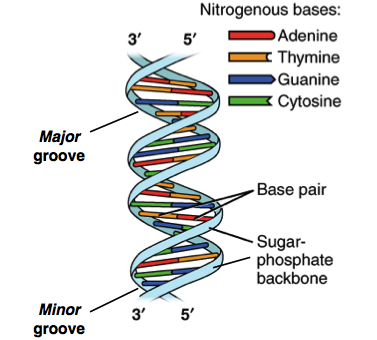
| The Structure of Chromosomes | - Composed of genes - Made up of DNA and protein - Made up of two strands twisted together into a double helix - Each strand is made of: ~sugars & acids on outside ~ 4 different bases that make up the rungs of the ladder - Adenine (A), Thymine (T), Cytosine (C) and Guanine (G - A only goes with T and C only goes with G - James Watson and Francis Crick established the structure of DNA in 1953. |
| DNA | DNA or deoxyribonucleic acid is a long molecule that contains our unique genetic code. |
| The Structure of DNA | - The building blocks of DNA are called nucleotides - 1 nucleotide is made up of 1 phosphate, 1 sugar and 1 nitrogenous base (A, G, T or C) |
| How is DNA the Blueprint of Life? | - Every cell in your body has the same 'blueprint' or DNA - The DNA 'blueprint' tells the cell how to build the organism. - A cell has the ability to turn off genes and only work with the genes necessary fir their job (how heart cells are made differently to skin cells) |
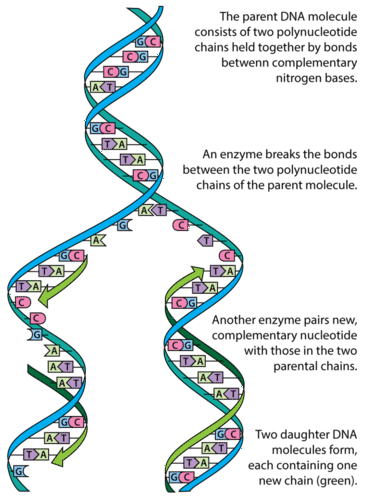
| DNA Replication Basic | When DNA duplicates, it splits down the middle and each side copies its complementary side. |
| DNA Replication Steps | 1. Unwinding the DNA molecule - the long strand of DNA is untwisted at a high speed by enzymes 2. Making new DNA strands - On one side, the nucleotides are assembled in a continuous fashion - from nucleotides floating around in nucleus 3. Rewinding the DNA molecule - The two molecules return to their double helix shape - Each double helix is then further wrapped to form separate chromatids with twice as much DNA as regular chromosomes - The 2 chromatids will separate in cell division. |
| Why is DNA the Molecule of Life? | -Because it is the only molecule that is able to replicate itself. |
| Diploid | The name for the normal number of chromosomes in a non-sex cell (46). |
| Haploid | Having half the number of 'normal' chromosomes (occurs in sex cells). |
Want to create your own Flashcards for free with GoConqr? Learn more.