
18414603


| Question | Answer |
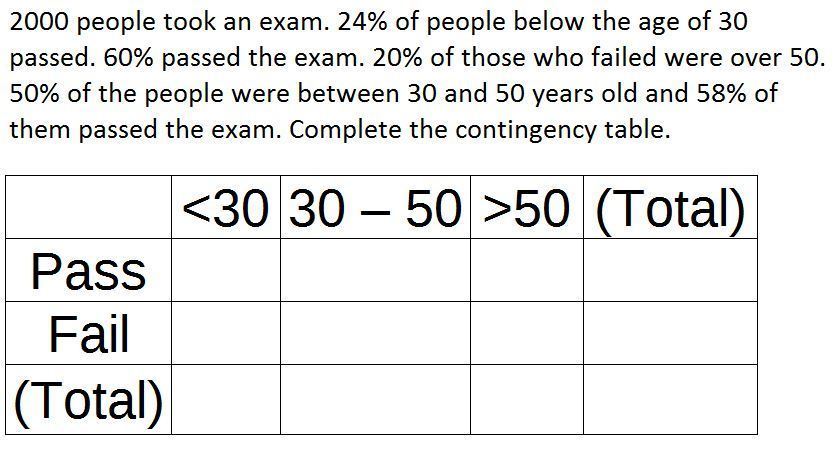
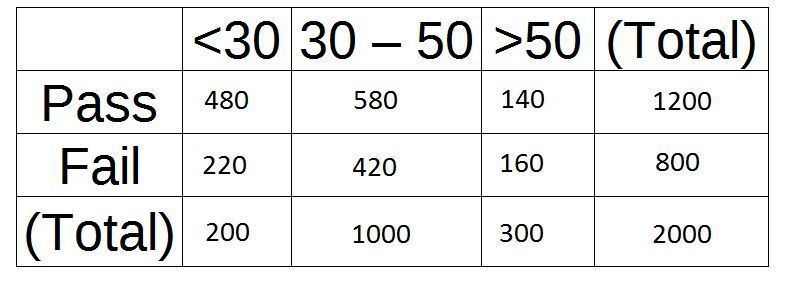
| What is a contingency table? | A method of showing bi-variate data, also known as a two-way table |
| What do we call the data collected in the table? | Observed values |
| How do we test for independence? | Test the observed values against the values that are expected in each of the cells |
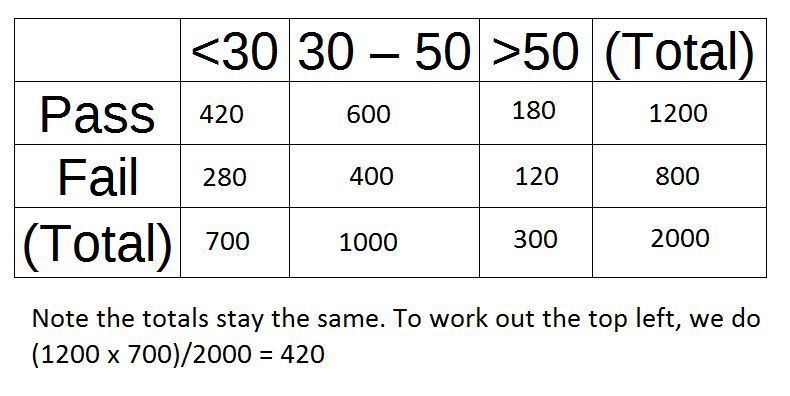
| How do we calculate the expected values? | (row total x column total) / grand total Note this is for each individual cell |
| Create an expected values table for this observed value table: | |
| The expected values don't need to be.... | Whole numbers |
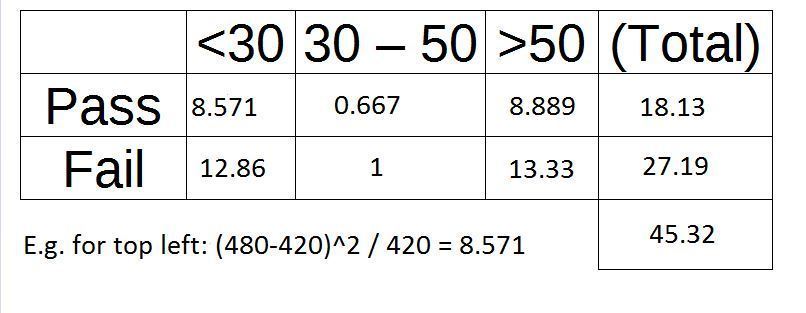
| What is the formula to work out the test statistic? | Σ(oi - Ei)^2 / Ei (Oi = observed frequency , Ei = expected frequency) Note: This is for corresponding cells |
| Create a test statistic table from the tables above: | |
| The greater the values in the (o - E)^2 / E cells correspond to the cells that have the greatest..... | Influence on association |
| What is Chi-squared distribution? | The distribution of the sum of the squares of set n, independent random variable |
| How is Chi-squared denoted? | χ^2 |
| The number of independent random variables is called.... | Degrees of freedom (nu / v) |
| For the contingency table m x n , how do we calculate the degrees of freedom? | v = (m-1)(n-1) |
| the test statistic calculated from a contingency table is approximately χ^2 distribution: | Σ(oi - Ei)^2 / Ei ~ χ^2 |
| Chi-squared test for association between category A and category B : | 1. State null and alternative hypothesis in context 2. Complete contingency tables for observed and expected values 3. Calculate approximate χ^2 statistic using Σ(oi - Ei)^2 / Ei 4. State degrees of freedom using v = (m-1)(n-1) 5. Determine critical value using χ^2 table for given significance level 6. Compare χ^2 statistic with critical value from table and conclude |
| For any Chi-squared test, what are our null and alternative hypothesis' ? | H0 : No association between A and B H1 : Association between A and B |
| What are our conclusions for Chi-squared distribution? | χ^2 statistic < critical value : accept H0 χ^2 statistic > critical value : reject H0 Remember to write conclusion is context |
| If the expected value in any cell is too small, it increases chance of..... | Error in the test |
| We should not run a χ^2 test for association if any cell has an expected value of less than or equal to.... | 5 |
| How could we attempt to fix the problem above? | Combine category's (e.g. if bike, run and walk, combine to bike, on-foot) |
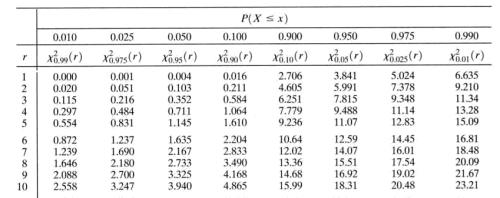
| Chi-squared table: (Use only 0.9 and above) |
Image:
Index (image/gif)
|
Want to create your own Flashcards for free with GoConqr? Learn more.