
1944934


| Question | Answer |
| Leading | Process of inspiring others to work hard to accomplish important tasks |
| Management Vs. Leadership | Efficiency vs Effectiveness Things vs People Position vs Person Functioning of organization vs Promotion of vision Achieving results vs Enabling change |
| Leadership styles | Autocratic/directive - High concern for the task and low concern for people Democratic/participative - High concern for both people and tasks |
| Directions in leadership research | Trait approach (on leader’s personal characteristics) Behavioral approach (leader’s behavior) Contingency approach (match between leader behavior and situational characteristics) Charismatic approach (Focus on visionary qualities) |
| Trait approach (Theories) | Physical traits Personality traits Intelligence |
| Behavioral approach | McGregor’s Theory X and Theory Y Likert’s management styles Blake and Mounton’s leadership grid |
| Likert’s management styles (Leadership behaviors) | Extremely autocratic Benevolently autocratic Consultative Group-participative |
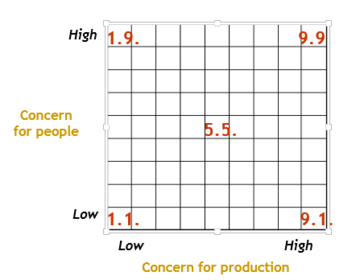
| Blake and Mounton’s leadership grid | |
| Blake and Mounton’s leadership grid (Explain points) | 9.9. Team Management 1.9. Country Club Management 9.1. Authority-Obedience Management 1.1. Impoverished Management 5.5. Middle-of-Road Management |
| Contingency approach | Fiedler’s contingency model House’s path-goal leadership theory Vroom-Jago leader-participation theory Integrative leadership style model |
| House’s path-goal leadership theory (Leadership styles) | Directive leadership Supportive leadership Achievement-oriented leadership Participative leadership |
| Leader behaviors | Directive Supportive Achievement oriented Participative |
| Situational contingencies | Subordinate: Ability, Experience,Locus of control. Environment: Task structure, Authority, system, Work group |
| Vroom-Jago leader participation theory | Effective leadership results when the decision method used correctly matches the characteristics of the problem to be solved |
| Decision-making methods | Authority decision Consultative decision Group decision |
| Integrative leadership style model | Leader | Leadership style ----------------------------------------- Followers| Situation |
| Charismatic approach | “Superleaders”: Charismatic leaders, Visionary leaders, Global leaders, etc. |
| Attributes of transformational leaders | Vision Charisma Symbolism Empowerment Intellectual stimulation Integrity |
| Characteristics of global leaders | Thinking globally, Appreciating diversity, Developing technological savvy, Building partnerships, Sharing leadership, Creating a shared vision, Developing people, Empowering people |
Want to create your own Flashcards for free with GoConqr? Learn more.