
20889773
Description

Flashcards by Roxanne Farhan, updated more than 1 year ago

|
Created by Roxanne Farhan
almost 6 years ago
|
|
| Question | Answer |
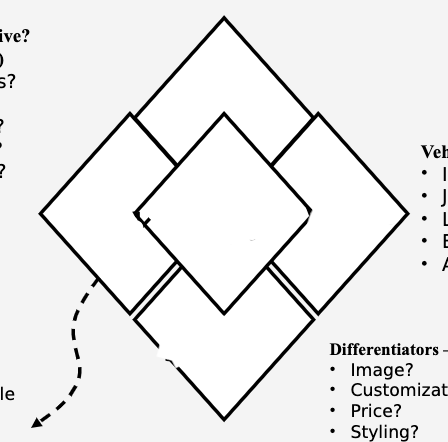
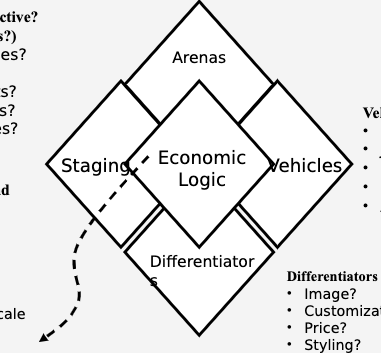
| 5 Diamond | |
| Framing | the way an issue is posed; how an issue is framed can significantly affect decisions and judgments. |
| Conceptual Overview of Strategic Decisions | |
| Competitive Advantage Definition | the reason a customer chooses to transact with and pay a profitable price to a particular firm |
| Competitive Advantage is... | - episodic & specific - identified & evidenced through customer action - directly related to value creation, value appropriation, and performance |
| Corporate vs. Business Strategy | In which businesses will we compete vs. how do we compete in this market? |
| Internal Aspect of Competitive Advantage | "resource view"; (firms are heterogenous) |
| External Aspect of Competitive Advantage | "positional view"; (firms competitive advantage & subsequent performance are due to industry attractiveness) |
| Consider whether a firm's resources are... (VRIN) | Valuable, Rare, Inimitable, Non-substitutable |
| Performance Measurements | Value, profitability |
| 5 Traps of Performance Measurement | measuring against yourself, looking backward, putting your faith in numbers, gaming your metrics, sticking to your numbers too long |
| Profitability (as a measure) | absolute and relative measurements, occurs continuously but reported discretely, backwards looking |
| Altman's Z | likelihood of insolvency. higher numbers indicate stronger performance. (< 1.8 great distress, > 3.0 no distress) |
| Tobin's Q | ratio of firm's market value to the replacement cost of its assets. reflects value of firm's intangible assets. Simple & powerful for public firms. |
| Economic Value Added (EVA) | net operating profit after taxes less weighted average cost of debt&equity(or capital) (NOPAT - WACC). captures economic profit for specific projects. |
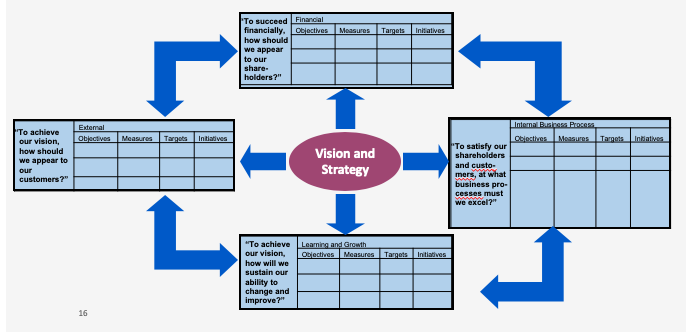
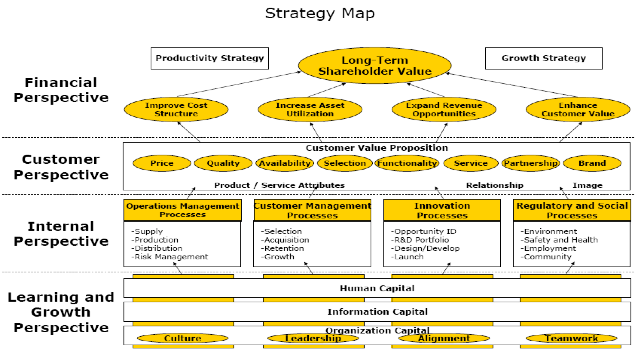
| Balanced Scorecard |
Image:
Image (binary/octet-stream)
|
| Strategy Map |
Image:
Image (binary/octet-stream)
|
| benefits of a good reputation | higher quality employees, premium prices, less negative reactions if something goes wrong |
| burdens of a good reputation | higher expectations, less positive reactions to positive outcomes |
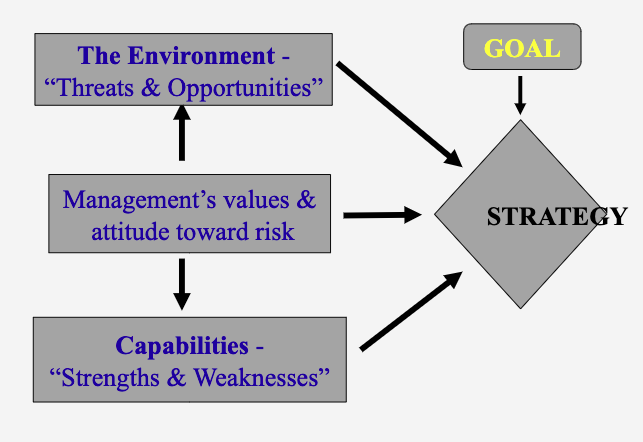
| Strategic Management | A systematic framework of relationships and associations that, when understood well, can facilitate the quest for performance |
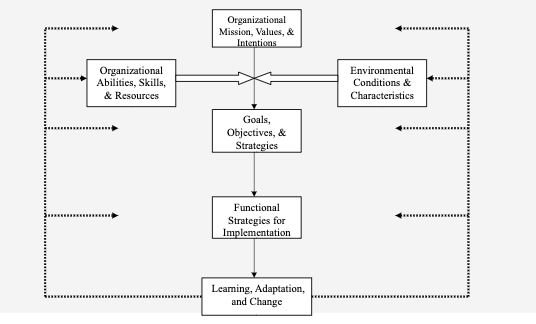
| Strategic Management Process | |
| Vision | simple statement of what the firm will be. forward looking. |
| Mission | what the firm is and stands for. fundamental values and purpose. |
| Vision & Mission -> Strategic Goals & Objectives -> | Firm's Overall Strategy |
| Goal Setting Principles | consistent with the firm's mission & flow from SWOT analysis. specific short term, general long term. |
| Confirmation Bias | look for information that supports existing beliefs, reject data that go against what you believe. |
| Overcoming Confirmation Bias | Seek out information from a range of sources & perspectives, assign someone to "devil's advocate", actively seek out contradictory information, surround yourself by diversity |
| Overconfidence | Place too much faith in your own knowledge & opinions |
| Anchoring Bias | An initial reference point distort subsequent estimates |
| Overcoming Anchoring Bias | throw initial value away if it sounds implausible, find another extreme anchor on the opposite end |
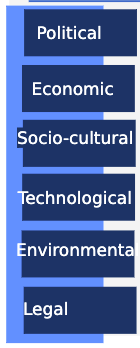
| Macro Environment Analysis: PESTEL | |
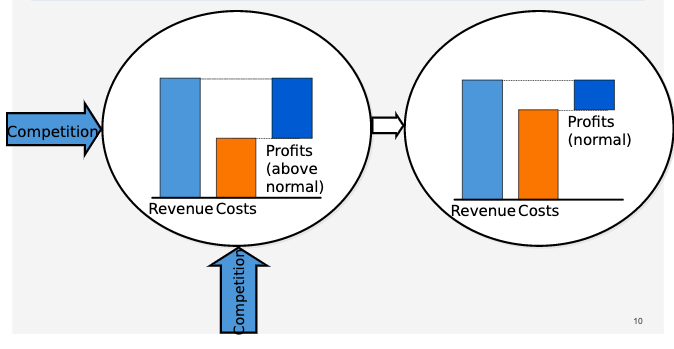
| Competition Theory | Competition should drive profit to "equilibrium" |
| Competitors | Firms who lure away customers. Their products & services are the benchmarks against which a firm's products and services are judged |
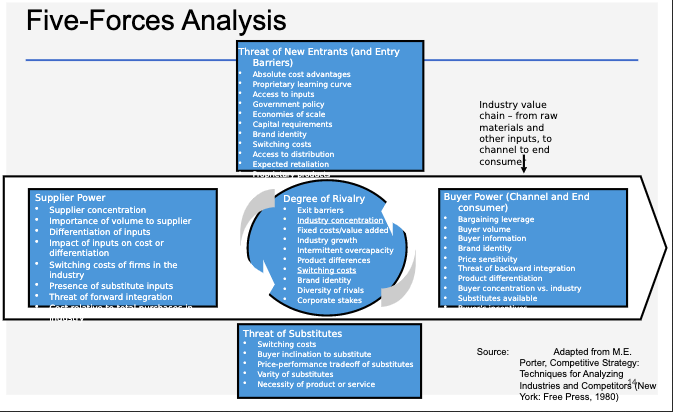
| Five-Forces Model | Bargaining Power of the Seller, Bargaining Power of the Buyer, Availability of Substitutes, Threat of New Entrants, Rivalry Among Competitors |
| Five-Forces Analysis (diagram) | |
| Bargaining Power can come from... | Attractiveness & availability, quality, absence of competition, importance of the product or service, exclusivity or prestige |
| Few buyers & many suppliers means... | Buyers capture a greater share of profits |
| Substitutes mean... | greater elasticity |
| Barriers to Entry | Strong brands, proprietary technology, start-up costs |
| Barriers to Exit | Few other opportunities, sunk investments |
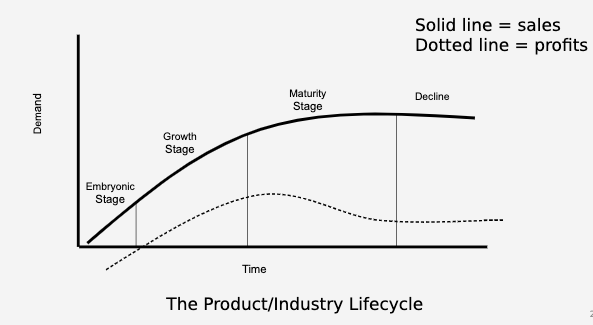
| Competitive Analysis & The Lifecycle Model | |
| Switching Costs | Costs to the buyer change from one provider to another |
| Organizational Performance | how well an organization is doing to reach its vision, mission, and goals |
| Market Cap | investors' perception of company's value/price |
| CSR investment vs. likelihood of dismissal | High CSR Investment, more likely to be let go if low financial performance. No CSR Investment, more likely to be let go when high financial performance. |
| Targeting | More successful people face higher expectations (tall poppy syndrome) |
| At what price range do you lose all demand? (CAPSIM) | $5 above range |
| How will we be evaluated? (CAPSIM) | stock price, contribution margin, plant utilization, amount of inventory, etc. |
| Center of Circle + Drift Rate = (CAPSIM) | Ideal |
| Cohen's Kappa | Assess reliability (qualitative) |
| Forward Integration | Expand business to include control of distribution or supply |
| Industry Definition | a set of firms that solves the same economic problem in the same way |
| If you put in more money for recruiting... (CAPSIM) | Better products, turnover decreases |
| How much of the market forgets about product each year? (CAPSIM) | a third of the market |
Want to create your own Flashcards for free with GoConqr? Learn more.