
23833155
Description
Flashcards by RadTech Fairy, updated more than 1 year ago
|
|
Created by RadTech Fairy
over 5 years ago
|
|
| Question | Answer |
| What is the unit of measurement for the strength of a magnetic field? | Tesla |
| 1 Tesla = ____ Gauss | 10,000 |
| What is the purpose of the magnetic field in MR imaging? | To excite Hydrogen nuclei so they will line up and precess along the magnetic field |
| What is the purpose of the gradient coils within the MRI bore? | The coils alter the magnetic field in 3 planes (x, y, z), and localize RF signals in space to capture images produced from the patient |
| What is the purpose of the RF coils within the MRI bore? | They send and receive radiofrequency signals to and from the selected tissues being imaged to cause resonance within the hydrogen nuclei |
| Which kinds of metals are attracted to the magnetic field of the MRI magnet and why? | It's an electromagnet Ferrous metals are most attracted to it |
| Examples of ferrous metals? | *containing iron* steel cast iron stainless steel |
| Examples of nonferrous metals? | *no iron content* aluminum copper tin lead nickel titanium platinum gold silver brass |
| Why are some patients allowed to keep their wedding bands on if they cannot be removed for the MRI exam? | Even though the metal will not rip off the patient and be stuck to the magnet, it will still be excited and heat up - could potentially cause burns to the skin |
| Atomic Number | the sum of protons in the nucleus - makes up the chemical identity |
| Mass number | Sum of protons + neutrons in the nucleus usually balanced making the mass an even number |
| Isotopes | atoms with slightly fewer or more neutrons than protons in the nucleus (making it unbalanced) |
| Ions | an atom becomes an ion when an external energy alters the orbital electrons by knocking them out or by adding electrons to the orbit causing an emission of radioactivity *an ion contains a net charge due to the altered orbital electrons* |
| Anion | atoms that gain electrons and become negatively charged |
| Cation | atoms that lose electrons and become positively charged |
| Spin | electrons spin in their own axis while they spin around the nucleus in orbit, the nucleus spins on its own axis |
| Angular Momentum | The quantity of rotation of a body, which is the product of its moment of inertia and its angular velocity. |
| Magnetic Moment | The magnetic moment is the magnetic strength and orientation of a magnet or other object that produces a magnetic field The magnetic moment can be considered to be a vector quantity with direction perpendicular to the current loop in the right-hand-rule direction. |
| What is the most important MR active nuclei in the human body and why? | Hydrogen the most abundant atom in the body (H2O) AND because H acts as a tiny magnet in itself due to its 1 spinning positively charged proton |
| Spin-Up Nuclei AKA parallel | low energy nuclei of Hydrogen under a magnetic field will align and precess with the general direction of the magnetic field (atoms need less energy to walk upright) |
| Spin-Down Nuclei AKA - antiparallel | high energy nuclei of Hydrogen under a magnetic field will align with the magnetic field in an antiparallel direction (atoms need higher energy to walk upside down) |
| Why is it true that in an external magnetic field, the number of Hydrogen protons will be equal as parallel and antiparallel? | Due to the Pauli Exclusion Principle : two fundamental particles cannot have the same properties, if 2 protons are in the same energy level one must exist as a spin-up, and one must exist as a spin-down |
| Net Magnetization Vector (NMV) | The relative balance between spin-up and spin-down nuclei |
| Under a stronger magnetic field (3T), the NMV is _____ compared to a weaker magnetic field (1.5T). | larger - direct relationship between B and NMV |
| Precession | The influence of an external magnetic field (B) on a Hydrogen nucleus causes the spinning on its axis to wobble |
| Precessional Frequency | dictates the speed of the precession around B and is measured in Megahertz (MHz) |
| Which principle governs the precessional frequency of Hydrogen protons in a magnetic field? | The Larmor Equation w = yB (precessional frequency = magnetic field strength x gyro-magnetic ratio) |
| Resonance | Phenomenon that occurs when an object or system is exposed to an oscillating force having a frequency close to its own natural frequency: RF pulse applied to the H protons under B causes the net magnetization of H to tip onto the horizontal axis (transverse magnetization) and the protons precess in phase simultaneously |
| Excitation | The application of radiofrequency (RF) pulses that causes resonance to occur |
| For resonance to occur in Hydrogen protons, the RF pulses must be applied at the exact ______ ______ to cause the protons to tip on their axis. | Larmor Frequency |
| Relaxation | When the RF pulse is switched off, the net magnetization of the H protons gradually returns to a vertical magnetization and the protons dephase back to their original precessions |
| Of these three phenomenon: excitation, resonance, relaxation; which one will produce a signal for the RF coils to detect? | Relaxation: as the protons return to their dephased precession, they lose energy and this energy is picked up by the coils producing an image |
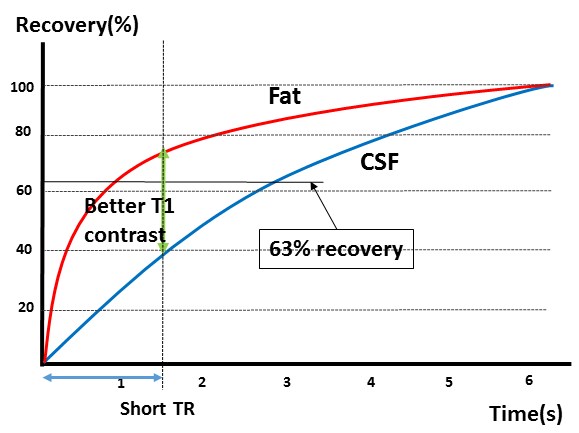
| T1 RELAXATION: the time it takes for the longitudinal magnetization vector to return to 63% of the original longitudinal magnetization after the RF pulse is switched off and the protons begin to dephase and relax | |
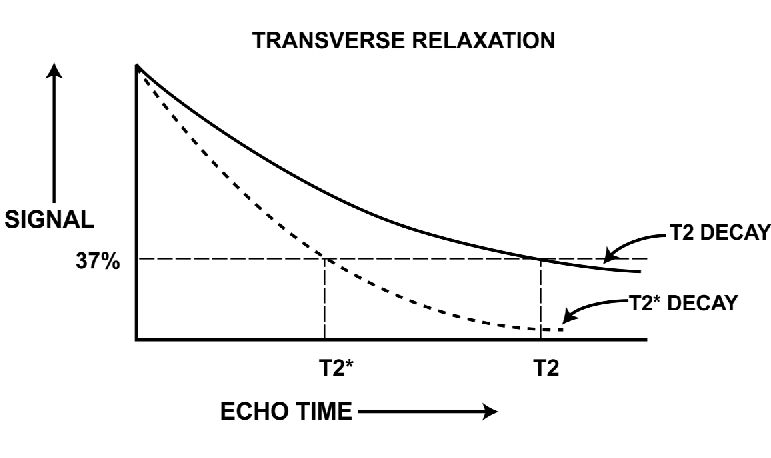
| T2 DECAY the time it takes for the transverse magnetization vector to decrease to 37% of its original value after the RF pulse is shut off and the protons dephase and begin to relax | |
| T1 is ___ as long as T2 | 2-10 times even though relaxation times vary depending on the tissue types, T1 always takes longer than T2 |
| T1 relaxation times vary depending on: | structure, tissue composition, and surroundings |
| T2 decay times vary depending on: | the rate at which the protons come out of phase after RF is turned off |
| Why is the sum vector (NMV) so important? | It represents the total magnetic moment of a tissue in general |
| What are the characteristics of a T1 image? | Air: dark Fat: bright Bone: dark Fluids: dark Gray Matter: gray White Matter: white Moving blood: dark Muscles: shades of gray Bone Marrow: equal to or higher than that of muscle (fatty marrow usually bright) |
| On a T1 weighted image, how does pathology usually appear? | Pathology normally increases the water content in tissues, therefore they're usually dark on T1 images |
| On a T2 weighted image, what do the tissue characteristics usually appear as? | Air - dark Bone - dark Fluids - bright Gray Matter - gray White Matter - darker than gray Moving Blood - dark Fat - bright (darker than the fat signal on T1) Muscles - gray (darker than T1) Bone Marrow - equal to or higher than that of muscle (fatty marrow is usually bright) |
| On a T2 weighted image, how does pathology usually appear? | Increased water to the area causes an image of increased brightness on T2 |
Want to create your own Flashcards for free with GoConqr? Learn more.