
3173731
Description

Flashcards by Jonathan Cash, updated more than 1 year ago

|
Created by Jonathan Cash
over 10 years ago
|
|
| Question | Answer |
| Characteristics of the Nervous System | Fast acting control system Responds to internal and external change (Stimuli) Activates muscles and glands |
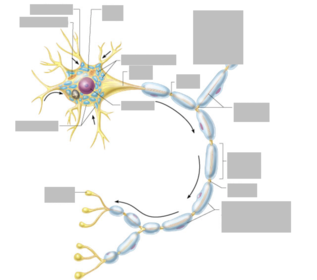
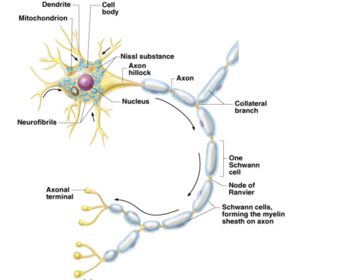
| Neurons = nerve cells Job | Major regions of neurons Cell body – nucleus and metabolic center of the cell Processes – fibers that extend from the cell body |
| What does the Cell body contain? | Nucleus Mitochondria |
| What does the Extensions outside the cell body contain? | Dendrites – conduct impulses toward the cell body Axons – conduct impulses away from the cell body |
| Nerve Axon Coverings | Schwann cells – produce myelin sheaths in jelly- roll like fashion Nodes of Ranvier – gaps in myelin sheath along the axon |
| Axons | Starts at the axon hillock Axons end in axonal terminals Axonal terminals contain vesicles with neurotransmitters Axonal terminals are separated from the next neuron by a gap |
| Axonal terminals gaps | Synaptic cleft – gap between adjacent neurons Synapse – junction between neurons |
| Neuron Cell Body Location p.1. | Most are found in the central nervous system Gray matter – cell bodies and unmyelinated fibers |
| Neuron Cell Body Location p.2. | Nuclei – clusters of cell bodies within the white matter of the central nervous system Ganglia – collections of cell bodies outside the central nervous system |
| Key Terms related to the Neuron | • Neuron – Dendrites – Cell body – Axon – Myelin sheath – Schwann cells – Axon terminals – Synapse – Neuromuscular junction • Neuroglia – Supporting cells in the CNS “nerve glue” |
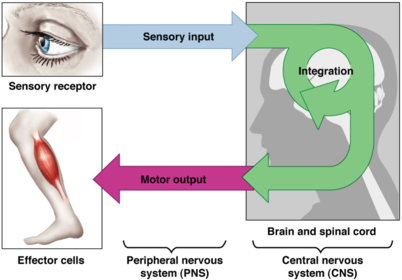
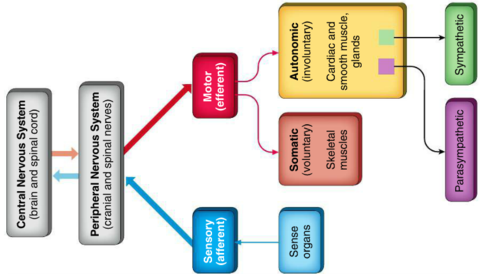
| Functional Classification of Neurons Motor (efferent) | Carry impulses from the central nervous system Signals muscles to move |
| Functional Classification of Neurons Sensory (Afferent) | Carry impulses from the sensory receptors Cutaneous sense organs Proprioceptors – detect stretch or tension Tells you what is happening in your body |
| Two Functional Classification of Neurons? | Sensory (Afferent) Motor (efferent) |
| Three Structural Classification of Neurons? | Multipolar Unipolar Bipolar |
| Multipolar neurons | – many extensions from the cell body, most common |
| Unipolar neurons | – have a short single process leaving the cell body, sensory |
| Bipolar neurons | – one axon and one dendrite, rare in adults eye & ear |
| Interneurons (association neurons) | Found in neural pathways in the central nervous system Connect sensory and motor neurons |
| Functional Properties of Neurons | Irritability – ability to respond to stimuli Conductivity – ability to transmit an impulse (electricity) The plasma membrane at rest is polarized Fewer positive ions are inside the cell than outside the cell |
| Resting Membrane Potential | The plasma membrane of a neuron at rest is polarized. Fewer positive ions are inside the cell than outside the cell |
| Resting Membrane Potential | Slightly more positive ions outside the cell compared to inside. As long as the inside stays more negative will be inactive  |
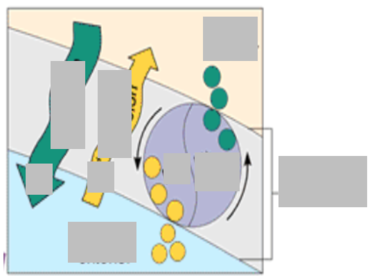
| Resting Membrane Potential Major ions inside and out? | Major positive ion inside the cell is K Major positive ion outside the cell is Na+  |
| Importance of Resting Membrane Potential | |
| Starting a Nerve Impulse | Different stimuli excite neurons to become active and produce an impulse. Most neurons are excited by neurotransmitters from other neurons Regardless of type of stimuli the result is the same - permeability of the membrane alters |
| Starting a Nerve Impulse p.1 | Normally very small amounts of Na+ diffuse through the membrane Na+ concentration higher outside cell than inside cell With adequate stimulation sodium gates open |
| Starting a Nerve Impulse p.2 | Na+ rushes into the cell (no Na+ entry no action potential) Na+ changes membrane polarity - inside more positive This is called depolarisation |
| The Action Potential p.1 | If the action potential (nerve impulse) starts, it is propagated over the entire axon and never goes part way along axon Immediately after Na+ rushes in membrane permeability changes again. |
| The Action Potential p.2 | Membrane become impermeable to Na+ but permeable to K+. Remember more K+ inside cell than outside. Potassium ions rush out of the neuron after sodium ions rush in, which repolarizes the membrane |
| The Action Potential p.3 | Repolarisation restores the membrane electrical conditions to resting. The sodium-potassium pump restores the original configuration of Na+ and K+ This action requires ATP |
| Nerve Impulse Propagation p.1 | The impulse continues to move away from the cell body This shows events in an unmyelinated axon Impulses travel faster when fibers have a myelin sheath Impulses travel faster when fibers are large |
| Nerve Impulse Propagation p.2 | Impulses travel faster when fibers have a myelin sheath Nerve impulse jumps from node of Ranvier to node of Ranvier along the length of the axon No electrical current can flow across the membrane where there is fatty myelin insulation This is called Saltatory conduction |
| Continuation of the Nerve Impulse between Neurons | Impulses are able to cross the synapse to another nerve Neurotransmitter is released from a nerve’s axon terminal The dendrite of the next neuron has receptors that are stimulated by the neurotransmitter An action potential is started in the dendrite |
| The synapse stage 1,2,3 | 1. Action potential arrives 2. Vesicle fuses with plasma membrane 3. Neurotransmitter is released into synaptic cleft |
| The synapse stage 4,5,6 | 4. Neurotransmitter binds to receptor on receiving neurone's membrane 5. 6. |


Want to create your own Flashcards for free with GoConqr? Learn more.