
3637306
Description

Flashcards by Jonathan Cash, updated more than 1 year ago

|
Created by Jonathan Cash
about 10 years ago
|
|
| Question | Answer |
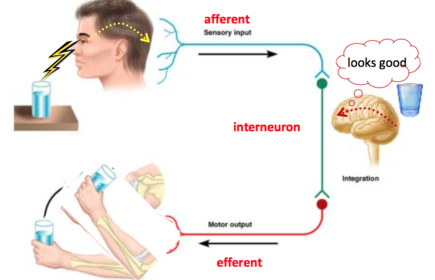
| Major Functions | The nervous system is a very fast communication system that responds to our biological needs in the micro- to millisecond range: Three major functions: • Gather information (sensory input) • Analyse & interpret – (aware or unaware) • Respond (behave) |
| Functional classifications | |
| Protection of the Brain | • The brain is protected by bone, meninges, and cerebrospinal fluid • Harmful substances are shielded from the brain by the blood-brain barrier |
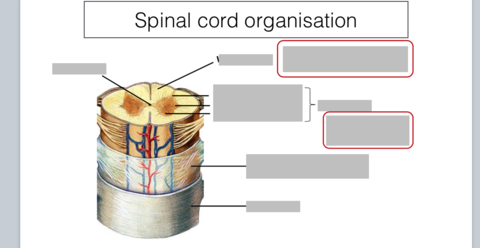
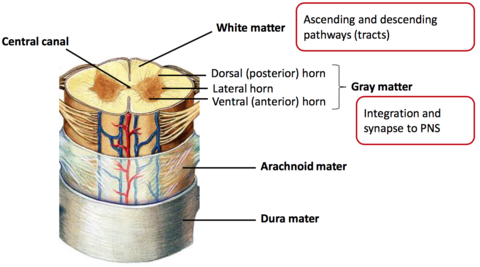
| Meninges | Three connective tissue membranes lie external to the CNS – dura mater, arachnoid mater, and pia mater |
| Dura Mater | – Leathery, strong membrane composed of two fibrous connective tissue layers |
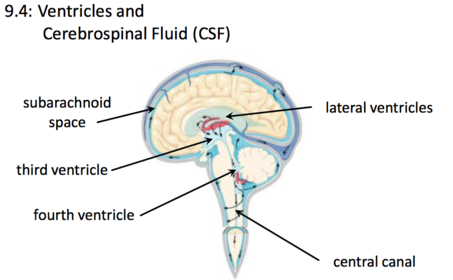
| Arachnoid Mater | – The middle tissue, which forms a loose brain covering – It is separated from the dura mater by the subdural space – Beneath the arachnoid is a wide subarachnoid space filled with CSF and large blood vessels |
| Pia mater | – Deep layer composed of delicate connective tissue that clings tightly to the brain |
| Meninges - function | • cover and protect the CNS • protect blood vessels • contain cerebrospinal fluid (CSF) |
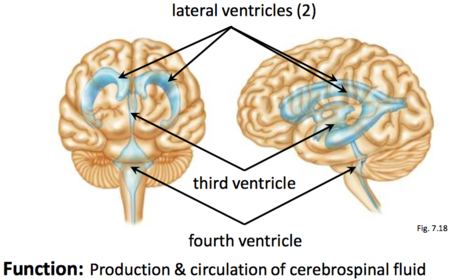
| Cerebrospinal Fluid (CSF) Functions | • Reduces the weight of the brain by floating it – 1500 grams becomes about 50 grams • Protection from blows (other than major ones) • Waste removal from the CNS • Regulation of chemicals and pH in CNS |
| The Brainstem | Midbrain Pons Medulla oblongata |
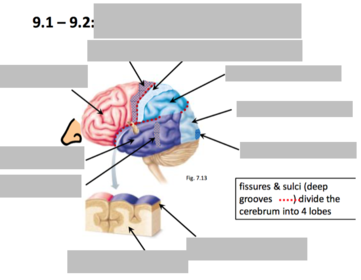
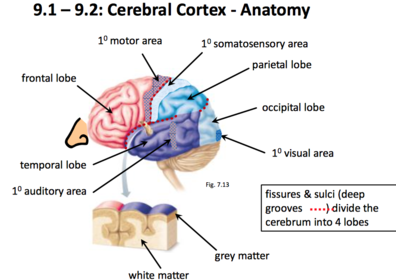
| Cerebral Cortex - Function Frontal lobe | • Controls voluntary movement of skeletal muscles • Executive area for task management e.g. solving complex, multitask problems and reasoning • Facilitates working and autobiographical memory |
| Cerebral Cortex - Function Parietal lobe | • Integrates sensory messages travelling from the body’s sensory receptors • Enables awareness of pain, cold, heat, and touch |
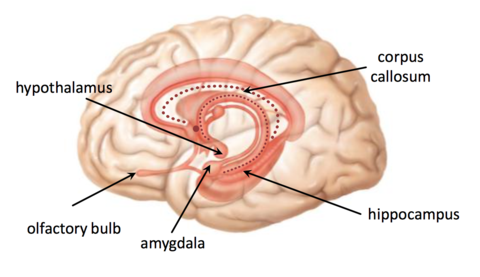
| Cerebral Cortex - Function Temporal lobe | • Integrates auditory (hearing) messages. from the ear • The olfactory (smell) area is also found deep in the temporal lobe |
| Cerebral Cortex - Function Occipital lobe | • Integrates visual messages sent via the eyes |
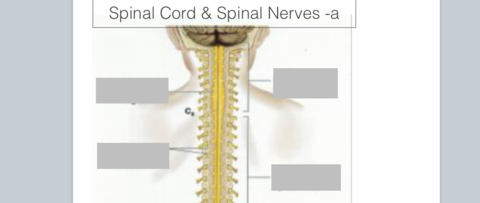
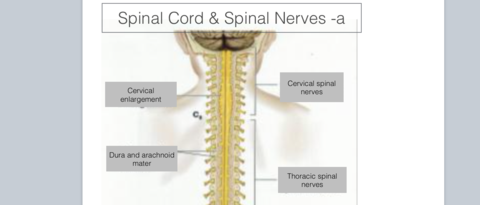
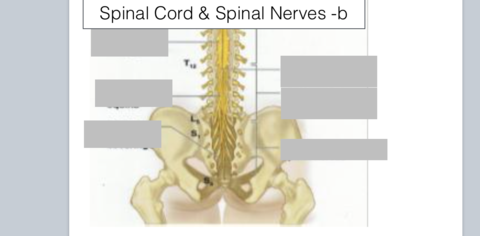
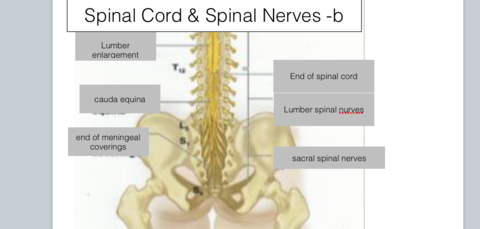
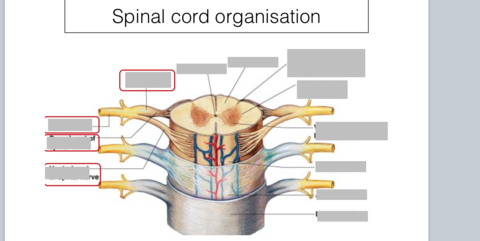
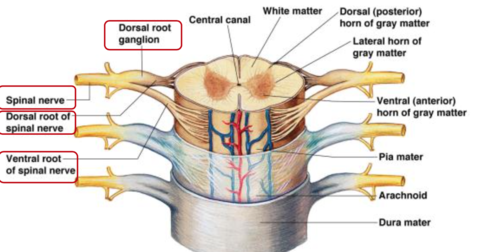
| Spinal Cord & Spinal Nerves - a | |
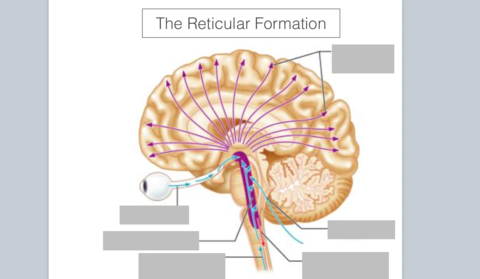
| Ascending and descending neural pathways | Neural pathways are the routes taken by nervous messages around the body - ascending (sensory) or - descending (motor) |
| ascending | (sensory) – taking messages from the peripheral nervous system to the central nervous system |
| descending | (motor)– taking messages from the central nervous system to their destination (skeletal muscles) |
| Reflex arc summary | • Sensory receptor – reacts to stimulus • Sensory neuron – carries message to integration centre • Integration centre – processes information and direct motor output (Interneuron and/or synapse) • Motor nerve – carries message to an effector • Effector organ – is the muscle or gland to be stimulated |
| Sympathetic Nervous System Sympathetic—“fight or flight” | • response to unusual stimulus • takes over to increase activities • remember as the “E” division - exercise, excitement, emergency, and embarrassment |
| Parasympathetic Nervous System Parasympathetic—“housekeeping” activities | • conserves energy • maintains daily necessary body functions • remember as the “D” division - digestion, defecation, and diuresis |






Want to create your own Flashcards for free with GoConqr? Learn more.