
3567492


| Question | Answer |
| Collagen | They are the most common type of fibrous protein found in animals (25-30%). The connect and strengthen tissues, and have a characteristic triple helical structure. |
| Poly-proline type II characteristics | Glycine as every third residue Lot of hydroxylated prolines and lysine |
| What hydroxylyzes proline and lysine | prolyl hydroxylase lysyl hydroxylase |
| What causes scurvy | A lack of vitamin c > which prevents iron from being reduces > which prevents the function of proly-hydroxylase > proline is not hydroxylised > poly-proline type II doesn't form triple helical structure |
| Is collagen hydrophobic? | Quite hydrophobic due to the many exposed hydrophobic side chains |
| Ostyogenesis Imperfecta | Often glycine mutations. Prevents proper assembly of triple helix. Leads to lack of collagen. |
| Malformed or absent bone | Ehlers–Danlos syndrome (EDS) – a connective tissue disorder caused by a defect in the synthesis of collagen |
| Antibodies | A specific protein produce by the immune system in response to a foreign molecule (antigen). They bind tightly to these antigens and mark them for destruction. |
| How are antibodies made? | Antibodies are made by B-lymphocytes and are found in blood, lymp and other bodily fluids. |
| We study Immunoglobulin G or IgG | Just know that. |
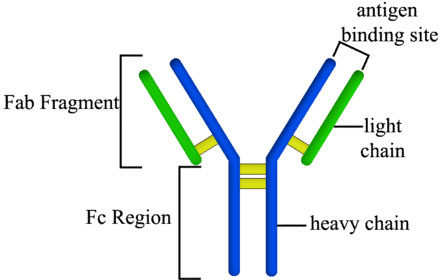
| Describe the basic structure of an antibody | They are made up of 4 chains which are held together by disulphide bonds. |
| FC region Fragment crystallized | Effector site which usually remains the same across different amino acids. -activate the complement pathway -bind to phagocytes -bind to mast cells, basophils, and eosinophils -bind to NK cells |
| 2x FAB region fragment antigen binding | They contain the antigen binding sites |
| Production of antibodies | Created by injecting an 'antigen‘ in an animal (often rabbit, goat) After immune response, antibodies harvested from blood. |
| Uses of antibodies | Extreme specificity makes IgG a valuable tool. 1. Lab experiments: identifying molecules 2. Clinical therapy: Anti venom 3. Clinical: diagnosis of diseases like HIV |
| Ligands | Many proteins contain sites to which ligands specifically bind and form a “complex” with the protein. (the site is called the active site on an enzyme) Binding occurs by multiple weak or a few strong forces - leads to extreme specificity |
| Ligand binding - Dissociation Constant | Kd High affinity = tight binding = small Kd Units are moles/L (M) (Check notes on it - the graphs are great.) |
Want to create your own Flashcards for free with GoConqr? Learn more.