
38459808


| Question | Answer |
| is there a time peramiter in a flow volume loop | no |
| give the equation for flow | flow = velocity x area |
| how does cross sectional area change as you go down the airways? | it increases because the exponential increase in number of smaller airways overcomes the decrease in individual size |
| what what generation is the speed of movement the same as that of diffusion | gen 17 and onwards |
| why does velocity decrease at lower airways | because the total flow needs to remain the same so over all the different airways it needs to be smaller with greater branching |
| what does a higher velocity of movement do to pressure | decreases pressure |
| how does the high velocity in larger airways affect pressure | causes pressure to be lower then expected |
| what factors effect reynolds number and therefore turbulance | radius density of fluid velocity viscosity |
| is flow laminar or turbulent in larger airways | turbulent because larger radius and higher velocity |
| why is flow transitional in the bronchial tree? | the radius is getting smaller and velocity is lower so reynolds decreases but the biforcations of these airways maintains some turbulance |
| what is the relationship between laminar flow and pressure gradient | directly related |
| what is the relationship between turbulent flow and pressure gradient | turbulence is the square root of pressure gradient |
| does pressure fall more quickly in turbulent or laminar airways | turbulent airways |
| what happens to resistance as you inhale and why | - resistance decreases because the airways expand during the inflation of the lungs - decreases to the power of 4 |
| at what point is there the least airway resistance | at total lung volume |
| at what point in the resp cycle is there the greatest airflow and why | as you start expiring from total lung volume because resistance is lowest here |
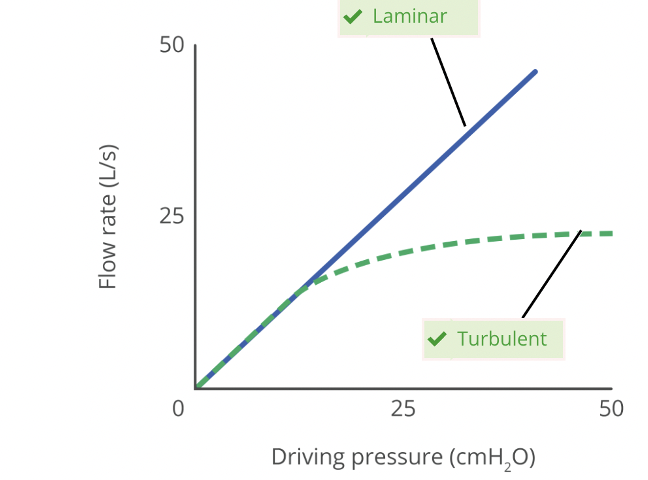
| how would a graph look where driving pressure is plotted against flow rate of both laminar and turbulant flow | initially the increase in driving pressure causes the same linear increase in flow rate but at a certain point the turbulent flow rate plataues |
| when expiring, why is the pressure gradient between alveoli and trachea greater than expected | - because as velocity increases and flow becomes more turbulent the pressure decreases so pressure is lower in larger airways - causes greater difference in pressure |
| what factors determine the pressure in the alveoli | pleural pressure, elastic recoil of the alveoli, surface tension |
| what does a larger elastic recoil mean for transmural pressure | greater transmural pressure |
| does the barometric or alveolar pressure generate driving pressuer | the alveolar pressure |
| what will happen to pleural pressure during forced expiration | the pleural pressure becomes positive |
| is the pressure gradient from the alveoli to the trachea linear? | no because of the change in pressure under turbulance and higher velocity |
| will a greater pleural pressure cause greater or lower alveolar pressure and why | will cause greater alveolar pressure because there is more of a collapsing force so greater driving pressure generated |
| why does there need to be cartialage in the upper airways | because of the pressure decrease during expiration they have a collapsing pressure so need to be held open |
| why does the location of an equal pressure point determine if there will be an airway collapse? | - because if there is an equal pressure point in the upper airway the cartillage will prevent collapse - if there is an equal pressure point in the lower airways then there is no cartilage so can collapse |
| in health do you get equal pressure points in the lower airways | not normally so normally doesn't collapse |
| does the equal pressure point move if you perform a forced expiration from below TLC compared to at TLC | yes it gets lower so closer to the alveoli |
| what would cause the airways to quickly open and close like a whoopy cussion | forced expiration from below TLC can cause pressure to drop to EPP, as you continue to contract exp muscle the pressure increases to open it again before once again it closes |
| why does the EPP drop when forced expiring below TLC | because there is less elastic recoil so the alveolar pressure is lower |
| what disease symptoms could cause a decrease in EPP | - disease which decreases elastic recoil so wont generate the same alveolar pressure - would also decrease the peak flow |
| where is peak flow greatest and why | at TLC bc resistance is lowest, recoil is greatest, pleural pressure is greatest, surfactant has the least effect |
| why is surfactant lower at TLC | because the SA of the alveoli is greater so the surfactant becomes more spread out |
| why at TLC can the expiratory muscle generate more contractile force? | because of the length tension relationship meaning the sarcomeres are stretched and the muscles can contract harder |
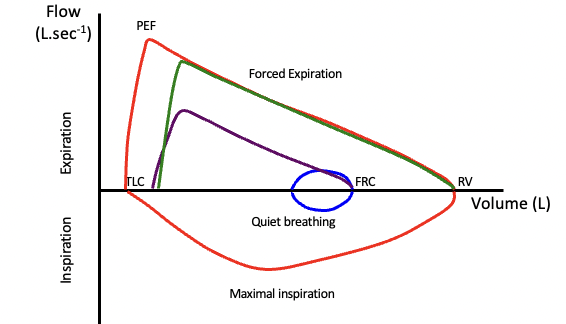
| what values go on the X and Y axis of a flow volume plot | flow on Y axis volume on X axis |
| is inspiration positive or negative on the flow volume loop | negative |
| can you determine FEV1 from a flow volume loop | no because no time peramiter |
| if you take a maximal exhale from a point below TLC would you reach PEF? | youd reach PEF for that breath but not for the system |
| in which direction do you read flow volume plots | clockwise, TLC is on left with greatest volume, RV is on right with lowest volume |
| where during the inspiration event is maximal inspiration | in the middle of the event |
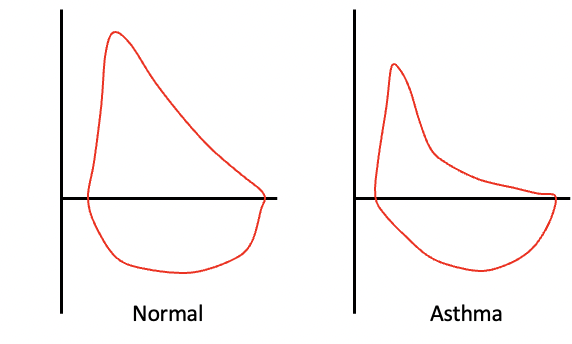
| how would a FV loop look in an asthma patient compared to a healthy person | |
| can you train expiratory muscle | no |
Want to create your own Flashcards for free with GoConqr? Learn more.