
3990123
Description

Flashcards by georgiahumz, updated more than 1 year ago

|
Created by georgiahumz
about 10 years ago
|
|
| Question | Answer |
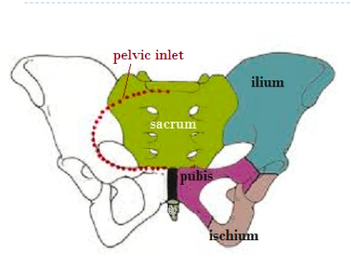
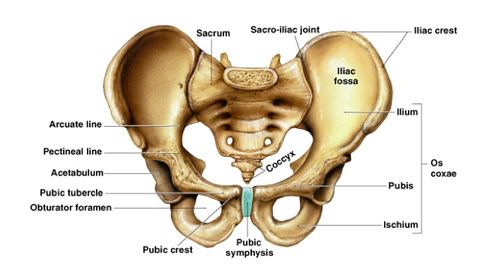
| Os Coxae | Ilium + Ischium + Pubis |
| bony features of the pelvis | |
| Sacrum and Sacroiliac joint | Sacrum=5 sacral vertebra fuse after puberty Synovial joint with fibrocartilage inside slight movement, during pregnancy Strong ligaments coccyx inferiorly |
| Pubic Symphysis | No movement During pregnancy some movement Fibrocartilaginous disc Reinforced by Superior pubic ligament Inferior pubic ligament |
| The hip Male vs Female | Female - childbearing Enlarged pelvic outlet Broader pubic angle, > 100 males are 90 or less Less curvature of sacrum and coccyx Wider, more circular pelvic inlet Broader pelvis Ilia project farther laterally Ilia don’t project as far superiorly |
| Femoral Triangle | The femoral triangle is bounded: (superiorly) by the inguinal ligament. (medially) by the medial border of the adductor longus muscle. (laterally) by the medial border of the sartorius muscle. LVAN lymph Vein Artery Nerve |
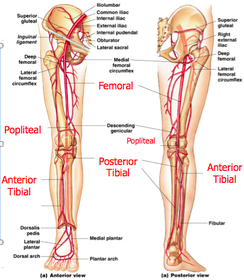
| Arteries throughout the hip into leg | Femoral Popliteal anterior & posterior tibial arteries arches in the foot |
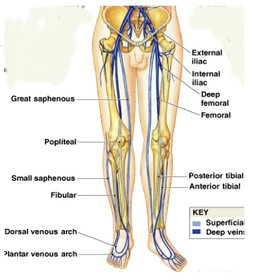
| veins throughout the hip into leg | Great saphenous | Popliteal | small saphenous | fibular | arches of foot |
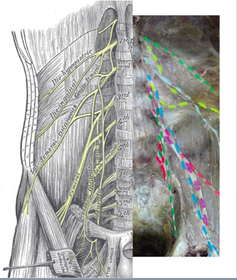
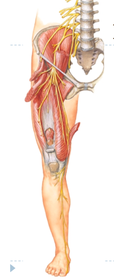
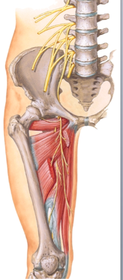
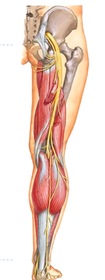
| Major Nerves to the lower limb | - Lumbosacral Plexus - Femoral - Obturator - Sciatic |
| Lumbosacral Plexus | Lumbar & Sacral Nerves L1 – S3 To pelvic organs & lower limb Sensory, motor & autonomic |
| Femoral Nerve | L2 – L4 Motor: Anterior;sartorius and quadriceps Medial; pectineus and iliopsoas Sensory: Anteromedial thigh, medial leg and foot |
| Obturator Nerve | L2-L4 Motor Adductors Adductor Magnus (ischial portion) Sensory Medial thigh |
| Sciatic Nerve | L4-S3 Motor Hamstrings, Adductor Magnus (hamstring portion) Largest nerve Exits pelvis posteriorly via greater sciatic foramen below piriformis Divides above popliteal fossa into tibial and fibular/peroneal Most common injury – disc compression at nerve root level |
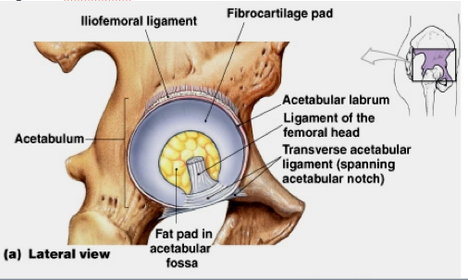
| Acetabulum | Deep fossa Horseshoe shaped fibrocartilaginous pad fibrocartilage rim - ‘acetabular labrum’ Missing inferior segment: acetabular notch |
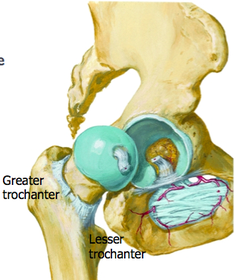
| Head of femur | Head of femur (ball) Covered with articular cartilage except fovea Neck of femur Greater trochanter Joint capsule extends to the intertrochanteric line (anterior) and crest (posterior) |
| Transverse acetabular ligament | fills in gap in acetabular labrum |
| Ligament of femoral head (ligamentum teres) | from transverse acetabular ligament to centre of head of femur |
| Angle of inclination | Between head and neck of femur, and shaft of femur Adult: 115o – 140o females < males puts strain on NOF What happens if the angle is too SMALL? What happens if the angle is too BIG? |
Want to create your own Flashcards for free with GoConqr? Learn more.