
4662002
Description

Flashcards by ranselll12, updated more than 1 year ago

|
Created by ranselll12
over 10 years ago
|
|
| Question | Answer |
| What are tectonic plates? | Massive portions of rock that the Earth is divided into |
| What makes tectonic plates able to move? | Convection currents |
| What do we use to document the movement of continents? | Magnetic clues in rocks |
| What direction does magnate get magnetised in? | Direction of the Earth's magnetic field (at that time) |
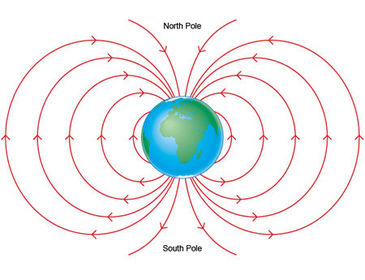
| What is this an image of? | The Earth's magnetic field |
| Why do people measure the angle at which rocks are magnetised? | Allows us to see what latitude the rock was originally formed at |
| How is a map of continental movement made? | By comparing the (predicted) historical location of magnetic direction to it's present location |
| What do we use fossils in sedimentary rocks for? | Identifying what geological period the rock was formed in (how old it is) |
| What do grains of sand found in rock determine? | If they were air or water borne (by comparing them to sand found in rivers and deserts |
| What are ripples in rocks formed by? | Wind blowing or water flowing |
| How is coal formed? | Plants have died and formed peat due to a lack of oxygen, the peat has been buried by sediment leading to compression and heating. |
| How is rock salt formed? | Seawater that was inland millions of years ago created salt marshes. As water in these marshes evaporated, deposits of rock salt formed. |
| How is sandstone formed? | By erosion and sedimentation |
Want to create your own Flashcards for free with GoConqr? Learn more.