
491465
Description

Flashcards by katiehumphrey, updated more than 1 year ago

|
Created by katiehumphrey
almost 13 years ago
|
|
| Question | Answer |
| urbanisation | the growth in the proportion of a country's population living in urban areas |
| rural - urban migration | the movement of people from the countryside to the cities |
| rural - urban migration PUSH factors | in countryside: few jobs/low wages lack of services poor harvests |
| rural - urban migration PULL factors | in cities: more jobs/higher wages stable income better infrastructure better services |
| impacts of urbanisation | overcrowding - disease spreads quickly increased traffic/pollution/waste |
| government management of impacts of urbanisation in urban areas | build more houses more jobs improve infrastructure improve services improve squatter settlements |
| government management of impacts of urbanisation in rural areas | invest in services - encourage people to stay encourage businesses to move there improve infrastructure |
| management of urbanisation in China - urban | changed water system to cope with increased sewage and pollution improving water quality and supply |
| management of urbanisation in China - rural 2009 | pension scheme giving retired farmers a monthly pension help raise income and reduce poverty |
| counter-urbanisation PUSH factors | pollution and traffic congestion higher crime rates houses cost more |
| counter-urbanisation PULL factors | better transport links growth of IT business parks mean more jobs |
| counter-urbanisation rural impacts | increased demand for houses = higher house prices lack of demand for out of town services decline in community spirit |
| counter-urbanisation urban impacts | high crime and pollution = unpopular commuters prefer to work outside city = centre shops lose customers |
| urban land use | |
| social needs | more housing social activities infrastructure/transport |
| economic needs | more jobs: business parks, shopping centres |
| environmental needs | waste disposal systems green spaces |
| brownfield sites | land that has been built on before |
| greenfield sites | land that has never been built on before |
| high order goods | goods that are only bought occasionally and are usually more expensive: TV, cars |
| low order goods | goods bought frequently and usually quite cheap: milk, bread |
| threshold population | minimum population needed to support a shop |
| sphere of influence | the area that people come from to visit a shop or area: high order goods |
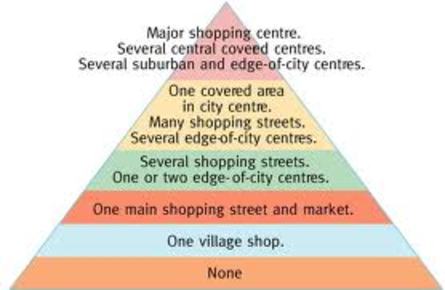
| shopping hierarchy |
Image:
download__6_ (image/jpg)
|
| changes to retail services | transport - car ownership = more out of town shops supply and demand social habits - less time to shop |

Want to create your own Flashcards for free with GoConqr? Learn more.