
59621
Description

Flashcards by Mark Arsenal, updated more than 1 year ago

|
Created by Mark Arsenal
almost 13 years ago
|
|
| Question | Answer |
| How do Expert and Novice Chess players differ? | Experts could memorize more pieces when the pieces were set up in a game setting. However when they were randomly scattered both groups could only remember 2-3 pieces. This shows that experts have superior memory and knowledge about chess and can chunk and code information easier. |
| In chess what is the relationship between experience and attained expertise? | There is a positive relationship between length of experience and attained expertise. |
| Define Expertise according to Ericsson and Chamess 1997. | An expert is someone who has displayed consistent evidence of a high level of proficiency in a specific field of knowledge as a result of at least 10 years of sustained training and experience. |
| In what four domains do you need to be an expert in to be an athletic expert? | Physiological, Technical, Cognitive, Emotional. |
| What is a Hardware Task? | General areas of ability which are fixed and thus cannot be trained, such as eyesight. |
| What is a Software task? | Domain specific which can be improved through practice and learning. |
| What are a better predictor of expertise, Software or Hardware tasks? | Software tasks. |
| Give some examples of Expert level athletes perceptual skills: | Recall specific patterns of play. Faster recognition and detection of objects. More appropriate and efficient visual search behaviors. Effectively pick up advance visual cues. |
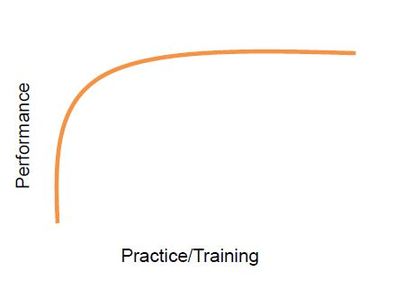
| What is the Power Law of Practice Trend of Improvement? | |
| What is the 10 year rule? As in the definition the of Expert. Does it hold true? | That individuals require at least 10 years of practice to acquire the necessary skills to perform at an expert level. In some ways this theory does hold true (Elite football players, figure skaters and wrestlers) BUT there are some exceptions to the rule: Quality of practice is just as important as quantity of practice, expertise in some tasks require less than 10 years (cycling). |
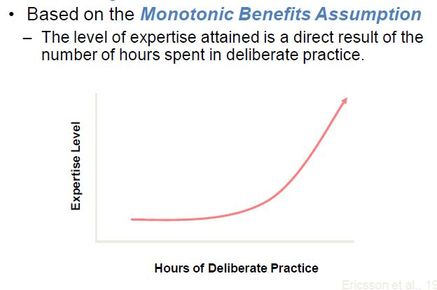
| What is the Theory of Deliberate Practice? | |
| Give a description of the Theory of Deliberate Practice? | Activities that are effortful,purposeful and not inherently enjoyable. Deliberate Practice is required for early specialization (early cognitive development). |
| What 3 constraints must be overcome in Deliberate Practice? | Resources, Effort, Motivation |
| What is the Relative Age Effect? | This refers to the differences between individuals in an age group. Those born earlier in the school year are older, thus have had more time to practice and physically and cognitively develop thus are more likely to be selected as Talented. |
| What is the Birthplace Effect? | This is whereby birthplace location effects the chance of being seen as talented. People born in geographic areas larger than 1000 but smaller than 1mil are more likely to reach elite level. Due to apt resources, big enough for scouting, but not too big to be overlooked. |
| What differences in effort are exhibited between expert and novice athletes? | Experts put more effort into both training and rest thus effort fluctuates whereas novice put less effort into either and thus remains more stable at a much lower level. |
| What other influence gaining expertise? | Culture (such as different countries preferred sports), Sports maturity- less mature sports are associated with less hours of training to reach expert. |
Want to create your own Flashcards for free with GoConqr? Learn more.