
653616
Description

Flashcards by Yee Voon Tang, updated more than 1 year ago

|
Created by Yee Voon Tang
almost 12 years ago
|
|
| Question | Answer |
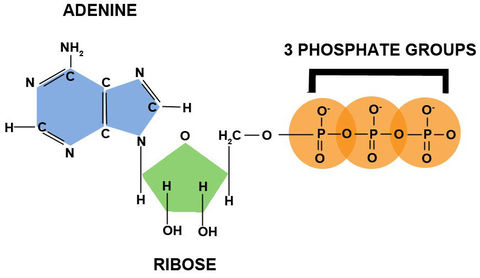
| What's ATP? | A nucleotide synthesised in mitochondria of animal cells, name in full? Adenosine TriPhospahte |
| How does a structure of ATP look like? |
Image:
ATP (image/jpg)
|
| What's the function of an ATP? | ATP is the short term energy source for cellular activity. |
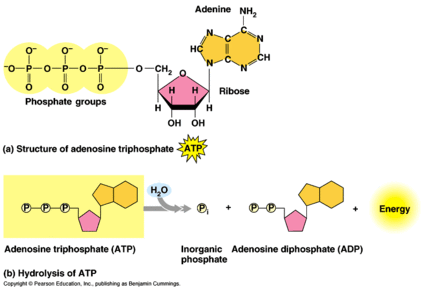
| Um.. how does it supply energy? | ATP breaks down to give ADP. The breakdown is an exothermic reaction and so it releases energy! |
| Wait.. can't see the picture yet. What's the equation? |
Image:
Image147.gif (image/gif)
|
| What type of reaction is this? (ATP <-> ADP) | It's a hydrolysis, coz it involves the breakdown of a molecule using water |
| Why is it so easy to break the ATP into an ADP? | the breakdown of ATP involves the release of the end phosphate group, which is favoured by the repulsion between the negatively charged O atoms on the adjacent phosphate groups |
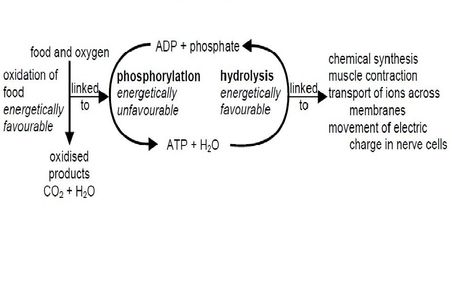
| So, where does an ATP supply energy to? | It supplies energy to various metabolic pathways that occur in our body, e.g. enzymatic reactions, muscle movement, active transport of ions across membranes, nerve impulse transmission |
| Then, how is ATP generated? | In plants, ATP is generated via photosynthesis while in animals, large amount of ATP is regenerated from ADP via phosphorylation |
| uh.. phosphorylation? | Phosphorylation is an endothermic reaction where ATP is regenerated from ADP. The energy being absorbed is gained through a series of oxidation of food (respiration) |
| I'm still lost.. illustration please? |
Image:
ATPtoADP1 (image/jpg)
|
| If conversion of ATP to ADP is exothermic, then it would be a spontaneous reaction, isn't it? | No, it will still require an enzyme to catalyse the reaction, i.e. it has high activation energy |
Want to create your own Flashcards for free with GoConqr? Learn more.