
Flowchart
Cardiovascular Infections
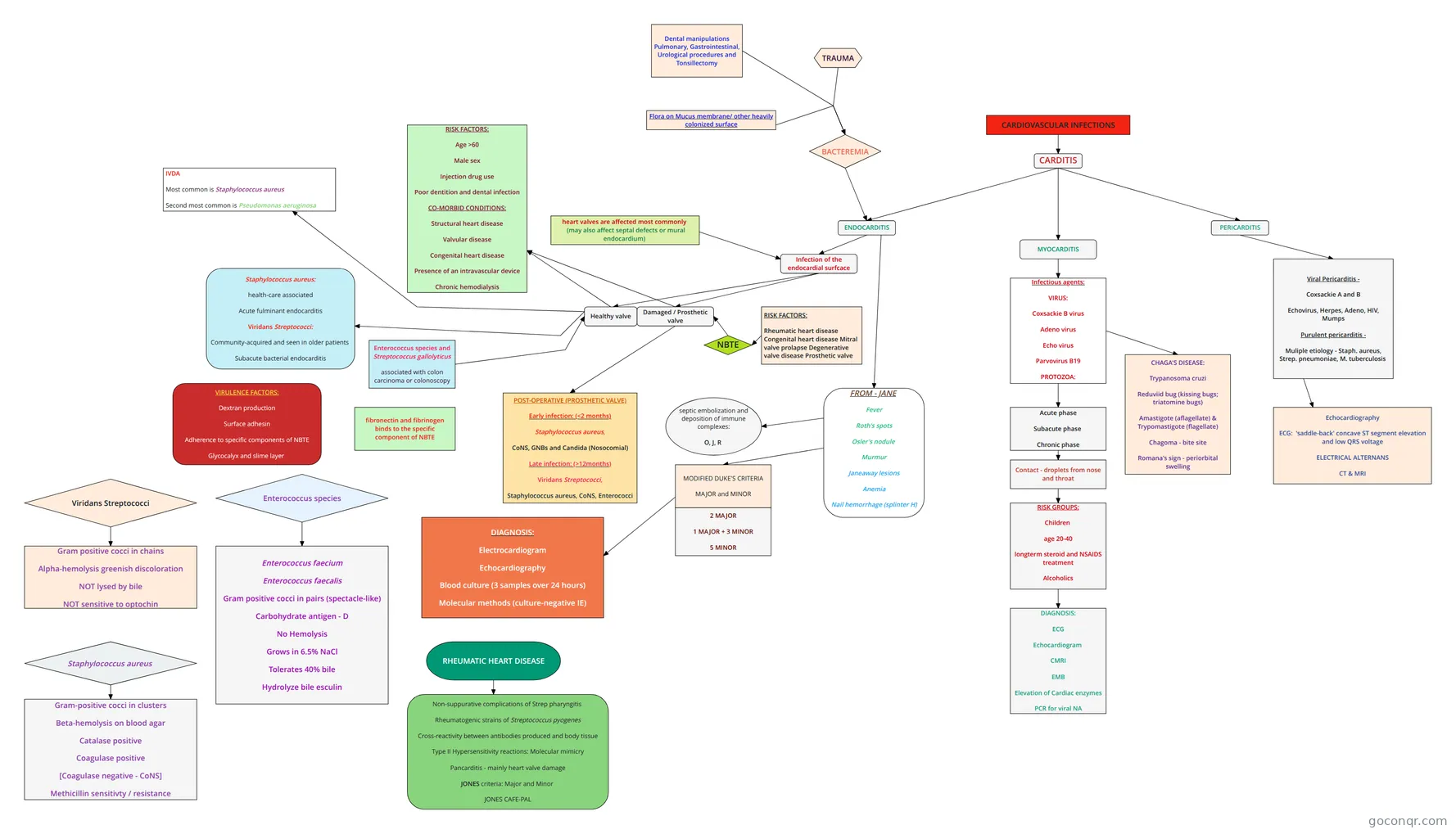
Flowchart: cardiovascular infections
Flowchart content
CARDIOVASCULAR INFECTIONS
CARDITIS
ENDOCARDITIS
MYOCARDITIS
PERICARDITIS
Infection of the endocardial surfcace
Healthy valve
Damaged / Prosthetic valve
heart valves are affected most commonly (may also affect septal defects or mural endocardium)
RISK FACTORS:
Rheumatic heart disease Congenital heart disease Mitral valve prolapse Degenerative valve disease Prosthetic valve
NBTE
Flora on Mucus membrane/ other heavily colonized surface
BACTEREMIA
TRAUMA
Dental manipulations Pulmonary, Gastrointestinal, Urological procedures and Tonsillectomy
FROM - JANE
Fever
Roth's spots
Osler's nodule
Murmur
Janeaway lesions
Anemia
Nail hemorrhage (splinter H)
Emboli
RISK FACTORS:
Age >60
Male sex
Injection drug use
Poor dentition and dental infection
CO-MORBID CONDITIONS:
Structural heart disease
Valvular disease
Congenital heart disease
Presence of an intravascular device
Chronic hemodialysis
HIV infection
Staphylococcus aureus:
health-care associated
Acute fulminant endocarditis
Viridans Streptococci:
Community-acquired and seen in older patients
Subacute bacterial endocarditis
POST-OPERATIVE (PROSTHETIC VALVE)
Early infection: (<2 months)
Staphylococcus aureus,
CoNS, GNBs and Candida (Nosocomial)
Late infection: (>12months)
Viridans Streptococci,
Staphylococcus aureus, CoNS, Enterococci
Enterococcus species and Streptococcus gallolyticus
associated with colon carcinoma or colonoscopy
IVDA
Most common is Staphylococcus aureus
Second most common is Pseudomonas aeruginosa
VIRULENCE FACTORS:
Dextran production
Surface adhesin
Adherence to specific components of NBTE
Glycocalyx and slime layer
fibronectin and fibrinogen binds to the specific component of NBTE
septic embolization and deposition of immune complexes:
O, J, R
MODIFIED DUKE'S CRITERIA
MAJOR and MINOR
2 MAJOR
1 MAJOR + 3 MINOR
5 MINOR
DIAGNOSIS:
Electrocardiogram
Echocardiography
Blood culture (3 samples over 24 hours)
Molecular methods (culture-negative IE)
Viridans Streptococci
Gram positive cocci in chains
Alpha-hemolysis greenish discoloration
NOT lysed by bile
NOT sensitive to optochin
Enterococcus species
Enterococcus faecium
Enterococcus faecalis
Gram positive cocci in pairs (spectacle-like)
Carbohydrate antigen - D
No Hemolysis
Grows in 6.5% NaCl
Tolerates 40% bile
Hydrolyze bile esculin
Staphylococcus aureus
Gram-positive cocci in clusters
Beta-hemolysis on blood agar
Catalase positive
Coagulase positive
[Coagulase negative - CoNS]
Methicillin sensitivty / resistance
RHEUMATIC HEART DISEASE
Non-suppurative complications of Strep pharyngitis
Rheumatogenic strains of Streptococcus pyogenes
Cross-reactivity between antibodies produced and body tissue
Type II Hypersensitivity reactions: Molecular mimicry
Pancarditis - mainly heart valve damage
JONES criteria: Major and Minor
JONES CAFE-PAL
Infectious agents:
VIRUS:
Coxsackie B virus
Adeno virus
Echo virus
Parvovirus B19
PROTOZOA:
Trypanosoma cruzi
Acute phase
Subacute phase
Chronic phase
Contact - droplets from nose and throat
RISK GROUPS:
Children
age 20-40
longterm steroid and NSAIDS treatment
Alcoholics
Nutritional deficiencies
DIAGNOSIS:
ECG
Echocardiogram
CMRI
EMB
Elevation of Cardiac enzymes
PCR for viral NA
CHAGA'S DISEASE:
Trypanosoma cruzi
Reduviid bug (kissing bugs; triatomine bugs)
Amastigote (aflagellate) & Trypomastigote (flagellate)
Chagoma - bite site
Romana's sign - periorbital swelling
Viral Pericarditis -
Coxsackie A and B
Echovirus, Herpes, Adeno, HIV, Mumps
Purulent pericarditis -
Muliple etiology - Staph. aureus, Strep. pneumoniae, M. tuberculosis
Echocardiography
ECG: 'saddle-back' concave ST segment elevation and low QRS voltage
ELECTRICAL ALTERNANS
CT & MRI
Information
- Description
- Professional CVS2 Flowchart on Cardiovascular Infections, created by Ut2am Udayan on 09/09/2021.
- Created by
- Ut2am Udayan
- Views
- 300
- Rating