
19447964
Description

Mind Map by johana Bernal Nieto , updated more than 1 year ago

|
Created by johana Bernal Nieto
over 6 years ago
|
|
Simple Past Tense
- The simple past is a verb tense that is used to
talk about things that happened or existed
before now.
- The simple past tense shows
that you are talking about
something that has already
happened.
- Unlike the past continuous tense, which is
used to talk about past events that happened
over a period of time, the simple past tense
emphasizes that the action is finished.
- You can also use the simple past to
talk about a past state of being,
such as the way someone felt about
something
- Unlike the past continuous tense, which is
used to talk about past events that happened
over a period of time, the simple past tense
emphasizes that the action is finished.
- How to Formulate the Simple Past
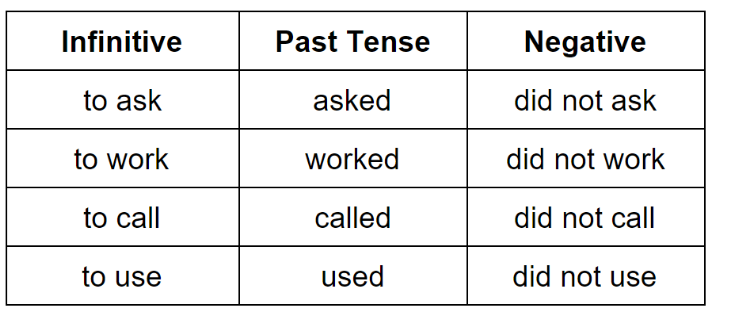
- For regular verbs, add -ed to the root form
of the verb (or just -d if the root form
already ends in an e)
- Play→Played Type→Typed
Listen→Listened Push→Pushed
Love→Loved
- Play→Played Type→Typed
Listen→Listened Push→Pushed
Love→Loved
- For irregular verbs, the simple past
tense of some irregular verbs looks
exactly like the root form
- Put→Put Cut→Cut Set→Set
Cost→Cost Hit→Hit
- Put→Put Cut→Cut Set→Set
Cost→Cost Hit→Hit
- For other irregular verbs, including the verb
to be, the simple past forms are more erratic
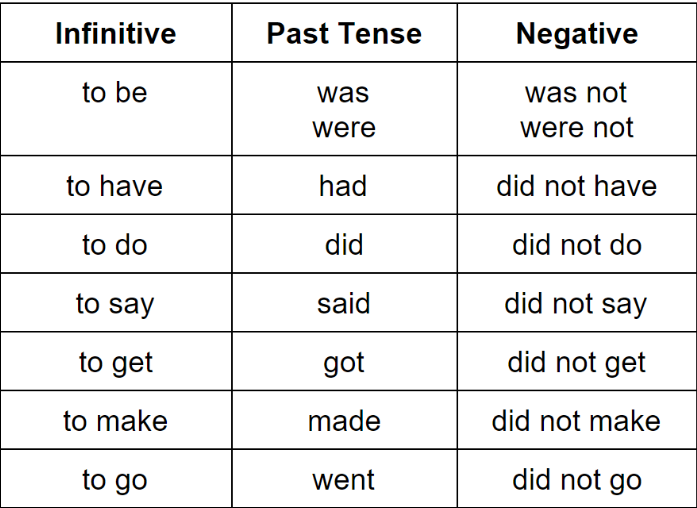
- See→Saw Build→Built Go→Went Do→Did
Rise→Rose Am/Is/Are→Was/Were
- See→Saw Build→Built Go→Went Do→Did
Rise→Rose Am/Is/Are→Was/Were
- For regular verbs, add -ed to the root form
of the verb (or just -d if the root form
already ends in an e)
- How to Make the Simple Past
Negative
- There is a formula for making simple
past verbs negative, and it’s the same for
both regular and irregular verbs (except
for the verb to be).
- The formula is did not + [root form of verb]. You
can also use the contraction didn’t instead of did
not.
- The formula is did not + [root form of verb]. You
can also use the contraction didn’t instead of did
not.
- For the verb to be, you don’t need the auxiliary
did. When the subject of the sentence is singular,
use was not or wasn’t. When the subject is plural,
use were not or weren’t.
- There is a formula for making simple
past verbs negative, and it’s the same for
both regular and irregular verbs (except
for the verb to be).
- How to Ask a Question
- The formula for asking a question in the
simple past tense is did + [subject] + [root
form of verb].
- When asking a question with the verb to be, you
don’t need the auxiliary did. The formula is
was/were + [subject].
- The formula for asking a question in the
simple past tense is did + [subject] + [root
form of verb].
Media attachments
Want to create your own Mind Maps for free with GoConqr? Learn more.