
Mapa mental
Business Meeting
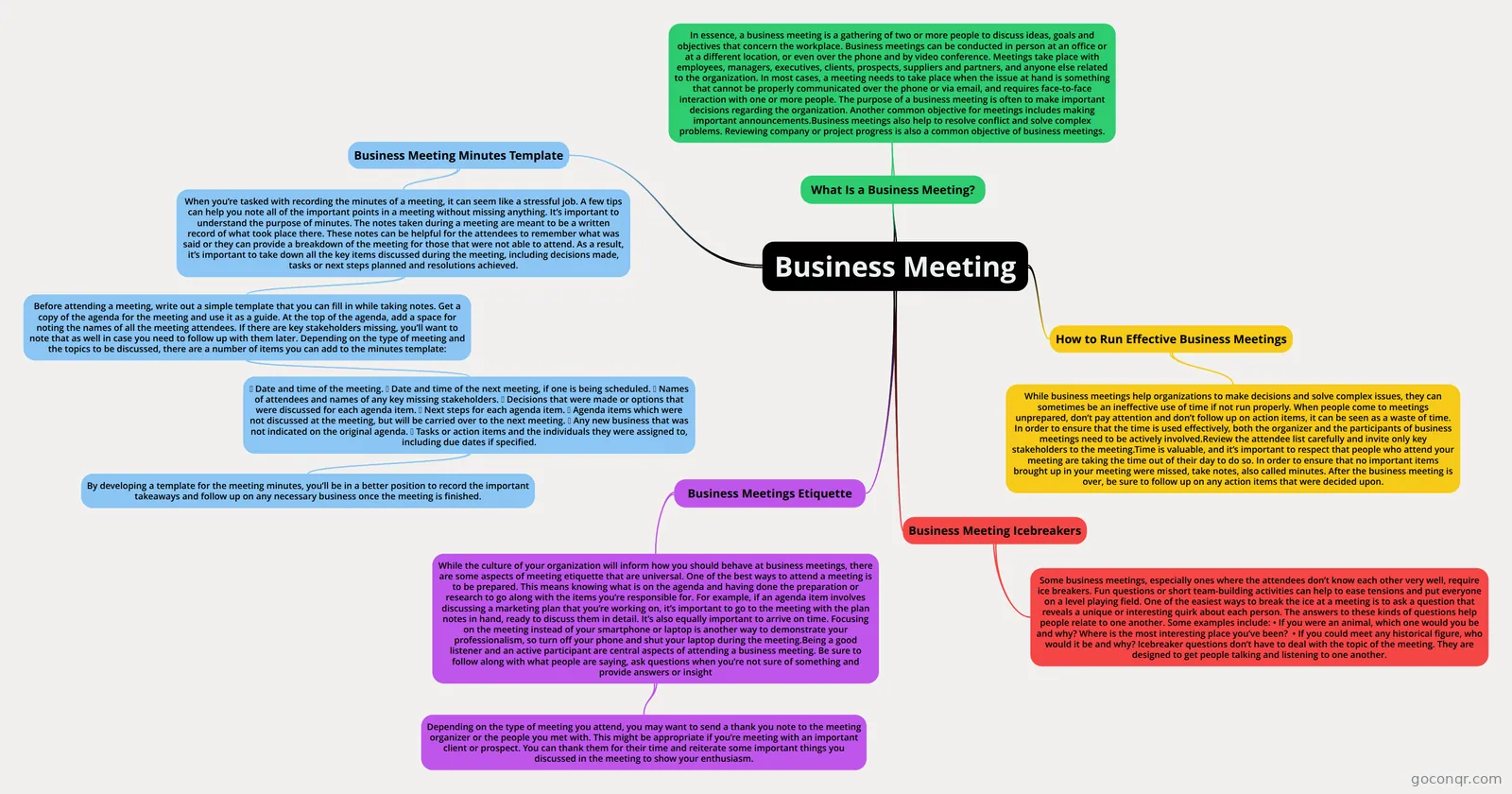
Mind map: Business Meeting Guide
Contenido del mapa
Business Meeting
What Is a Business Meeting?
- In essence, a business meeting is a gathering of two or more people to discuss ideas, goals and objectives that concern the workplace. Business meetings can be conducted in person at an office or at a different location, or even over the phone and by video conference. Meetings take place with employees, managers, executives, clients, prospects, suppliers and partners, and anyone else related to the organization. In most cases, a meeting needs to take place when the issue at hand is something that cannot be properly communicated over the phone or via email, and requires face-to-face interaction with one or more people. The purpose of a business meeting is often to make important decisions regarding the organization. Another common objective for meetings includes making important announcements.Business meetings also help to resolve conflict and solve complex problems. Reviewing company or project progress is also a common objective of business meetings.
How to Run Effective Business Meetings
- While business meetings help organizations to make decisions and solve complex issues, they can sometimes be an ineffective use of time if not run properly. When people come to meetings unprepared, don’t pay attention and don’t follow up on action items, it can be seen as a waste of time. In order to ensure that the time is used effectively, both the organizer and the participants of business meetings need to be actively involved.Review the attendee list carefully and invite only key stakeholders to the meeting.Time is valuable, and it’s important to respect that people who attend your meeting are taking the time out of their day to do so. In order to ensure that no important items brought up in your meeting were missed, take notes, also called minutes. After the business meeting is over, be sure to follow up on any action items that were decided upon.
Business Meeting Icebreakers
- Some business meetings, especially ones where the attendees don’t know each other very well, require ice breakers. Fun questions or short team-building activities can help to ease tensions and put everyone on a level playing field. One of the easiest ways to break the ice at a meeting is to ask a question that reveals a unique or interesting quirk about each person. The answers to these kinds of questions help people relate to one another. Some examples include: • If you were an animal, which one would you be and why? Where is the most interesting place you’ve been? • If you could meet any historical figure, who would it be and why? Icebreaker questions don’t have to deal with the topic of the meeting. They are designed to get people talking and listening to one another.
Business Meetings Etiquette
- While the culture of your organization will inform how you should behave at business meetings, there are some aspects of meeting etiquette that are universal. One of the best ways to attend a meeting is to be prepared. This means knowing what is on the agenda and having done the preparation or research to go along with the items you’re responsible for. For example, if an agenda item involves discussing a marketing plan that you’re working on, it’s important to go to the meeting with the plan notes in hand, ready to discuss them in detail. It’s also equally important to arrive on time. Focusing on the meeting instead of your smartphone or laptop is another way to demonstrate your professionalism, so turn off your phone and shut your laptop during the meeting.Being a good listener and an active participant are central aspects of attending a business meeting. Be sure to follow along with what people are saying, ask questions when you’re not sure of something and provide answers or insight
- Depending on the type of meeting you attend, you may want to send a thank you note to the meeting organizer or the people you met with. This might be appropriate if you’re meeting with an important client or prospect. You can thank them for their time and reiterate some important things you discussed in the meeting to show your enthusiasm.
- While the culture of your organization will inform how you should behave at business meetings, there are some aspects of meeting etiquette that are universal. One of the best ways to attend a meeting is to be prepared. This means knowing what is on the agenda and having done the preparation or research to go along with the items you’re responsible for. For example, if an agenda item involves discussing a marketing plan that you’re working on, it’s important to go to the meeting with the plan notes in hand, ready to discuss them in detail. It’s also equally important to arrive on time. Focusing on the meeting instead of your smartphone or laptop is another way to demonstrate your professionalism, so turn off your phone and shut your laptop during the meeting.Being a good listener and an active participant are central aspects of attending a business meeting. Be sure to follow along with what people are saying, ask questions when you’re not sure of something and provide answers or insight
Business Meeting Minutes Template
- When you’re tasked with recording the minutes of a meeting, it can seem like a stressful job. A few tips can help you note all of the important points in a meeting without missing anything. It’s important to understand the purpose of minutes. The notes taken during a meeting are meant to be a written record of what took place there. These notes can be helpful for the attendees to remember what was said or they can provide a breakdown of the meeting for those that were not able to attend. As a result, it’s important to take down all the key items discussed during the meeting, including decisions made, tasks or next steps planned and resolutions achieved.
- Before attending a meeting, write out a simple template that you can fill in while taking notes. Get a copy of the agenda for the meeting and use it as a guide. At the top of the agenda, add a space for noting the names of all the meeting attendees. If there are key stakeholders missing, you’ll want to note that as well in case you need to follow up with them later. Depending on the type of meeting and the topics to be discussed, there are a number of items you can add to the minutes template:
- Date and time of the meeting. Date and time of the next meeting, if one is being scheduled. Names of attendees and names of any key missing stakeholders. Decisions that were made or options that were discussed for each agenda item. Next steps for each agenda item. Agenda items which were not discussed at the meeting, but will be carried over to the next meeting. Any new business that was not indicated on the original agenda. Tasks or action items and the individuals they were assigned to, including due dates if specified.
- By developing a template for the meeting minutes, you’ll be in a better position to record the important takeaways and follow up on any necessary business once the meeting is finished.
- Date and time of the meeting. Date and time of the next meeting, if one is being scheduled. Names of attendees and names of any key missing stakeholders. Decisions that were made or options that were discussed for each agenda item. Next steps for each agenda item. Agenda items which were not discussed at the meeting, but will be carried over to the next meeting. Any new business that was not indicated on the original agenda. Tasks or action items and the individuals they were assigned to, including due dates if specified.
- Before attending a meeting, write out a simple template that you can fill in while taking notes. Get a copy of the agenda for the meeting and use it as a guide. At the top of the agenda, add a space for noting the names of all the meeting attendees. If there are key stakeholders missing, you’ll want to note that as well in case you need to follow up with them later. Depending on the type of meeting and the topics to be discussed, there are a number of items you can add to the minutes template:
- When you’re tasked with recording the minutes of a meeting, it can seem like a stressful job. A few tips can help you note all of the important points in a meeting without missing anything. It’s important to understand the purpose of minutes. The notes taken during a meeting are meant to be a written record of what took place there. These notes can be helpful for the attendees to remember what was said or they can provide a breakdown of the meeting for those that were not able to attend. As a result, it’s important to take down all the key items discussed during the meeting, including decisions made, tasks or next steps planned and resolutions achieved.
Información
- Descripción
- Oral Comunication Mapa Mental sobre Business Meeting, creado por Kevin Bryan Téllez Angulo el 16/03/2021.
- Creado por
- Kevin Bryan Téllez Angulo
- Visitas
- 0
- Valoración