
Mapa mental
Investment Casting
Contenido del mapa
Investment Casting
Is a manufacturing process in which a wax pattern is coated with a refractory ceramic material. Once the ceramic material is hardened its internal geometry takes the shape of the casting.
- The wax is melted out and molten metal is poured into the cavity where the wax pattern was. The metal solidifies within the ceramic mold and then the metal casting is broken out.
- PROCESS
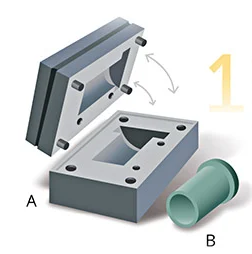
- 1.Tooling and Pattern Making
- A tool is built to customer provided specifications (A) Cold wax is then injected into the tool to create a wax pattern/prototype (B) that will hold precise dimensional requirements in the final Casting.
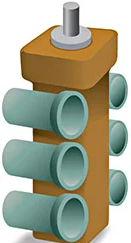
- 2.Pattern Assembly
- The wax patterns are assembled into the sprue
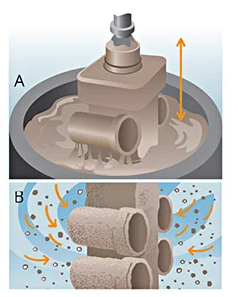
- 3. Dipping coating
- Succesive layers of ceramic (A) and stucco (B) are applied to the sprue assembly to form a hard shell
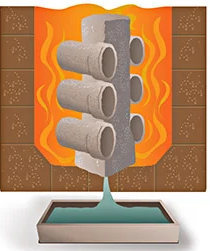
- 4. De-waxing and Firing
- The molds are flash fired to remove the wax and sprue materials and the heated to 1800° and placed on a stand bed, ready for pouring
- 5.Casting
- 6.Knockout
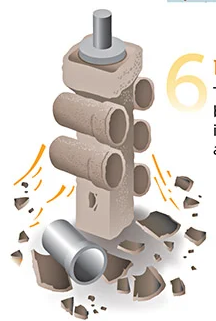
- The ceramic shell is broken off, and the individual castings are cut away
- 7. Finishing
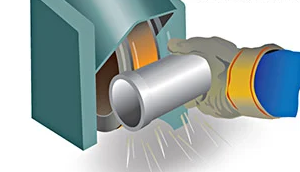
- Excess metal is removed, surfaces are finished, and casting are heat treated
- 8.Testing and inspection
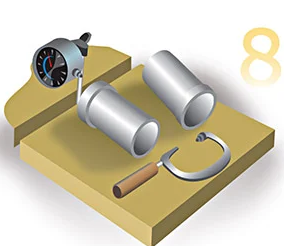
- Casting undergo thorough testing and inspection to ensure that tey meet dimensional tolerance and specification
- Casting undergo thorough testing and inspection to ensure that tey meet dimensional tolerance and specification
- Excess metal is removed, surfaces are finished, and casting are heat treated
- The ceramic shell is broken off, and the individual castings are cut away
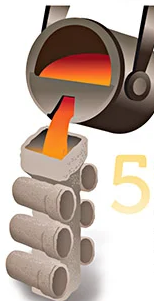
- Molten metal up 3000° is poured into the holow mold and the cooled
- 6.Knockout
- The molds are flash fired to remove the wax and sprue materials and the heated to 1800° and placed on a stand bed, ready for pouring
- Succesive layers of ceramic (A) and stucco (B) are applied to the sprue assembly to form a hard shell
- The wax patterns are assembled into the sprue
- A tool is built to customer provided specifications (A) Cold wax is then injected into the tool to create a wax pattern/prototype (B) that will hold precise dimensional requirements in the final Casting.
- 1.Tooling and Pattern Making
- •Excellent precision, ideal for complex geometries •Can meet tight tolerance requirements •Superior surface finish, little additional machining required •Higher total cost than other casting processes •Lower tooling costs •Suitable for both ferrous and non-ferrous metals •Some product size restrictions
- PROCESS
- CONSIDERATION FOR USE IC
- 1. Design Complexity
- IC offers great design flexibility since you can cast intricate shapes and easily incorporate design features, such as logos and other information, into the component. You can also achieve precise dimensional results, complex geometries and thin-walled parts.
- 2. Material Selection
- A wide range of alloys (including both ferrous and non-ferrous metals) can be used in IC
- 3. Annual Usage
- 4. Part Size
- 5. Tolerance
- 6. Cost
- 7. Finish Requirements
- The surface finish of IC is superior to other casting methods, reducing the need for excessive secondary machining. A 125 micro finish is standard, and better finishes can be achieved with the help of other finishing techniques like polishing or blasting.
- IC ordinarily costs more than other process, because it's a highly manual process that produces superior dimensionality and excellent surface finishes.But the final cost truly comes down to tooling. IC can be designed for minimal machining, reducing both time and cost.
- 7. Finish Requirements
- IC can really deliver on tight tolerances
- 6. Cost
- IC can accommodate parts from an ounce up to about 200 pounds. There is some limitation to the size of parts that can be investment cast simply because the wax pattern must be securely gated to a sprue for repeated dipping in the ceramic slurry.
- 5. Tolerance
- One of the biggest misconceptions about IC is that it only makes sense for large order quantities. While you can opt for IC for smaller production runs, the final call usually comes down to tooling costs. Start by deciding your desired payback period for the tool and crunch some numbers to see if IC is actually the best option
- 4. Part Size
- 1. Design Complexity
- The wax is melted out and molten metal is poured into the cavity where the wax pattern was. The metal solidifies within the ceramic mold and then the metal casting is broken out.
Parts manufactured in industry by this process include dental fixtures, gears, cams, ratchets, jewelry, turbine blades, machinery components and other parts of complex geometry.
Imágenes y archivos del mapa
Información
- Descripción
- Ingeniería Mapa Mental sobre Investment Casting, creado por Bere Sanchez el 15/10/2021.
- Creado por
- Bere Sanchez
- Visitas
- 0
- Valoración