
Mapa mental
Learning Theories & Modern Psychotherapy
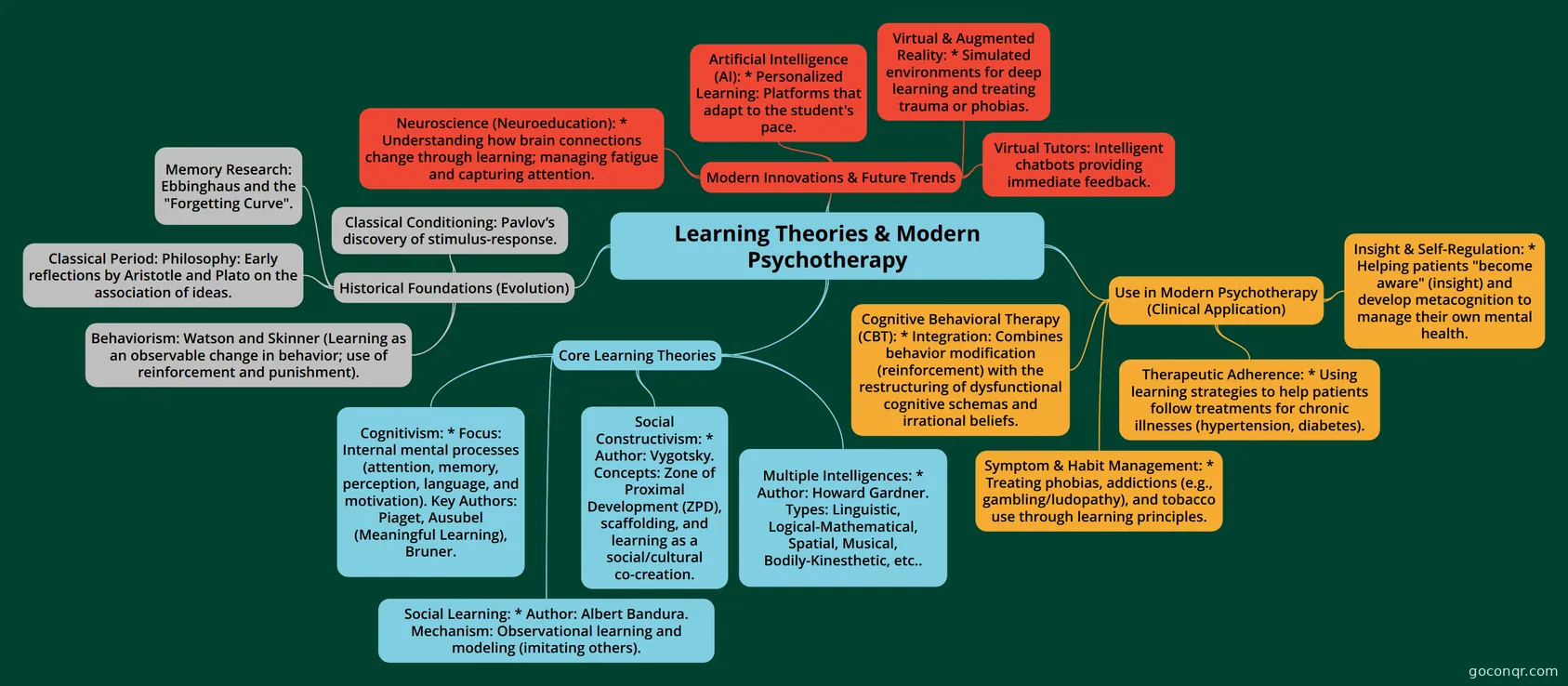
Mind map: learning theories and modern psychotherapy
Contenido del mapa
Learning Theories & Modern Psychotherapy
Historical Foundations (Evolution)
- Classical Period: Philosophy: Early reflections by Aristotle and Plato on the association of ideas.
- Memory Research: Ebbinghaus and the "Forgetting Curve".
- Classical Conditioning: Pavlov’s discovery of stimulus-response.
- Behaviorism: Watson and Skinner (Learning as an observable change in behavior; use of reinforcement and punishment).
Core Learning Theories
- Cognitivism: * Focus: Internal mental processes (attention, memory, perception, language, and motivation). Key Authors: Piaget, Ausubel (Meaningful Learning), Bruner.
- Social Constructivism: * Author: Vygotsky. Concepts: Zone of Proximal Development (ZPD), scaffolding, and learning as a social/cultural co-creation.
- Social Learning: * Author: Albert Bandura. Mechanism: Observational learning and modeling (imitating others).
- Multiple Intelligences: * Author: Howard Gardner. Types: Linguistic, Logical-Mathematical, Spatial, Musical, Bodily-Kinesthetic, etc..
Use in Modern Psychotherapy (Clinical Application)
- Cognitive Behavioral Therapy (CBT): * Integration: Combines behavior modification (reinforcement) with the restructuring of dysfunctional cognitive schemas and irrational beliefs.
- Symptom & Habit Management: * Treating phobias, addictions (e.g., gambling/ludopathy), and tobacco use through learning principles.
- Therapeutic Adherence: * Using learning strategies to help patients follow treatments for chronic illnesses (hypertension, diabetes).
- Insight & Self-Regulation: * Helping patients "become aware" (insight) and develop metacognition to manage their own mental health.
Modern Innovations & Future Trends
- Neuroscience (Neuroeducation): * Understanding how brain connections change through learning; managing fatigue and capturing attention.
- Artificial Intelligence (AI): * Personalized Learning: Platforms that adapt to the student's pace.
- Virtual Tutors: Intelligent chatbots providing immediate feedback.
- Virtual & Augmented Reality: * Simulated environments for deep learning and treating trauma or phobias.
Información
- Descripción
- cuadro sinóptico actividad 1 de observación y entrevista, punto de la unidad 2
- Creado por
- Elkin Yesid Peña Suarez
- Visitas
- 20
- Valoración