
Mind map
uncertain ontologies
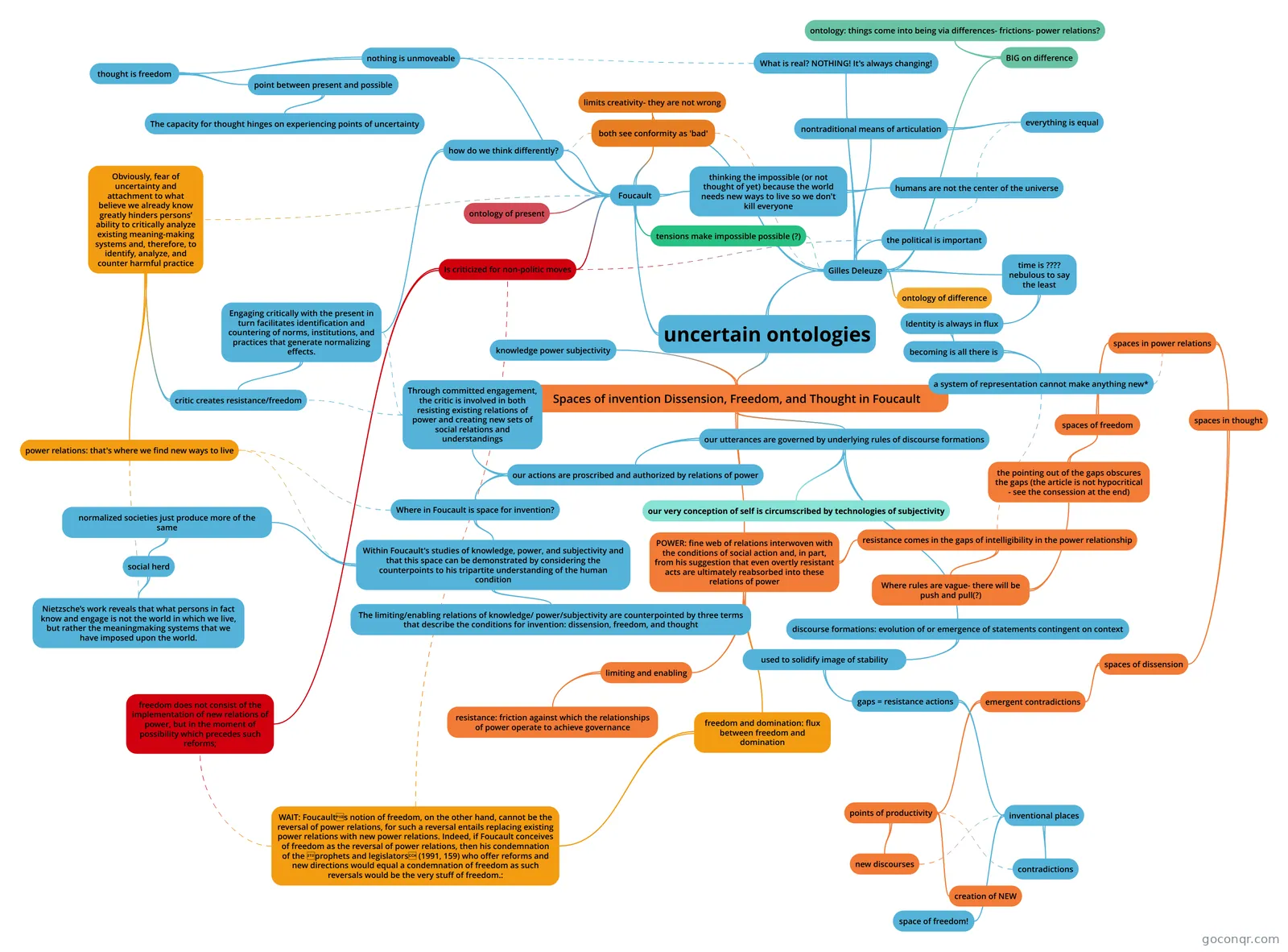
Mind map: uncertain ontologies
Map content
uncertain ontologies
Gilles Deleuze
- the political is important
- ontology of difference
- time is ???? nebulous to say the least
- Identity is always in flux
- becoming is all there is
- a system of representation cannot make anything new*
- becoming is all there is
- Identity is always in flux
- nontraditional means of articulation
- everything is equal
- What is real? NOTHING! It's always changing!
- BIG on difference
- ontology: things come into being via differences- frictions- power relations?
Foucault
- thinking the impossible (or not thought of yet) because the world needs new ways to live so we don't kill everyone
- humans are not the center of the universe
- Is criticized for non-politic moves
- freedom does not consist of the implementation of new relations of power, but in the moment of possibility which precedes such reforms;
- ontology of present
- tensions make impossible possible (?)
- how do we think differently?
- Engaging critically with the present in turn facilitates identification and countering of norms, institutions, and practices that generate normalizing effects.
- critic creates resistance/freedom
- Obviously, fear of uncertainty and attachment to what believe we already know greatly hinders persons’ ability to critically analyze existing meaning‐making systems and, therefore, to identify, analyze, and counter harmful practice
- power relations: that's where we find new ways to live
- Obviously, fear of uncertainty and attachment to what believe we already know greatly hinders persons’ ability to critically analyze existing meaning‐making systems and, therefore, to identify, analyze, and counter harmful practice
- critic creates resistance/freedom
- Engaging critically with the present in turn facilitates identification and countering of norms, institutions, and practices that generate normalizing effects.
- both see conformity as 'bad'
- limits creativity- they are not wrong
- nothing is unmoveable
- thought is freedom
- point between present and possible
- The capacity for thought hinges on experiencing points of uncertainty
- point between present and possible
- thought is freedom
- thinking the impossible (or not thought of yet) because the world needs new ways to live so we don't kill everyone
Spaces of invention Dissension, Freedom, and Thought in Foucault
- our utterances are governed by underlying rules of discourse formations
- our very conception of self is circumscribed by technologies of subjectivity
- our actions are proscribed and authorized by relations of power
- Where in Foucault is space for invention?
- Within Foucault's studies of knowledge, power, and subjectivity and that this space can be demonstrated by considering the counterpoints to his tripartite understanding of the human condition
- The limiting/enabling relations of knowledge/ power/subjectivity are counterpointed by three terms that describe the conditions for invention: dissension, freedom, and thought
- normalized societies just produce more of the same
- social herd
- Nietzsche’s work reveals that what persons in fact know and engage is not the world in which we live, but rather the meaningmaking systems that we have imposed upon the world.
- social herd
- Within Foucault's studies of knowledge, power, and subjectivity and that this space can be demonstrated by considering the counterpoints to his tripartite understanding of the human condition
- Through committed engagement, the critic is involved in both resisting existing relations of power and creating new sets of social relations and understandings
- Where in Foucault is space for invention?
- discourse formations: evolution of or emergence of statements contingent on context
- used to solidify image of stability
- gaps = resistance actions
- inventional places
- contradictions
- space of freedom!
- inventional places
- gaps = resistance actions
- used to solidify image of stability
- knowledge power subjectivity
- POWER: fine web of relations interwoven with the conditions of social action and, in part, from his suggestion that even overtly resistant acts are ultimately reabsorbed into these relations of power
- resistance comes in the gaps of intelligibility in the power relationship
- Where rules are vague- there will be push and pull(?)
- the pointing out of the gaps obscures the gaps (the article is not hypocritical - see the consession at the end)
- spaces of freedom
- spaces in power relations
- spaces in thought
- spaces of dissension
- emergent contradictions
- points of productivity
- new discourses
- creation of NEW
- points of productivity
- emergent contradictions
- spaces of dissension
- spaces in thought
- spaces in power relations
- spaces of freedom
- the pointing out of the gaps obscures the gaps (the article is not hypocritical - see the consession at the end)
- Where rules are vague- there will be push and pull(?)
- limiting and enabling
- resistance: friction against which the relationships of power operate to achieve governance
- freedom and domination: flux between freedom and domination
- WAIT: Foucaults notion of freedom, on the other hand, cannot be the reversal of power relations, for such a reversal entails replacing existing power relations with new power relations. Indeed, if Foucault conceives of freedom as the reversal of power relations, then his condemnation of the prophets and legislators (1991, 159) who offer reforms and new directions would equal a condemnation of freedom as such reversals would be the very stuff of freedom.:
- resistance comes in the gaps of intelligibility in the power relationship
- our utterances are governed by underlying rules of discourse formations
Information
- Description
- combination of articles for Foster's class
- Created by
- Jennifer Wilhite
- Views
- 17
- Tags
- Rating