
Mind map
Judicial review
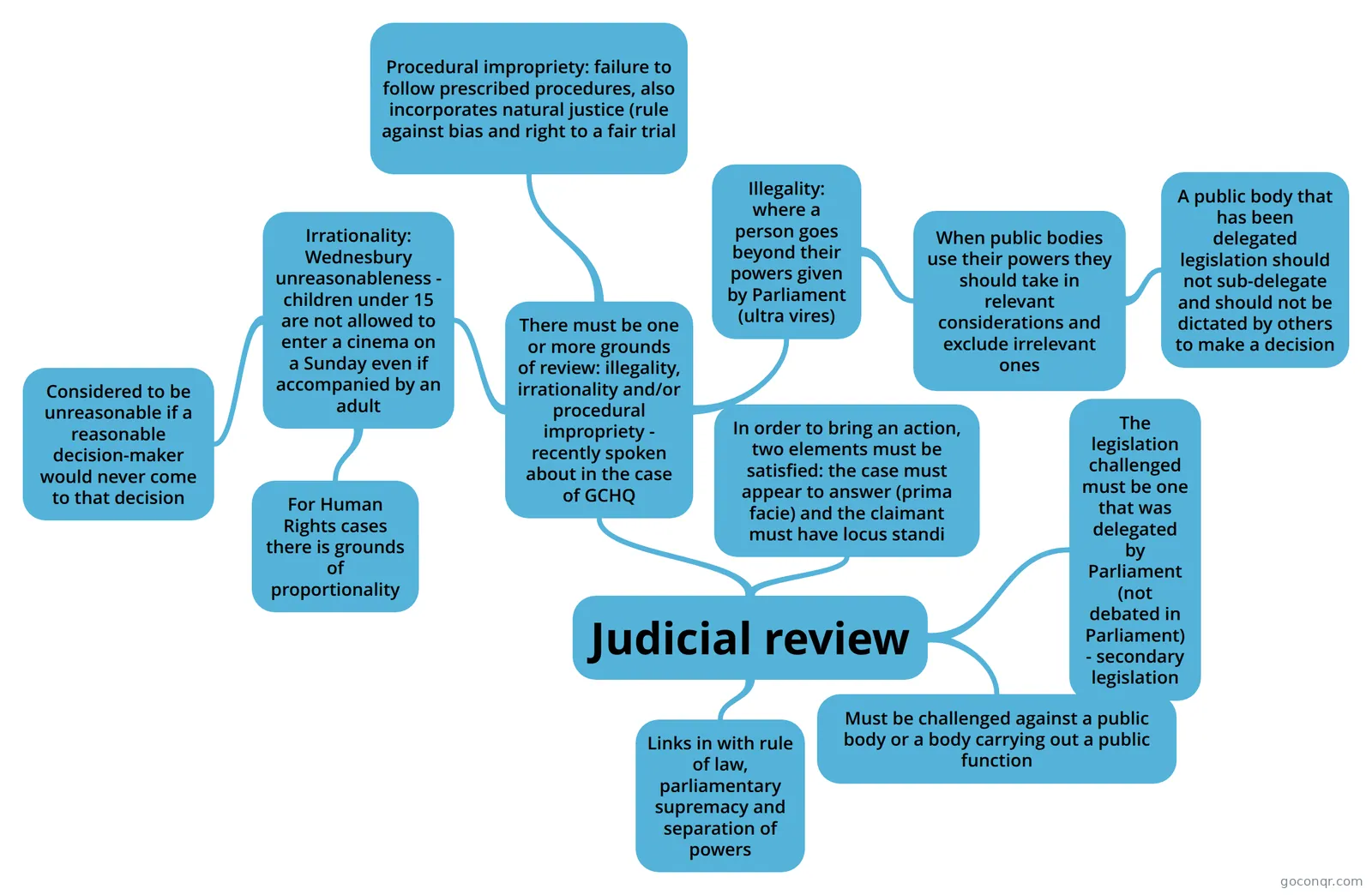
Mind map: Judicial review
Map content
Judicial review
Must be challenged against a public body or a body carrying out a public function
The legislation challenged must be one that was delegated by Parliament (not debated in Parliament) - secondary legislation
Links in with rule of law, parliamentary supremacy and separation of powers
In order to bring an action, two elements must be satisfied: the case must appear to answer (prima facie) and the claimant must have locus standi
There must be one or more grounds of review: illegality, irrationality and/or procedural impropriety - recently spoken about in the case of GCHQ
- Irrationality: Wednesbury unreasonableness - children under 15 are not allowed to enter a cinema on a Sunday even if accompanied by an adult
- For Human Rights cases there is grounds of proportionality
- Considered to be unreasonable if a reasonable decision-maker would never come to that decision
- Illegality: where a person goes beyond their powers given by Parliament (ultra vires)
- When public bodies use their powers they should take in relevant considerations and exclude irrelevant ones
- A public body that has been delegated legislation should not sub-delegate and should not be dictated by others to make a decision
- When public bodies use their powers they should take in relevant considerations and exclude irrelevant ones
- Procedural impropriety: failure to follow prescribed procedures, also incorporates natural justice (rule against bias and right to a fair trial
- Irrationality: Wednesbury unreasonableness - children under 15 are not allowed to enter a cinema on a Sunday even if accompanied by an adult