
Mind map
SLP Orals Concepts Review
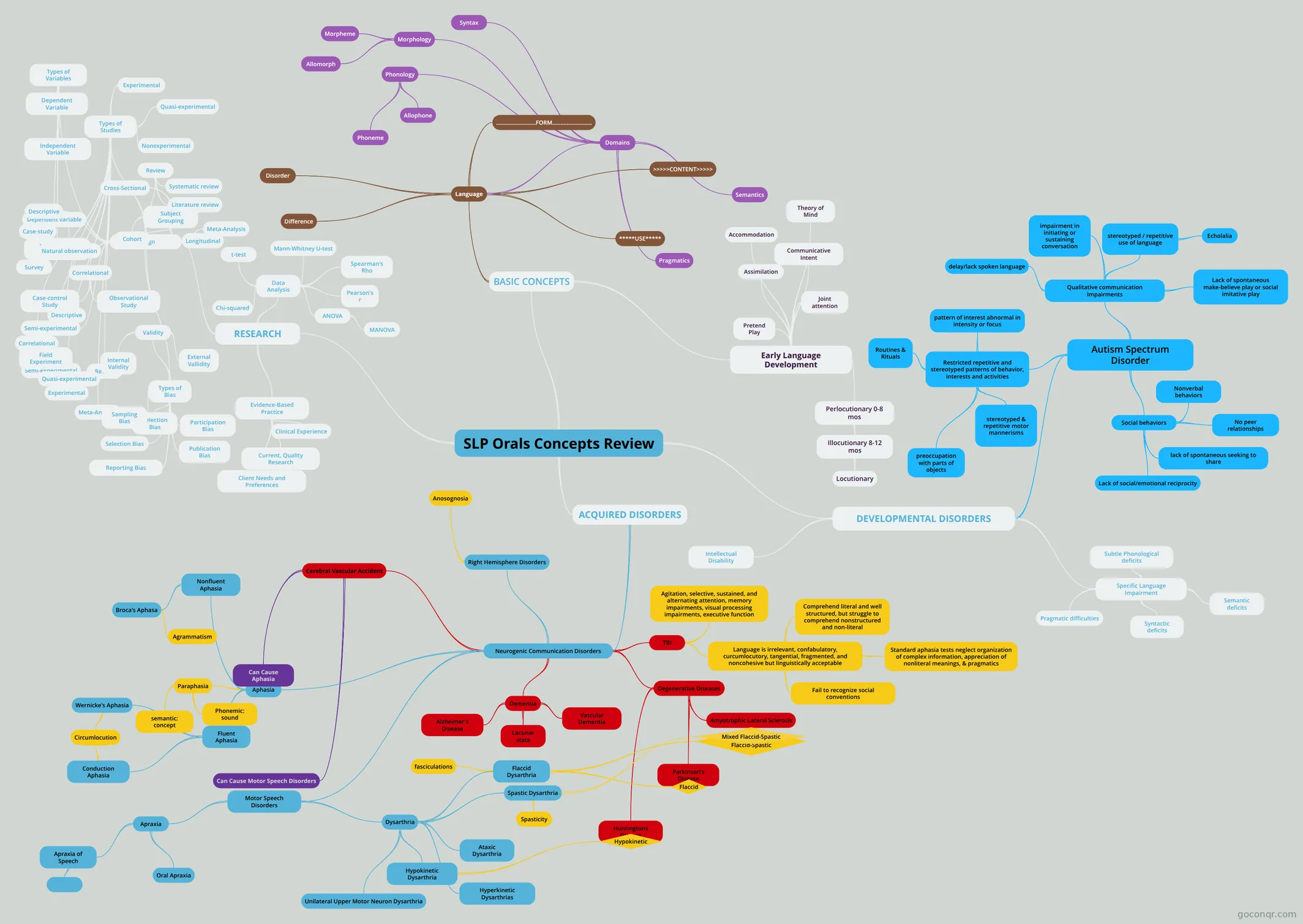
Mind map: SLP Orals Concepts Review
Map content
SLP Orals Concepts Review
ACQUIRED DISORDERS
- Neurogenic Communication Disorders
- Aphasia
- Acquired neurogenic language disorder (injury to the brain) that affects all language modalities: spoken language expression, spoken language comprehension, written expression, and reading comprehension. Often has relatively intact nonlinguistic cognitive skills, such as memory and executive function skills, although these may co-occur
- Nonfluent Aphasia
- Broca's Aphasa
- Characterized by nonfluent speech, good comprehension, and poor repetition
- Agrammatism
- Content words intact, most function words missing--common in Brocas
- Broca's Aphasa
- Fluent Aphasia
- Conduction Aphasia
- characterized by fluent speech, fair comprehension, and poor repetition
- Circumlocution
- Wernicke's Aphasia
- Conduction Aphasia
- Paraphasia
- Phonemic: sound
- semantic: concept
- Dementia
- Alzheimer's Disease
- Progressive neurologic disease characterized by increasing dementia
- Vascular Dementia
- Lacunar state
- A progressive neurologic disease cause by successive small infarcts in the midbrain and brain stem
- Alzheimer's Disease
- Right Hemisphere Disorders
- Anosognosia
- Denial of illness
- Anosognosia
- Motor Speech Disorders
- Dysarthria
- Types of several speech abnormalities caused by nervous system damage that affects movement or sensation within body parts involved in speech
- Flaccid Dysarthria
- Atrophy & fasciculations, hypotonia & hypoactive gag, nasal regurgitation; phonatory/resonatory abnormalities: continuous breathiness, vocal fold weakness, pronounced hypernasality (rapid deterioration of speech -- myasthenia gravis)
- Mixed Flaccid-Spastic
- Flaccid
- fasciculations
- involuntary movements that cause visible movements of muscle fibers
- Spastic Dysarthria
- Pathologic oral reflex, hyperactive gag, pseudobulbar affect, Slow rate, slow and regular speech AMRs, strained voice quality, excess and equal stress
- Mixed Flaccid-Spastic
- Spasticity
- abnormally high levels of tension in resting muscles cuase by upper motor neuron damage
- Ataxic Dysarthria
- Irregular articulatory breakdowns, irregular speech AMRs, dysprosody, automatic speech no better than other speech
- Hypokinetic Dysarthria
- monopitch, monoloudness, reduced loudness and stress, rapid and blurred speech AMRs
- Hypokinetic
- Hyperkinetic Dysarthrias
- Involuntary movements, tremor, chorea, dystonia, abnormal noises interrupting speech
- Unilateral Upper Motor Neuron Dysarthria
- Mildness, rarely accompanied by resonance or voice abnormalities, no atrophy or fasciculations, Regular AMRs (even though breakdowns occur in speech)
- Apraxia
- Disruption of volitional movement sequences in the absence of sensory loss, weakness, paralysis, or incoordination of the muscles involved in the movements. Usually a consequence of damage in the premotor cortex.
- Apraxia of Speech
- A disorder of motor planning in the absence of impaired muscle control that affects voluntary positioning and sequencing of muscle movements for speech.
- Regular AMRs, Irregular SMRs, better automatic speech, articulatory groping
- Unlike aphasia, nonspeech modalities remain intact, attempt to correct articulatory errors, artic groping, errors influenced by artic complexity
- Oral Apraxia
- Dysarthria
- TBI
- Agitation, selective, sustained, and alternating attention, memory impairments, visual processing impairments, executive function
- Language is irrelevant, confabulatory, curcumlocutory, tangential, fragmented, and noncohesive but linguistically acceptable
- Fail to recognize social conventions
- Comprehend literal and well structured, but struggle to comprehend nonstructured and non-literal
- Standard aphasia tests neglect organization of complex information, appreciation of nonliteral meanings, & pragmatics
- Degenerative Diseases
- Amyotrophic Lateral Sclerosis
- Parkinson's Disease
- Huntingtons Disease
- a hereditary neurologic disease characterized by progressive chorea and dementia
- Cerebral Vascular Accident
- Temporary or permanent disruption of brain function due to interruption of its blood supply
- Signs (all sudden onset): one-sided weakness/numbness, vision impairment, difficulty speaking/understanding, dizziness/falling, severe headache
- Can Cause Aphasia
- Can Cause Motor Speech Disorders
- Aphasia
- Neurogenic Communication Disorders
DEVELOPMENTAL DISORDERS
- Intellectual Disability
- Specific Language Impairment
- Subtle Phonological deficits
- Complex phonological production (Multi-syllabics, alliteration, nonwords) Phonological awareness Phonological memory & retrieval (Nonword repetition, Rapid Auditory Naming)
- Semantic deficits
- Restricted vocabulary Reduced depth of word meaning Poor semantic organization & categorization Less developed semantic relationships Difficulties with multiple meanings Difficulties with abstract & relational terms Indefinite vocabulary Difficulties w/ semantic relations
- Syntactic deficits
- May have generally delayed morphological development Marked difficulty with verbal morphology esp. verb tense and agreement, auxiliary verbs, and copula verbs even compared with younger normally developing children with similar MLU.
- Pragmatic difficulties
- For most SLI, pragmatic issues are very important, but often reflect difficulties rather than cause them Conversation: Less out put overall and less Fluent, Assertive, Persuasive, Polite & Tactful, Clear & Complete Difficulties Realizing communication breakdowns, Clarifying, Requesting clarification
- Subtle Phonological deficits
- Autism Spectrum Disorder
- Childhood disorder with core deficits in socialization, communication, play, and behavior.
- Social behaviors
- Nonverbal behaviors
- No peer relationships
- lack of spontaneous seeking to share
- Lack of social/emotional reciprocity
- Qualitative communication Impairments
- delay/lack spoken language
- impairment in initiating or sustaining conversation
- stereotyped / repetitive use of language
- Echolalia
- tendency to repeat back what is said
- Echolalia
- Lack of spontaneous make-believe play or social imitative play
- Restricted repetitive and stereotyped patterns of behavior, interests and activities
- pattern of interest abnormal in intensity or focus
- Routines & Rituals
- stereotyped & repetitive motor mannerisms
- preoccupation with parts of objects
RESEARCH
- Design
- Types of Variables
- Independent variable
- What is controlled or preexisting
- Dependent variable
- that which is measured
- Independent Variable
- That which is controlled or pre-existing
- Dependent Variable
- that which is measured
- Independent variable
- Types of Studies
- Descriptive
- Correlational
- Semi-experimental
- Experimental
- Review
- Meta-Analysis
- Experimental
- Random assignment of participants
- Quasi-experimental
- Multiple groups or multiple measurements
- Nonexperimental
- Types of Bias
- Selection Bias
- the selection of individuals, groups or data for analysis such that proper randomization is not achieved, thereby ensuring that the sample obtained is not representative of the population intended to be analyzed
- Sampling Bias
- when a sample is not representative
- Selection Bias
- Experimenter or participant choices skew the experimental results
- Validity
- Internal Validity
- Internal validity refers to how well an experiment is done, especially whether it avoids confounding (more than one possible independent variable [cause] acting at the same time). The less chance for confounding in a study, the higher its internal validity is.
- External Vallidity
- the extent to which the results of a study can be generalized to other situations and to other people.
- Internal Validity
- Participation Bias
- in which the results become non-representative because the participants disproportionately possess certain traits which affect the outcome.
- Publication Bias
- what is likely to be published, among what is available to be published
- Reporting Bias
- reporting bias is defined as "selective revealing or suppression of information" by subjects
- Selection Bias
- Subject Grouping
- Cohort
- Cross-Sectional
- Longitudinal
- Descriptive
- Case-study
- Natural observation
- Survey
- Correlational
- Case-control Study
- Observational Study
- Semi-experimental
- Field Experiment
- Quasi-experimental
- Review
- Literature review
- Systematic review
- Meta-Analysis
- Types of Variables
- Data Analysis
- Chi-squared
- used with categorical data to see whether any difference in frequencies between your sets of results is due to chance
- t-test
- enables you to see whether two samples are different when you have data that are continuous and normally distributed. The test allows you to compare the means and standard deviations of the two groups to see whether there is a statistically significant difference between them.
- Mann-Whitney U-test
- It is used when comparing ordinal data (i.e. data that can be ranked or has some sort of rating scale) that are not normally distributed. Measurements must be categorical – for instance, yes or no – and independent of each other (e.g. a single person cannot be represented twice)
- Spearman's Rho
- tests the relationship between two variables in a dataset. If there is a statistically significant relationship, you can reject the null hypothesis, which may be that there is no link between the two variables.
- NONPARAMETRIC
- Pearson's r
- Pearson r correlation is widely used in statistics to measure the degree of the relationship between linear related variables.
- For the Pearson r correlation, both variables should be normally distributed. Other assumptions include linearity and homoscedasticity
- ANOVA
- tests for the difference in means between two or more groups
- MANOVA
- Multivariate analysis of variance (MANOVA) is simply an ANOVA with several dependent variables, tests for the difference in two or more vectors of means.
- Chi-squared
- Evidence-Based Practice
- Clinical Experience
- Current, Quality Research
- Client Needs and Preferences
- Design
BASIC CONCEPTS
- Language
- An organized system of symbols shared among a group of people, with rules governing the form, content, and use of that language.
- Domains
- Phonology
- study of how sounds are put together to form words
- Phoneme
- linguistically contrastive or significant sounds (or sets of sounds) of a language
- Allophone
- one of two or more variants of the same phoneme
- linguistically non-significant variants of each phoneme
- Morphology
- Study of word structure, describes how words are formed out of the basic elements of language (called morphemes)
- Morpheme
- Smallest meaningful unit of language
- Allomorph
- any of the versions of a morpheme, such as the plural endings s (as in bats ), z (as in bugs ), and iz (as in buses ) for the plural morpheme.
- Syntax
- Word order and overall structure of a sentence, the arrangement of words to form meaningful sentences, and a collection of rules that specify the ways and order in which words may be combined to form sentences in a particular language
- Semantics
- The study of word meaning in a language. Involves the lexicon and the rules governing meaning relations among words
- Pragmatics
- The use and purpose of language as it relates to knowing why to communicate what to say, how to say it, when to say it, and to whom to say it.
- Phonology
- .........................FORM.........................
- >>>>>CONTENT>>>>>
- *****USE*****
- Difference
- A communication difference is a variation of speech that is shared by a group of individuals within a particular region or culture.
- Disorder
- When a person has trouble understanding others (receptive language), or sharing thoughts, ideas, and feelings completely (expressive language), then he or she has a language disorder
- Early Language Development
- Pretend Play
- Assimilation
- Accommodation
- Theory of Mind
- Communicative Intent
- Language is intentional. Parents attribute intent when preintentional
- Joint attention
- Perlocutionary 0-8 mos
- Pre-intentional and pre-linguistic
- Illocutionary 8-12 mos
- Intention but no language
- Locutionary
- Intent and Language
- Language
Information
- Description
- General Review of multiple concepts of cognition, language development, and language disorders (adult and pediatric)
- Created by
- FreeAriel
- Views
- 34
- Rating