Mind map
Prenatal Development
Map content
Prenatal Development
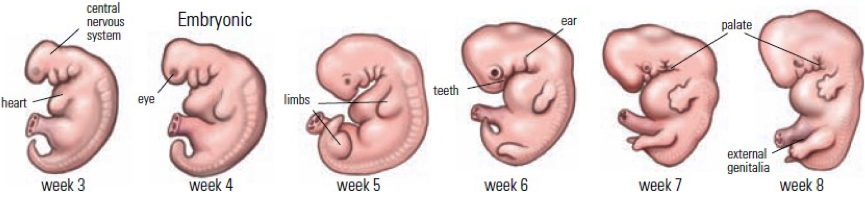
Week 3 to week 8
- Embryonic stage
- one implantation has occurred Organism is now known as the embryo
- 2cm in length
- Cell Differentiation
- Cells take on specialised roles
- Heart Cells
- Skin Cells
- Cells take on specialised roles
- Most critical stage for human development
- begins to develop all major organs
- Brain
- Spinal Cord
- Heart
- By the end of this stage, all major organs are present and will continue to develop
- begins to develop all major organs
- Sex cells begin to develop
- Cannot determine if male/female yet
- Limbs start to bud
- Eventually form fingers and toes
- By week 8, 90% of structures found in an adult human can be identified
- starts to look human looking
- Head and neck account for half the total length
- Brain makes up half of its body weight
- sensitive during this stage to environmental influences
- Teratogens
- Tobacco
- Alcohol
- Medication
- Teratogens
- one implantation has occurred Organism is now known as the embryo
- Embryonic stage
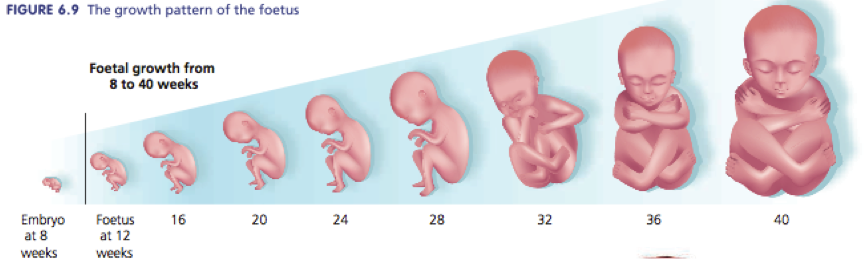
Week 8 to Week 40/birth
- Foetal Stage
- Embryo is now known as foetus
- Characterised by Rapid growth
- Measures only a few cm long at beginning
- Ends stage at 50cm
- Measures only a few cm long at beginning
- Systems begin to function
- Lungs
- Digestive system
- Liver
- Kidneys
- Sex organs start taking shape by week 15.
- Identify Sex by ultrasound
- Female
- Produces millions of eggs
- Male
- Testes produce testosterone
- Movement and reflexes occurs
- Sucking
- Grasping
- Breathing movements occur
- No air but amniotic fluid
- Bones Harden
- Tooth buds form in gums
- Senses begin to function
- Sound
- Light
- Touch
- Fat is deposited under skin
- Assists with temperature after birth
- Foetal Stage
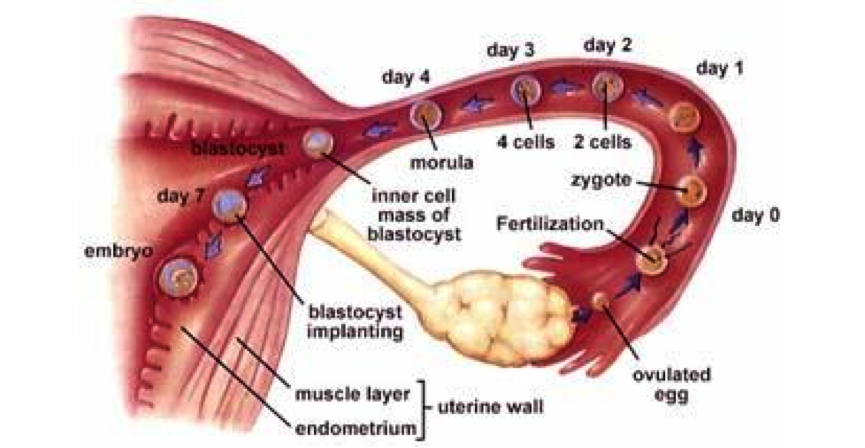
Conception to week 2
- Germinal Stage
- Zygote
- Forms when a sperm and ova meet
- Travels down the fallopian tube and constantly divides
- Morula
- At approx. 16 cells (day 3-4) starts to form a spherical shape
- Blastocyst
- At approx. 64 cells (day 5) begins to form a hollow fluid centre, an inner mass and an outer mass
- Inner cell becomes embryo
- Outer cell becomes placenta
- At approx. day 7/8 blastocyst attaches to the wall of the uterus
- Fully implanted by day 11-15
- At approx. 64 cells (day 5) begins to form a hollow fluid centre, an inner mass and an outer mass
- Zygote
- Germinal Stage
Placenta
- Formed and fully functioning in embryonic stage
- Disc Shaped
- Temporary organ
- Acts as kidney, lung and digestive system for the foetus
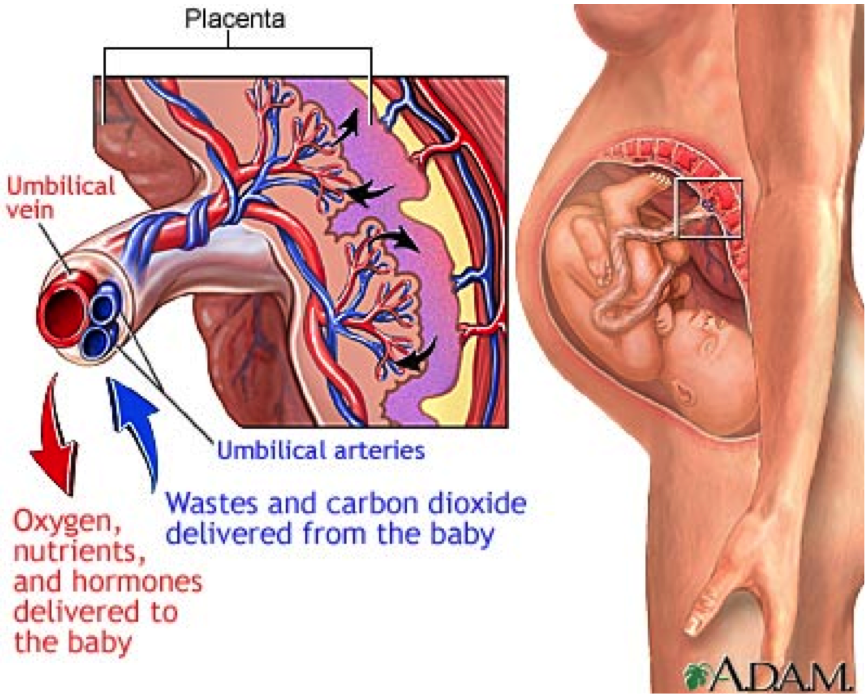
- Supplies oxygen
- Delivers nutrients and hormones
- Removes waste (urine and carbon dioxide
- Provides Immune Support
- Acts as kidney, lung and digestive system for the foetus
- Connected through the foetus through the umbilical cord
- Made up of two artiries
- Oxygenated/nutrient rich
- Deoxygenated/nutrient depleted
- Exchange of substances between mother and baby occur through thing walls of placenta
- Made up of two artiries
- Produces hormones that helps maintain pregnancy