
30245931
Description

Mind Map by Camila Paz Noriega, updated more than 1 year ago

|
Created by Camila Paz Noriega
over 5 years ago
|
|
DNA
- How did scientists
discover that genes are
made of DNA?
- By the early 1900s, studies of dividing
cells provided strong evidence that genes
are part of chromosomes.
- Soon, biologist found that eukaryotic chromosomes
are composed only of protein and DNA, so one of
these must be the molecule of hereditary.
- Soon, biologist found that eukaryotic chromosomes
are composed only of protein and DNA, so one of
these must be the molecule of hereditary.
- By the early 1900s, studies of dividing
cells provided strong evidence that genes
are part of chromosomes.
- Transformed bacteria revealed the link
between genes and DNA
- In the late 1920s, Frederick Griffith was
trying to make a vaccine to prevent
bacterial pneumonia, a major cause of
death at that time.
- Injecting antibacterial vaccines
weakened but living strain into an
animal may stimulate immunity
against the disease- causing strains.
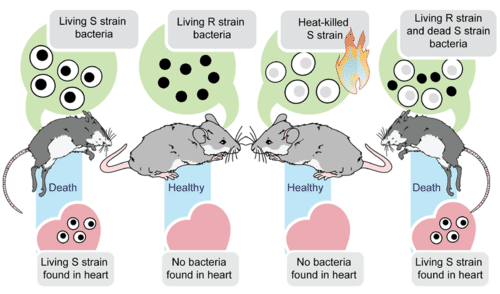
- He experimented with two
strains of the bacterium
Streptococcus pneumonaie.
- R- strain does not cause
pneumonia. The mouse remains
healthy.
- S- strain causes pneumonia. Most mouse
contracts pneumonia and dies.
- Heat- killed S- strain does not caused
pneumonia. Most mouse remains
healthy.
- A substance from heat-killed- S-
strain can transform the harmless
R-strain into deadly S-strain.
Mouse contracts pneumonia and
dies.
- R- strain does not cause
pneumonia. The mouse remains
healthy.
- He experimented with two
strains of the bacterium
Streptococcus pneumonaie.
- Injecting antibacterial vaccines
weakened but living strain into an
animal may stimulate immunity
against the disease- causing strains.
- In the late 1920s, Frederick Griffith was
trying to make a vaccine to prevent
bacterial pneumonia, a major cause of
death at that time.
- Griffith hypothesized that some substances in the
heat-killed S-strain changed the living, harmless R-strain
bacteria into deadly S-strain, a process he called
trasformation.
- He never discovered an effective pneumonia vaccine so this experiment was a
failure. However, his experiment marked a turning point in our understanding of
genetics.
- He never discovered an effective pneumonia vaccine so this experiment was a
failure. However, his experiment marked a turning point in our understanding of
genetics.
- The Transformation Molecule is DNA
- in 1944 Oswaldo Avery, Colin MacLeod, and
Maclyn McCarty discovered that the
trasformating molecule in DNA. The insolated
DNA form S-starch bacteria, mixed it with live
R-strain bacteria, and produce live S-strain
starin bacteria.
- The protein destroying enzymes did nor prevent
transformation. However, treating DNA- destroying
enzymes. Therefore, they concluded that tranformation
must be caused by DNA, and not by traces of protein
contaminating the DNA.
- DNA is the genetic material in many
organisms. DNA is the hereditary molecule
of certain viruses.
- DNA is the genetic material in many
organisms. DNA is the hereditary molecule
of certain viruses.
- The protein destroying enzymes did nor prevent
transformation. However, treating DNA- destroying
enzymes. Therefore, they concluded that tranformation
must be caused by DNA, and not by traces of protein
contaminating the DNA.
- in 1944 Oswaldo Avery, Colin MacLeod, and
Maclyn McCarty discovered that the
trasformating molecule in DNA. The insolated
DNA form S-starch bacteria, mixed it with live
R-strain bacteria, and produce live S-strain
starin bacteria.
Media attachments
Want to create your own Mind Maps for free with GoConqr? Learn more.