
35180321


4.7.1.1 Internal Hardware Components
of a Computer
- Internal Components
- The internal components of a
computer system consist of the
hardware required to store and
process data, and communicate with
external (peripheral) devices
- Main Internal Components:
- Procesor
- Main Memory
- Input / Output Controllers
- Procesor
- Internal components are
connected by the system
bus
- The internal components of a
computer system consist of the
hardware required to store and
process data, and communicate with
external (peripheral) devices
- The Processor
- Sometimes refered to as the
CPU, the processor is the part
of the computer that
processes data by executing
program instructions.
- The processor's program instructions
will be low-level instructions in the
form of machine code that the
processor has been designed to
handle, based on a specific processor
instruction set
- For the processor to execute a program:
- The program instructions need to be
transferred from secondary storage into
main memory
- In main memory they can be decoded
and executed
- The data that is needed is also loaded
into main memory from secondary
storage or provided by the input /
output devices
- The data that is needed is also loaded
into main memory from secondary
storage or provided by the input /
output devices
- In main memory they can be decoded
and executed
- The program instructions need to be
transferred from secondary storage into
main memory
- Sometimes refered to as the
CPU, the processor is the part
of the computer that
processes data by executing
program instructions.
- Main Memory
- Memory that can be accessed directly by the
processor
- Each memory location where
instructions or data are stored as
binary sequences, has a physical
address, which is a number used to
locate that memory location and
access its contents
- There are two main types of main memory:
- RAM
- The 'working memory'
- Used by the processor during the
Fetch-Decode-Execute Cycle
- The 'working memory'
- ROM
- Used in the boot process for the
computer system
- Used in the boot process for the
computer system
- RAM
- Memory that can be accessed directly by the
processor
- Input / Output Controllers
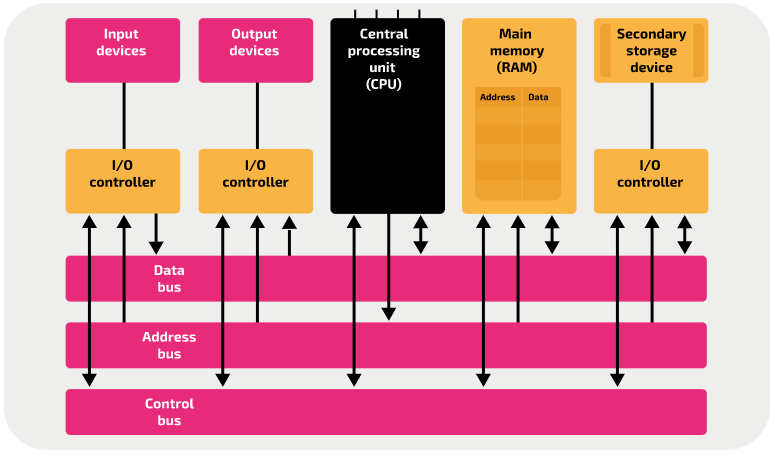
- All external (peripheral) devices are connected to
the processor through I/O Controllers.
- E.g. Secondary Storage Devices
- In contrast to main memory,
Secondary Storage cannot be
accessed directly by the processor
- In contrast to main memory,
Secondary Storage cannot be
accessed directly by the processor
- Can also be described as
an interface between
the core computer
system and its
peripherals
- E.g. Secondary Storage Devices
- All external (peripheral) devices are connected to
the processor through I/O Controllers.
- Buses
- The components of a computer system
are connected together using buses
- Used to transfer data
- Used to transfer data
- System Bus
- Address Bus
- Used to specify the address of a
memory location to either read (i.e.
LOAD) data from or write (e.g. STORE)
data to that memory location.
- Uni-directional
- Bigger Width = Increased maximum memory capacity
- Uni-directional
- Used to specify the address of a
memory location to either read (i.e.
LOAD) data from or write (e.g. STORE)
data to that memory location.
- Data Bus
- Used to transfer data and
instructions
- Bi-directional
- Bigger Width = More data that can be fetched at one time
- Bi-directional
- Used to transfer data and
instructions
- Control Bus
- Used to send control signals that
manage and orchestrate
instructions/operations
- Control Signals include:
- Memory Read
- Memory Write
- Bus Request
- Bus Grant
- Bus Busy
- Interrupt Request
- Clock Signals
- Memory Read
- Control Signals include:
- Bi-directional
- Used to send control signals that
manage and orchestrate
instructions/operations
- Address Bus
- One Way Conntections:
- I/O Controller (Input) -> Data Bus
- Data Bus -> I/O Controller (Output)
- Processor -> Address Bus
- Address Bus -> (ALL)
- Address Bus -> (ALL)
- Processor -> Address Bus
- Data Bus -> I/O Controller (Output)
- I/O Controller (Input) -> Data Bus
- Two Way Conntections
- Data Bus - I/O Controller (Sec. Storage)
- Main Memory - Data Bus
- Main Memory - Data Bus
- Data Bus - I/O Controller (Sec. Storage)
- Width
- Refers to its number of parallel
lines.
- This determines the number of
bits that can be transferred in
one operation
- e.g. If the width of the bus is 8
bits, then 2^8 bits can be
transferred at one time
- e.g. If the width of the bus is 8
bits, then 2^8 bits can be
transferred at one time
- This determines the number of
bits that can be transferred in
one operation
- Refers to its number of parallel
lines.
- The components of a computer system
are connected together using buses
Media attachments
Want to create your own Mind Maps for free with GoConqr? Learn more.