
Mind map
Hematology Overview/Anemia
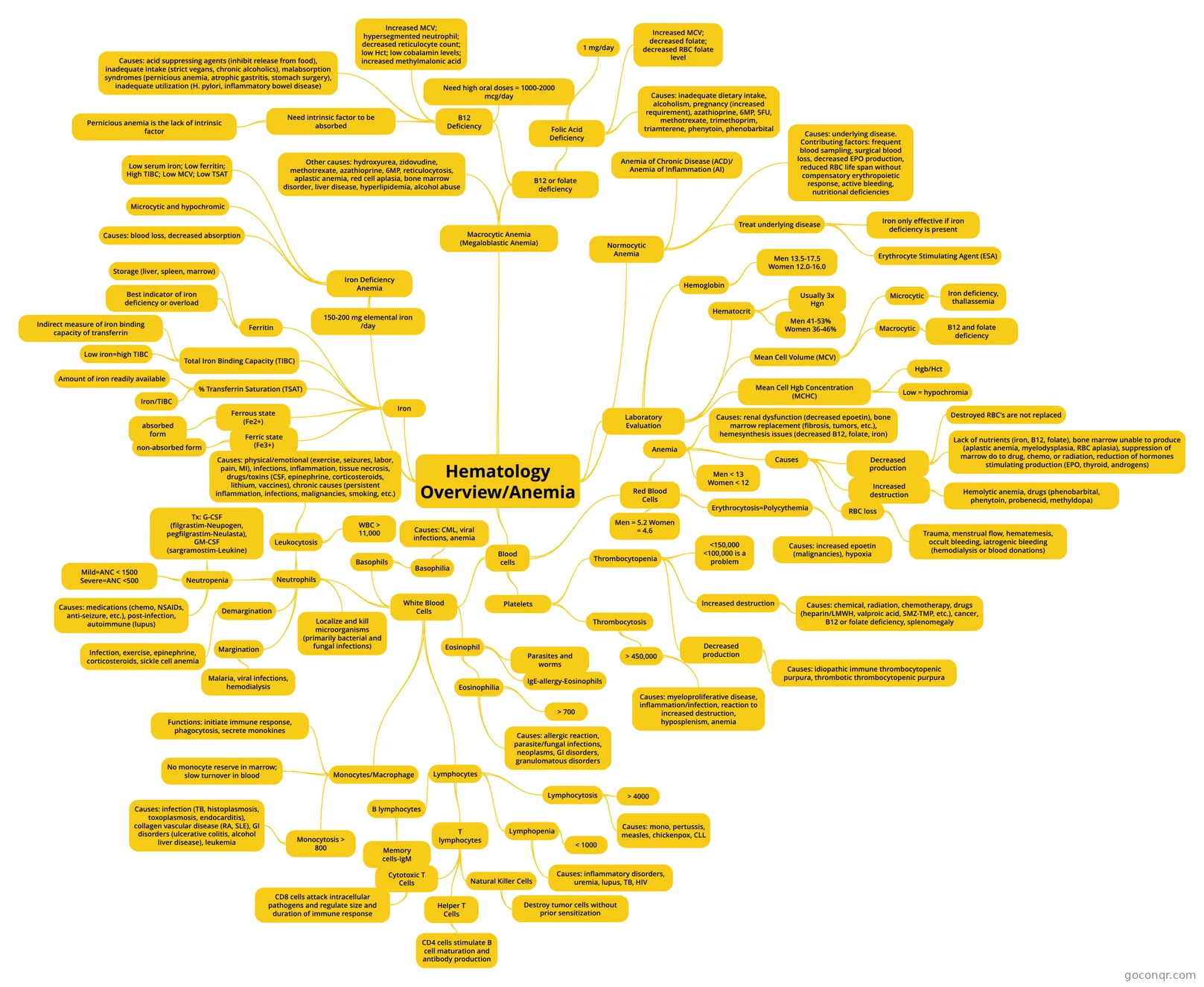
Mind map: Hematology overview and anemia
Map content
Hematology Overview/Anemia
Blood cells
- White Blood Cells
- Neutrophils
- Demargination
- Infection, exercise, epinephrine, corticosteroids, sickle cell anemia
- Margination
- Malaria, viral infections, hemodialysis
- Localize and kill microorganisms (primarily bacterial and fungal infections)
- Neutropenia
- Mild=ANC < 1500 Severe=ANC <500
- Causes: medications (chemo, NSAIDs, anti-seizure, etc.), post-infection, autoimmune (lupus)
- Tx: G-CSF (filgrastim-Neupogen, pegfilgrastim-Neulasta), GM-CSF (sargramostim-Leukine)
- Leukocytosis
- WBC > 11,000
- Causes: physical/emotional (exercise, seizures, labor, pain, MI), infections, inflammation, tissue necrosis, drugs/toxins (CSF, epinephrine, corticosteroids, lithium, vaccines), chronic causes (persistent inflammation, infections, malignancies, smoking, etc.)
- Demargination
- Monocytes/Macrophage
- No monocyte reserve in marrow; slow turnover in blood
- Functions: initiate immune response, phagocytosis, secrete monokines
- Monocytosis > 800
- Causes: infection (TB, histoplasmosis, toxoplasmosis, endocarditis), collagen vascular disease (RA, SLE), GI disorders (ulcerative colitis, alcohol liver disease), leukemia
- Basophils
- Basophilia
- Causes: CML, viral infections, anemia
- Basophilia
- Lymphocytes
- Lymphocytosis
- > 4000
- Causes: mono, pertussis, measles, chickenpox, CLL
- Lymphopenia
- < 1000
- Causes: inflammatory disorders, uremia, lupus, TB, HIV
- B lymphocytes
- Memory cells-IgM
- T lymphocytes
- Natural Killer Cells
- Destroy tumor cells without prior sensitization
- Helper T Cells
- CD4 cells stimulate B cell maturation and antibody production
- Cytotoxic T Cells
- CD8 cells attack intracellular pathogens and regulate size and duration of immune response
- Natural Killer Cells
- Lymphocytosis
- Eosinophil
- IgE-allergy-Eosinophils
- Parasites and worms
- Eosinophilia
- > 700
- Causes: allergic reaction, parasite/fungal infections, neoplasms, GI disorders, granulomatous disorders
- Neutrophils
- Red Blood Cells
- Men = 5.2 Women = 4.6
- Erythrocytosis=Polycythemia
- Causes: increased epoetin (malignancies), hypoxia
- Anemia
- Men < 13 Women < 12
- Causes: renal dysfunction (decreased epoetin), bone marrow replacement (fibrosis, tumors, etc.), hemesynthesis issues (decreased B12, folate, iron)
- Causes
- Decreased production
- Destroyed RBC's are not replaced
- Lack of nutrients (iron, B12, folate), bone marrow unable to produce (aplastic anemia, myelodysplasia, RBC aplasia), suppression of marrow do to drug, chemo, or radiation, reduction of hormones stimulating production (EPO, thyroid, androgens)
- Increased destruction
- Hemolytic anemia, drugs (phenobarbital, phenytoin, probenecid, methyldopa)
- RBC loss
- Trauma, menstrual flow, hematemesis, occult bleeding, iatrogenic bleeding (hemodialysis or blood donations)
- Decreased production
- Platelets
- Thrombocytopenia
- <150,000 <100,000 is a problem
- Decreased production
- Causes: idiopathic immune thrombocytopenic purpura, thrombotic thrombocytopenic purpura
- Increased destruction
- Causes: chemical, radiation, chemotherapy, drugs (heparin/LMWH, valproic acid, SMZ-TMP, etc.), cancer, B12 or folate deficiency, splenomegaly
- Thrombocytosis
- > 450,000
- Causes: myeloproliferative disease, inflammation/infection, reaction to increased destruction, hyposplenism, anemia
- > 450,000
- Thrombocytopenia
- White Blood Cells
Laboratory Evaluation
- Hemoglobin
- Men 13.5-17.5 Women 12.0-16.0
- Hematocrit
- Men 41-53% Women 36-46%
- Usually 3x Hgn
- Mean Cell Volume (MCV)
- Macrocytic
- B12 and folate deficiency
- Microcytic
- Iron deficiency, thallassemia
- Macrocytic
- Mean Cell Hgb Concentration (MCHC)
- Hgb/Hct
- Low = hypochromia
- Hemoglobin
Iron
- Ferric state (Fe3+)
- non-absorbed form
- Ferrous state (Fe2+)
- absorbed form
- Total Iron Binding Capacity (TIBC)
- Indirect measure of iron binding capacity of transferrin
- Low iron=high TIBC
- % Transferrin Saturation (TSAT)
- Iron/TIBC
- Amount of iron readily available
- Ferritin
- Storage (liver, spleen, marrow)
- Best indicator of iron deficiency or overload
- Ferric state (Fe3+)
Iron Deficiency Anemia
- Causes: blood loss, decreased absorption
- Low serum iron; Low ferritin; High TIBC; Low MCV; Low TSAT
- Microcytic and hypochromic
- 150-200 mg elemental iron /day
Normocytic Anemia
- Anemia of Chronic Disease (ACD)/ Anemia of Inflammation (AI)
- Causes: underlying disease. Contributing factors: frequent blood sampling, surgical blood loss, decreased EPO production, reduced RBC life span without compensatory erythropoietic response, active bleeding, nutritional deficiencies
- Treat underlying disease
- Iron only effective if iron deficiency is present
- Erythrocyte Stimulating Agent (ESA)
Macrocytic Anemia (Megaloblastic Anemia)
- B12 or folate deficiency
- B12 Deficiency
- Need intrinsic factor to be absorbed
- Pernicious anemia is the lack of intrinsic factor
- Causes: acid suppressing agents (inhibit release from food), inadequate intake (strict vegans, chronic alcoholics), malabsorption syndromes (pernicious anemia, atrophic gastritis, stomach surgery), inadequate utilization (H. pylori, inflammatory bowel disease)
- Increased MCV; hypersegmented neutrophil; decreased reticulocyte count; low Hct; low cobalamin levels; increased methylmalonic acid
- Need high oral doses = 1000-2000 mcg/day
- Need intrinsic factor to be absorbed
- Folic Acid Deficiency
- Causes: inadequate dietary intake, alcoholism, pregnancy (increased requirement), azathioprine, 6MP, 5FU, methotrexate, trimethoprim, triamterene, phenytoin, phenobarbital
- Increased MCV; decreased folate; decreased RBC folate level
- 1 mg/day
- B12 Deficiency
- Other causes: hydroxyurea, zidovudine, methotrexate, azathioprine, 6MP, reticulocytosis, aplastic anemia, red cell aplasia, bone marrow disorder, liver disease, hyperlipidemia, alcohol abuse
- B12 or folate deficiency