
Mind map
Pack 3 - Transport across cell membranes
Map content
Pack 3 - Transport across cell membranes
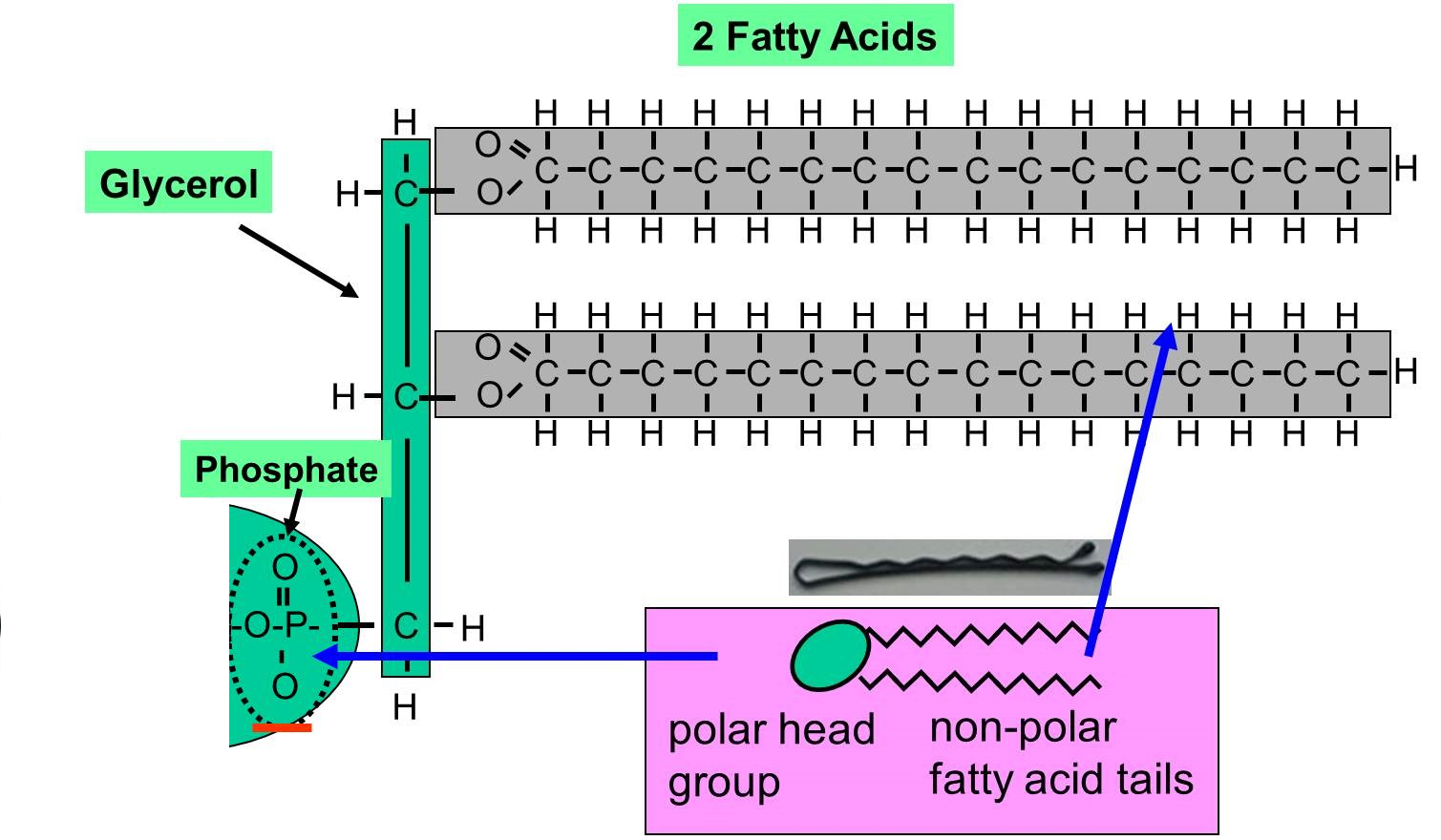
Phosphate groups, glycerol and 2 fatty acids make up a phospholipid
- An ester bond is made and water is removed (condensation)
- Phospholipids
- They are polar molecules
- The head (top) is hydrophobic
- The tail is hydrophilic
- They are polar molecules
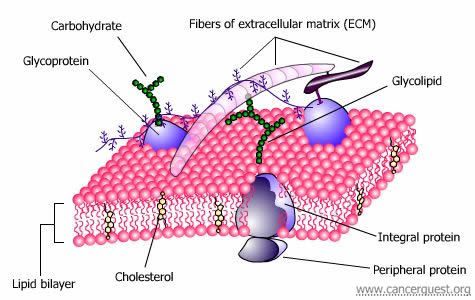
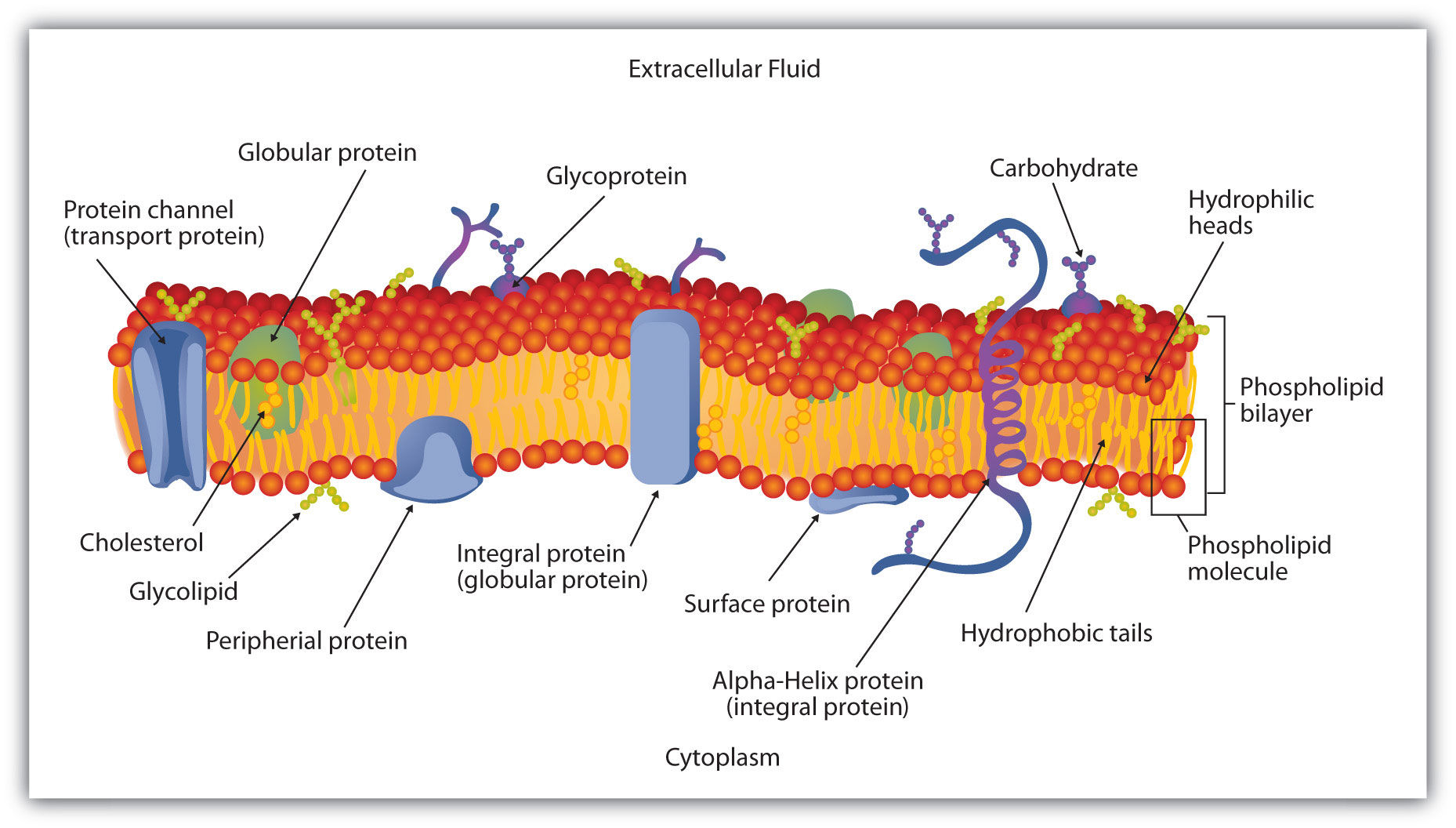
Phospholipid bilayer
- Functions of the bilayer
- Allows lipid-soluble substances to enter and leave the cell
- Prevents water-soluble to enter and leave the cell
- Makes the membrane flexible and self-sealing
- Proteins
- Proteins can span the membrane or just sit on one of the surfaces of the bilayer
- Functions:
- Structural
- Help cells attach to each other
- Channel proteins allow water soluble substances through
- They facilitate facilitated diffusion
- Carrier proteins help diffusion
- Help active transport
- Act as cell surface receptors
- Cholesterol
- Functions
- Adds strength to the membrane
- Reduces movement of other molecules
- Makes the membrane less fluid at higher temperatures
- Prevents leakage of water and dissolved ions
- Found between the phospholipids in the bilayer
- Functions
- Glycolipids
- Lipid covalently bonded to carbohydrate
- Carb extends from bilayer into watery environment
- Functions
- Act as recognition site
- Help maintain stability of membrane
- Help cells attach together forming tissues
- Lipid covalently bonded to carbohydrate
- Glycoproteins
- Extrinsic protein covalently bonded to carb
- Carb extends from the bilayer into water environment around cell
- Functions
- Recognition sites
- Help cells stick together
- Allow cells to recognise each other
- Extrinsic protein covalently bonded to carb
- Fluid-mosaic model of the plasma membrane
- The molecules act like a fluid
- It looks like the tiles on a mosaic
- Functions of the bilayer
Permeability of plasma membrane
- Most substances can't pass through the plasma membrane because:
- Not lipid soluble
- Too large
- They're polar molecules
- Most substances can't pass through the plasma membrane because:
Diffusion
- The net movement of molecules or ions from a region where they are highly concentrated to a region where their concentration is lower
- Diffusion is passive as it does not require any ATP
- When the net flow of molecules from one direction stops it is called dynamic equilibrium
- Factors that affect the rate:
- Temperature
- More temp = more KE in particles so they move quicker = faster diffusion
- Difference in concentration
- Higher difference in concentration = faster diffusion
- Distance over which diffusion occurs
- Greater distance = slower diffusion
- Area over which diffusion occurs
- As are increases diffusion rate increases
- Nature of any structure across which diffusion occurs
- e.g. if a molecule is lipid soluble it will get through plasma membranes fast
- Size of diffusing molecule
- Smaller means they can pass through pores quickly = faster diffusion
- Temperature
- Fick's Law
- Diffusion rate is proportional to:
- (Surface area*conc. difference)/diffusion distance
- Diffusion rate is proportional to:
Facilitated diffusion
- This is passive, it does not require ATP
- Goes with the conc. gradient
- Proteins
- Channel Proteins
- These from water filled hydrophilic channels across the membrane
- Allows specific water soluble ions to pass through
- They are selective
- They may only open in the presence of a specific ion
- The binding of the specific ion changes the shape of the protein allowing the ions to pass
- They may only open in the presence of a specific ion
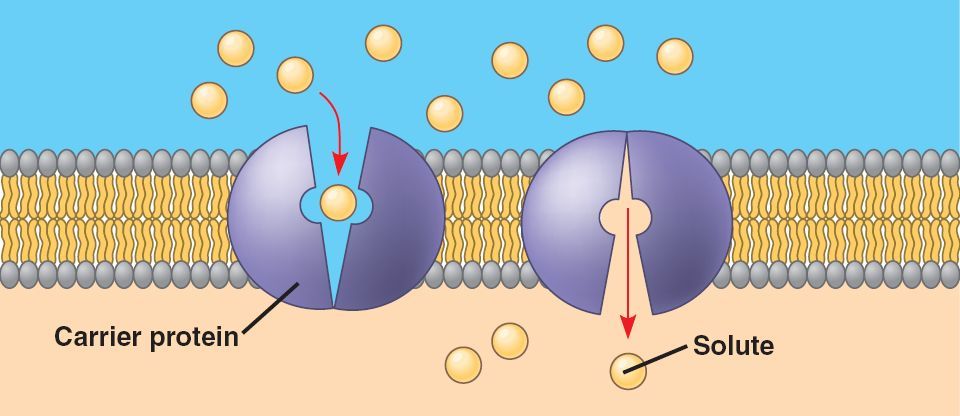
- Carrier proteins
- These span the plasma membrane
- A molecule (must be specific and complementary) to bind to the carrier protein
- This causes the protein to change shape
- Then the molecule is released on the opposite side
- This causes the protein to change shape
- A molecule (must be specific and complementary) to bind to the carrier protein
- These span the plasma membrane
- More carrier proteins and channel proteins = faster diffusion
- Channel Proteins
- This is passive, it does not require ATP
Osmosis
- The net movement from an area of less negative water potential to an area of more negative water potential through a semi - permeable membrane
- High conc. to low conc.
- Larger molecules, like glucose, can't fit through the membrane
- Water potential
- Pure water has a WP of 0
- Addition of water will lower the WP
- Water potential of a solution will always be negative
- More solute = more negative
- Water potential of a solution will always be negative
- Addition of water will lower the WP
- Pure water has a WP of 0
- Osmosis in animal cells
- If you place a red blood cell in water
- The red blood cells have a lower water potential than pure water
- So the net movement of water will be into the red blood cells by osmosis
- Red blood cells will swell and lyse
- If you place rbc's in strong solution then rbc's shrink
- Red blood cells will swell and lyse
- So the net movement of water will be into the red blood cells by osmosis
- The red blood cells have a lower water potential than pure water
- If you place a red blood cell in water
- Osmosis in plant cells
- In pure water, plant cells have a lower water potential and the net movement will be into the plant
- The cell wall becomes rigid and resists the entry of water
- It becomes turgid
- The cell wall becomes rigid and resists the entry of water
- If plant cells have higher water potential then net movement out of the cell, protoplast comes away from the cell wall
- It is plasmolysed
- Incipient plasmolysis is when there is no net movement of water, the protoplast is just pulling away from the cell
- In pure water, plant cells have a lower water potential and the net movement will be into the plant
- The net movement from an area of less negative water potential to an area of more negative water potential through a semi - permeable membrane
Active transport
- The movement of molecules or ions usually from a region of low conc. to a region of high conc.
- Against the conc. gradient
- Requires carrier proteins and ATP
- e.g. Sodium/potassium pump
- Stages are:
- 1. Na+ binds to specific receptor sit on the carrier protein
- 2. ATP binds to the protein and splits into ADP and a phosphate molecule
- 3. Energy is released, the phosphate molecule remains bound to the carrier protein
- 4. The carrier protein changes shape, Na+ is released on the opposite side of the membrane
- 5. K+ now bind to their receptor sites, causing the protein to change shape again
- K+ and phosphate are released on the original side of the membrane leaving the carrier protein to pick up more Na+
- Stages are:
- The movement of molecules or ions usually from a region of low conc. to a region of high conc.
Absorption
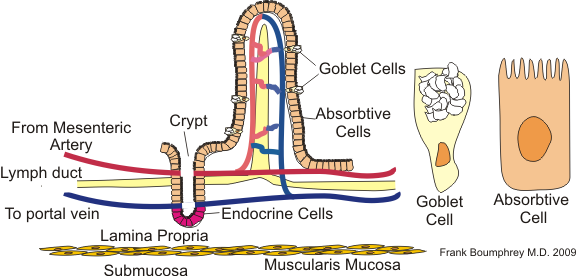
- This occurs in the ileum (small intestine)
- To increase diffusion in the ileum there is microvilli
- This increases surface area
- Starch is broken into maltose then glucose in the small intestine
- Enzymes are amylase then maltase
- After a meal the conc. of glucose etc. will be higher in the ileum than the blood
- The circulatory system maintains a difference in the conc. gradient by carrying away the products of digestion
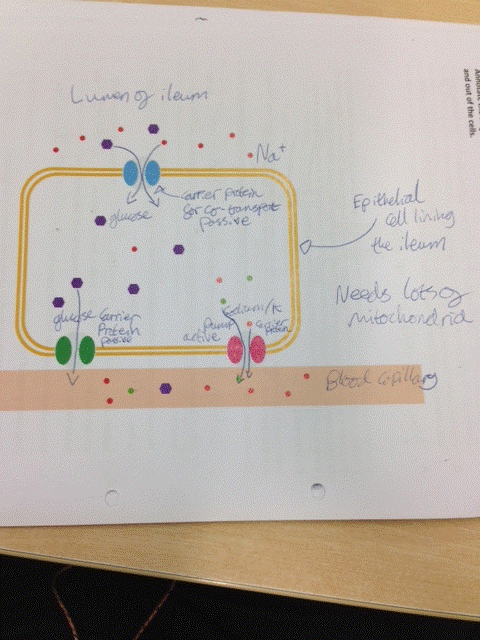
- Co - transport
- Glucose or amino acids are drawn into the cell with sodium ions
- 1. sodium ions are pumped out of the cell into the blood stream
- This requires ATP
- Therefore is active transport
- This requires ATP
- 2. This maintains a conc. gradient of sodium ions from the lumen (high) to the cell (low)
- 3. Sodium ions diffuse into the cells down their conc. gradient through the co-transport carrier protein
- For this to happen glucose also has to bind to the protein, therefore it is brought through with the sodium ions
- Glucose goes against its conc. gradient
- 4. Glucose molecules pass into the blood plasma by facilitated diffusion with another carrier protein
- 1. sodium ions are pumped out of the cell into the blood stream
- Glucose or amino acids are drawn into the cell with sodium ions
Images and files in the map
Information
- Description
- Biology revision for diffusion etc.
- Created by
- Jacob Shepherd
- Views
- 44
- Tags
- Rating