
Mind map
Water Conservation
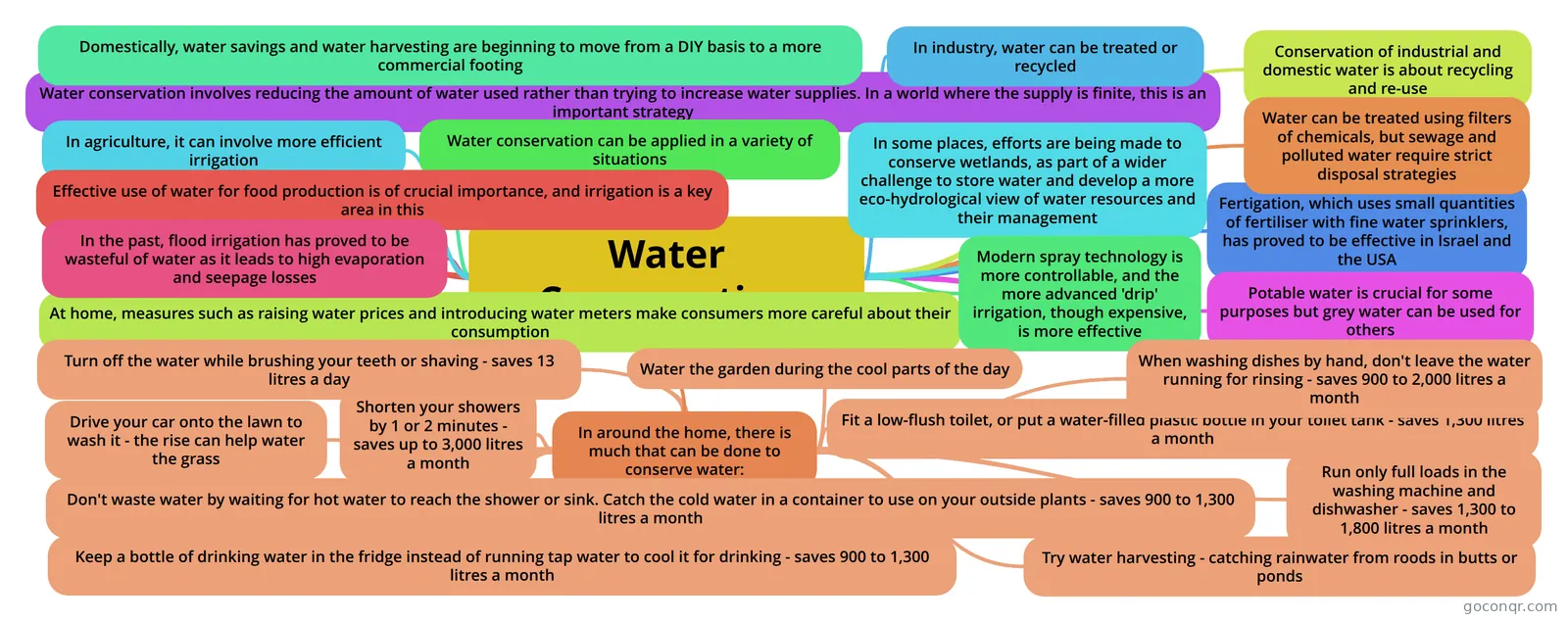
Mind map: Water conservation
Map content
Water Conservation
Water conservation involves reducing the amount of water used rather than trying to increase water supplies. In a world where the supply is finite, this is an important strategy
Water conservation can be applied in a variety of situations
In agriculture, it can involve more efficient irrigation
In industry, water can be treated or recycled
Domestically, water savings and water harvesting are beginning to move from a DIY basis to a more commercial footing
In some places, efforts are being made to conserve wetlands, as part of a wider challenge to store water and develop a more eco-hydrological view of water resources and their management
At home, measures such as raising water prices and introducing water meters make consumers more careful about their consumption
Effective use of water for food production is of crucial importance, and irrigation is a key area in this
In the past, flood irrigation has proved to be wasteful of water as it leads to high evaporation and seepage losses
Modern spray technology is more controllable, and the more advanced 'drip' irrigation, though expensive, is more effective
Fertigation, which uses small quantities of fertiliser with fine water sprinklers, has proved to be effective in Israel and the USA
Conservation of industrial and domestic water is about recycling and re-use
Potable water is crucial for some purposes but grey water can be used for others
Water can be treated using filters of chemicals, but sewage and polluted water require strict disposal strategies
In around the home, there is much that can be done to conserve water:
- Fit a low-flush toilet, or put a water-filled plastic bottle in your toilet tank - saves 1,300 litres a month
- Shorten your showers by 1 or 2 minutes - saves up to 3,000 litres a month
- Don't waste water by waiting for hot water to reach the shower or sink. Catch the cold water in a container to use on your outside plants - saves 900 to 1,300 litres a month
- Turn off the water while brushing your teeth or shaving - saves 13 litres a day
- When washing dishes by hand, don't leave the water running for rinsing - saves 900 to 2,000 litres a month
- Run only full loads in the washing machine and dishwasher - saves 1,300 to 1,800 litres a month
- Keep a bottle of drinking water in the fridge instead of running tap water to cool it for drinking - saves 900 to 1,300 litres a month
- Water the garden during the cool parts of the day
- Try water harvesting - catching rainwater from roods in butts or ponds
- Drive your car onto the lawn to wash it - the rise can help water the grass
Information
- Description
- A-Levels Geography (Water Conflicts) Mind Map on Water Conservation, created by Jodie Goodacre on 15/12/2013.
- Created by
- Jodie Goodacre
- Views
- 155
- Tags
- Rating